
Sponsor
AmazingRibs.com Barbecue masthead


The best books and periodicals

Below are some of my favorite food books, magazines, newsletters, and periodicals. If you have others to recommend, please contact me with the info. Click here for a complete list of all of the barbecue books on Amazon.com. Click here for a complete list of all of the cooking books on Amazon.com. Full disclosure: Amazon.com pays me a small commission, but a better reason to buy from them is low price, fast delivery, and a good refund policy. They also offer many of these books in audio form.

About these links. Links and recommendations on this site are absolutely positively not advertisements or paid endorsements unless clearly marked as such. They are products and places I admire. Your suggestions are always welcome. Click here to send them to me. If you would like me to link to your website, click here to read my links policy first. Most of the product photographs are provided by the manufacturer.


Books

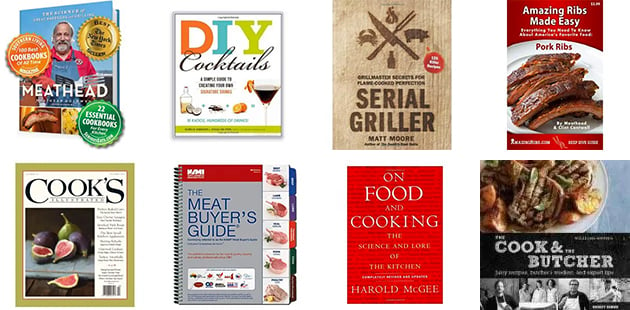
Hot Stuff Award On Food and Cooking: The Science and Lore of the Kitchen by Harold McGee. If you want to know why we do what we do in the kitchen, not just what to do or how to do it, this fat tome is a must have. It is a fascinating and easy to read textbook that explains what food is made of, and how it reacts with heat and other foods. McGee describes scores of different kinds of foods and their characteristics as well as every cooking method and how it changes the food.The meticulous black and white pen and ink illustrations are illuminating, and if you have the technical bent, the molecular drawings will give you the real nitty gritty. This book belongs in every kitchen.Here's a typical passage: "Get down on all fours and 'graze,' and you'll notice that the neck, shoulders, chest, and front limbs all work hard while the back is more relaxed...Tenderloin is appropriately named because it is a single muscle with little connective tissue that runs along the back and gets little action; it's tender."Here's something more techical: "The basic texture of meat, dense and firm, comes from the mass of muscle fibers, which cooking makes denser, dryer, and tougher. And the enlongated arrangement accounts for the 'grain' of the meat. Cut parallel to the bundles and you see them from the side, lined up like logs of a cabin wall; cut across the bundles and you see just the ends. It's easier to push fiber bundles apart from each other than to break the bundles themselves, so it's easier to chew along the direction of the fibers than across them.

We usually carve across the grain, so that we can chew with the grain."And here's my favorite tip. He tells us how to have a safe rare hamburger! He explains that rare hamburger is dangerous because fecal contamination can get on the surface of the meat, and it then gets mixed in as the meat is ground. When you cook a rare steak the surface is sterilized, but when you grind meat, the interior can be contaminated because the surface is mixed into the interior. So here's his solution: "Bring a large pot of water to a rolling boil, immerse [unground pieces of meat] in the water for 30-60 seconds, then remove, drain and pat dry, and grind in a scrupulously clean meat grinder."


Hot Stuff AwardWeber's Real Grilling by Jamie Purviance. This beautiful book has 305 large pages with more than 200 recipes and perhaps 300 superb color photos. Purviance begins with managing the grill, and although Weber's grills are featured, the advice is broad enough to cover most charcoal and gas grills. Shockingly, there is nary a mention of the Weber Smokey Mountain, considered by many to be the best bullet smoker on the market, and winner of a Meathead's Hot Stuff Award. So, although there are several smoked meat recipes, they are all cooked on the Weber Kettle or a gas grill. You can cook barbecue on grills and braziers, but a specialty smoker is a better tool for the job.

Then it's off to describing tools and accessories, ingredients, and a chapter on rubs, marinades, and sauces. Despite the omission of a real smoker in the book, if you want some superb, contemporary as well as traditional outdoor meal recipes, this is the book to buy. Purviance is a witty fellow, and his text is fun reading. Not surprising, his cooking instructions are precise and easy to follow. He knows his food.

As good as the text is, I must spend a minute praising the photographer, Tim Turner. His work has made this the most beautiful book on barbecue and grilling on the market. The lighting, the composition, color, are all superb. You really get a sense of what the dish could look like (but of course we both know it never looks as good as the photos).


Hot Stuff AwardThe Cook's Illustrated Guide to Grilling and Barbecue, A Practical Guide For the Outdoor Cook. A superb hardbound, 420 page book with more than 450 recipes. The limited illustrations are mostly high quality black and white pen drawings with a handful of beautiful large color plates scattered throughout. As I have exclaimed perhaps too often and too breathlessly elsewhere on this site, Cook's Illustrated, the magazine, the website, the book publisher, and producer of America's Test Kitchen on PBS, is my favorite source for no-nonsense, thoroughly tested info. The editors take little for granted and they are constantly questioning and testing accepted wisdom and wives' tales. And these folks really understand barbecue.

Here's a sampling: "Ounce for ounce, hardwood lump charcoal burns much hotter than briquettes. However, the differences are less dramatic when the coals are measured by volume. (Because of their shape, briquettes compact more easily so you can fit more coals into the same amount of space.) For all practical purposes, a heaping chimney of charcoal briquettes will make a fire that is as hot as a level chimney of hardwood lump charcoal. So if you need to substitute briquettes for hardwood, use slightly more briquettes to achieve the same heat level." They then show a chart of exquivalent volumes.


Hot Stuff Award Barbecue Secrets, Unbeatable Recipes, Tips & Tricks From a Barbecue Champion by Ron Shewchuk. Shewchuk is a Vancouver based competitor who really knows his stuff. This is a good beginner's guide to serious barbecue with many of his competition recipes. Unfortunately there are only two recipes for ribs. One is called "Cheater ribs" for people in a hurry, and it involves boiling water. This oversight is balanced by the quality of the other recipe for ribs and his great advice on everything from brisket to smoked duck salad. Ingredients are measured in both standard English measurements (pounds, cups, tablespoons, Fahrenheit) as well as metric (kilograms, liters, Centigrade).

From a section called "All I ever needed to know, I learned from barbecue" here's a quote: "Think of what a better world it would be if we all, the whole world, had barbecue and peach daiquiris about 3 o'clock every afternoon and then lay down for a nap with a bag of charcoal for a pillow." Check out his podcast on iTunes or click here.


The Barbecue! Bible by Steven Raichlen.
Nobody knows more about barbecue than Steven Raichlen. This book and this author have had a greater influence on the meteoric growth in popularity of barbecue in the US than anything since the Weber kettle grill was invented in 1951 by George Stephen. With several other books on barbecue and grilling, Raichlen has had the kind of influence on men who cook, that Julia Child had on women who cook and has probably vastly improved the way we eat in the summer. In fact, this book has been given a Julia Child Cookbook Award.

Raichlen has since gone on to launch a cooking school called BBQ-U, a television show, a lecture tour, and a line of outdoor cooking tools.

The Barbecue! Bible was his first book on the subject. Published in 1998, this 556 page tome with 500 recipes covers everything from hamburgers to bread. The illustrations are little more than black and white clip art. Cute, but not very educational, and there is no depiction of what the finished product looks like.


Barbecue! Bible Sauces, Rubs, and Marinades by Steven Raichlen. The BBQ guru with the oval sunglasses and denim shirt dishes up more than 200 savory liquids to soak your food in or slather on it. A wide range of creative flavors from around the world.

BBQ USA by Steven Raichlen. This is my favorite of Raichlen's books. Published in 2003, it is a whopping 774 pages with 425 recipes. He begins with a history of barbecue that is fun and enlightening. Then there is a primer on grilling and barbecue with lots of great tips. Most of the recipes come from restaurants, from joints to white tablecloth temples of food. There are more useful tips and fun facts in the sidebars. I love the sepia toned photos of pitmasters and plain folk cooking, but I'd love to see some color photos of the finished products.

Hot Stuff AwardHere's a typical passage: "A great deal of ink, beer, and maybe even blood have been spilled over the great debate: charcoal or gas," he starts. He praises the convenience of gas grills, and then tells us "If I could use only one grill for the rest of my life (or take it to a deserted island), it would be my trusty charcoal kettle. Why? For starters, charcoal burns hotter than gas, so it sears better (better searing makes for bolder flavors). It's also easier to smoke on a charcoal grill. Charcoal imparts a distinct flavor all its own, one that's less pronounced that that from grilling over a wood fire (which, by the way, is easy to build on a charcoal grill), but definItely more discernable than what you get from gas. And, of course, charcoal gives you the thrill of playing with fire."

Raichlen sums this book's concept up with this quote: "When I grew up, barbecue meant the main course. Today, we grill everything, and I mean everything from appetizers to desserts."


Hot Stuff Award Peace, Love, and Barbecue: Recipes, Secrets, Tall Tales, and Outright Lies from the Legends of Barbecue by Mike Mills, Amy Mills Tunnicliffe. Mike "The Legend" Mills has earned his nickname with achievements as a restaurateur (17th Street Bar and Grill in Southern Illinois and four Memphis Championship Barbecue restaurants in Las Vegas), an award-winning chef (three-rime Grand World Champion at Memphis in May), president of the National Barbecue Association (2004-2005), and now, with the help of his daughter (herself an accomplished chef, writer, and photographer), he has created a classic in the pantheon of barbecue literature. Peace, Love, and Barbecue, published in 2005, not only contains the expected count of excellent recipes and cooking tips, but includes interviews with the legends of barbecue, and visits to the "shrines, shacks, joints, and right respectable restaurants." This is a first rate reference and a fun read.

Here's a quote: "I never told either of my wives the recipe [for our secret family barbecue sauce]. Let me tell you, this didn't set well with either one of them. I have had it in my head, so it isn't written down anywhere. It's not as thou they could've found it in the recipe box.

"My first marriage lasted only seven years, so keeping a secret wasn't too much of a problem, although Wife #1 wasn't amused. Marriage to Wife #2 lasted for only 27 years, so she didn't make the cut either. Now if we'd made it to 30 years, I might've broken down and spilled my guts. But she would've had to change her ways."


Championship Barbecue Sauces by Paul Kirk. Paul Kirk is known as the Baron of Barbecue. He teaches classes in barbecue and, as a competiton cook, has won more awards than can be counted. This book has 175 sauces, marinades, dry rubs, wet rubs, mops, and salsas. Nothing fancy, no long-winded tales and stories, just tried and true recipes, mostly from his buddies on the competition circuit. He's not the best writer, but he has a lot to teach.

Here's a quote: "People ask me what is the most important aspect of barbecue: the rub, cooker, smoker, fire, wood, charcoal, meat, what? All things being equal, my answer is without a doubt the rub or barbecue seasoning! If you have good rub, your chances of being the neighborhood Barbecue King, or this year's big winner in barbecue competitions, are very good. The next thing people usually want to know is what's in my rub and whether I'll give out my recipe. My answer is, sure, you can have what's in my rub, but I won't give you the proportions. My rub consists of sugar, salt, paprika, chili powder, pepper, and other spices."


Steak Lover's Cookbook by William Rice. A former columnist for the Washington Post, Chicago Tribune, and editor of Food & Wine magazine, Bill Rice is one of the great food writers of our time. In this 246 page book he teaches us how to come close to great steakhouse porterhouse steaks with the classic accompaniments like creamed spinach and steak fries. He teaches us how to buy steaks, store them, prep them, carve them, cook them outdoors, cook them indoors, how to season them, garnish them, and what to serve with them. The beef recipes range from stewed to stuffed, fajitas, curry, orange beef, and even pot roast. The sides include mango guacamole, chicken liver pate, gazpacho, fried zucchini, cowboy beans, apple stilton cole slaw; and the desserts include a grilled dessert pizza, cobbler, mud pie, and bread pudding.

A quote: "Do not try to dry-age steak in your home. Only large primal and sub-primal cuts are suitable to the process. The bacteria that will collect on a single steak could cause illness. Keep fresh steak in the refrigerator, well wrapped, for no more than four days. If you choose to freeze uncooked steak, do it under the coldest temperature possible because the faster it freezes the less fluid loss there will be when you thaw it."


Hot Stuff AwardThe Tummy Trilogy by Calvin Trillin. The Tummy Trilogy is actually three books in one, all long out of print, but occasionally available used. Trillin is witty, urbane, observant, and ironic, and he has written intelligently on everything from politics to barbecue. These three books, American Fried (1974), Alice, Let's Eat (1978), and Third Helpings (1983), are insightful recountings of meals, eateries, and eaters. Although so much has changed on the culinary scene since then, Trillin is a great storyteller, and his wisdom paved the way for people like us to openly admire "common" food like ribs, hotdogs, and burgers.

The American Fried, the first in the trilogy, speaks directly to rib eaters with its first sentence: "The best restaurants in the world are, of course, in Kansas City. Not all of them; only the top four or five. Anyone who has visited Kansas City and still doubts that statement has my sympathy: He never made it to the right places." A few pages later he drives home his point: "It has long been acknowledged that the single best restaurant in the world is Arthur Bryant's Barbecue at Eighteenth and Brooklyn in Kansas City." There are a lot of folks I know who agree with this statement to this day.


The Bacon Cookbook by James Villas. Is there anything that bacon doesn't enhance? Yes, even that is enhanced by bacon. This paen to pork bellies is a winner. The standards such as quiche, carbonarra, BLT, are there among 168 intriguing recipes by an experienced cookbook author, including chocolate truffles with peanut butter and bacon, bacon parmeson biscuits, cauliflower with bacon and pimento, conch and bacon stew, peppered bacon cornbread, Maryland crab and bacon chowder, bacon wrapped salmon, and a whole bunch of stews and salads. Only one complaint. No bacon ice cream. Yes, there is such a thing, I have seen the recipe, and people I know who have tasted it say it is the perfect dessert. He also explains how bacon is made, defines all the different kinds of bacons, tells us how to buy bacon, and tells us about some of the best artisan bacon makin places.

A quote "Virtually all bacon is cured, but not all bacon is smoked... Smoking not only imparts more flavor to the bacon but also enhances the curing process and renders some of the fat. Smoking methods vary enormously from one craftsman to the next, but most American and European Artisinal producers smoke their cured sides of bacon naturally and slowly in smokehouses over wood logs or chips (hickory, applewood, oak, cherry, maple, beach) or dried corncobs, a time-consuming technique that can last up to a week or longer for double-smoked bacon. Giant commercial companies can either smoke their bacons with sawdust in stainless-steel smokers for four to six hours or simply inject the meat with liquid smoke. Since long smoking partially cooks bacon and reduces fat content, a pound of raw artisinal bacon yields about three-quarters of a pound cooked, whereas more ordinary, quick-smoked bacon produces as little as a quarter to a third. The ideal result of long, careful smoking is a dense bacon with firm, smooth fat and dark to mahogany lean meat; one that does not shrink excessively in the frying pan; and one that delivers just the right rich balance of meat and crackling fat and a mellow smoky flavor."


The Meat Buyers Guide: Meat, Lamb, Veal, Pork and Poultry by NAMP (North American Meat Processors Association). This is the definitive reference on all the different cuts of meat, with charts, excellent photos, a glossary, and nutritional info.

Hot Stuff AwardA quote: "Spareribs shall consist of at least 11 ribs and associated coastal cartilages and may include portions of the sternum and diaphragm. The membranous portion of the diaphragm, close to the lean, and any portion of the diaphragm not firmly attached close to the inside surface of the ribs, shall be excluded. The lean shall not extend more than 2.0 inches (5.0 cm) past the curvature of the last rib and coastal cartilage. Heart fat on the inside surface of the ribs shall not exceed 0.25 inch (6 mm) average depth. Leaf fat shall be trimmed practically free from the diaphragm and transverse abdominis." Ok. So it's a bit technical. But don't let this deter you if you really want to learn about meat. The charts and pictures are worth the price alone.

A Cook's Guide to Chicago by Marilyn Pocius. Chicago, my home town, is also home to practically every ethnic group and language and there are enclaves of immigrants and their descendants served by grocers, butchers, restaurants, bookstores, music stores, and churches rich in their culture. Pocius, a trained chef and a woman of eclectic and boundless taste (she has been seen on television teaching us how to cook bugs) has compiled this definitive guide to culinary Chicago. There are also some great recipes, sources for specialized equipment, and even cooking schools. For more about the author, check out her website. Useful to the tourist, this book is a must for locals. Legends of Texas Barbecue by Robb Walsh. This book is a wonderful piece of scholarly research that is also a great read. Walsh has delved into the history and lore of Texas barbecue, it origins, its ingredients, its personalities, and its tall tales. He recommends the best places to eat when in the Lone Star State, what to eat, and provides recipes from pitmasters to help you replicate the real thing at home. Even the photos are fascinating.

Hot Stuff AwardA quote: "The majority of Texas barbecue joints now serve a little bit of everything. You'll always find some kind of beef offered, and usually German-style sausage along with Southern-style pork with barbecue sauce, Mexican tortillas, West Texas beans, and sides from all over the place. Not to mention banana pudding, coconut cake, and sweet potato pie. Some places try to maintain a degree of stylistic purity, but few succeed. That's why when you say "Texas barbecue," no one can ever be sure about what you are talking about... The best way to preserve our tradition is to constantly disagree about what Texas barbecue really is."


Magazines and periodicals

Hot Stuff AwardCook's Illustrated. This is my favorite cooking magazine. The authors have grown from a really good magazine that people in the know swore by, to a great website, to a TV show, and have recently added another magazine.

The outstanding feature of their approach is that they test every assumption and often dispel myths. Their specialty is rethinking old recipes, and developing new techniques that work better than the tried and maybe no longer true. They will do things like cook a sauce at five different temperatures to determine what is the optimum. They also often develop techniques for shortening the preparation or cooking time for a dish. Or lower the fat. Or make it more flavorful.

In addition, they test equpment in a rigorous fashion similar to Consumer Reports. What is the best saucepan? They test nine of them by steaming rice, scalding cream, browning onions, and making pastry cream. They also have lots of little tips and tricks from their staff and their readers. There are no ads, and the painting on the front cover is elegant and mouthwatering. The back cover usually is a painted poster showing, for example, 12 different kind of peaches. The main body of the magazine is illustrated in realistic black-and-white pen-and-ink drawings, and small color photos appear on the inside back cover.

Here's how staffer Sean Lawrence approached the problem of developing a recipe for the ultimate Pepper-Crusted Filet Mignon: "I recalled the test kitchen's prior frustrations with peppercorn crusts. Peppercorns fall off in the pan, interfere with the meat's browning, and - used in sufficient quantity to create a real crust - delivering punishing pungency." He solved the problems by crushing the peppercorns by rocking a skillet on them; defanged them by simmering them in olive oil; improved adherence by pressing them into the filets and then covering them with plastic wrap and letting them rest for an hour; then sauteed the meat in a well-oiled skillet until the meat browned beneath the peppercorns; and finished them off by roasting them in the oven to complete the cooking and brown the sides. Clever, no?


All About Beer. Easily the leading beer magazine, each of the six issues per year contains features about different beer types, breweries, the interesting characters who make it, places to drink it, beer and food matching, the politics influencing the marketplace, insider news, new releases, ratings and reviews, travel, commercial brewing, home brewing, beer tasting, cooking with beer, results from beer competitions, collecting beer memorabilia, history, interviews, glassware, calendar of events, travel, book reviews, pub hopping, as well as brewery openings and closings. Publisher Daniel Bradford is well respected and brings great insight to the subject, as do columnists Michael Jackson, Fred Eckhardt, and the others.
Wine Spectator. The leading wine periodical comes out 16 times a year, and it is rich in features about the endless range of wine types, the regions from where they come, and the fascinating people who make them. Each issue has hundreds of wine reviews and ratings on a 100 point scale. There is a special issue devoted to their Restaurant Grand Award Winners, another on the Top 100 wines of the Year, and another on Great Wine Values. Every issue comes with a Wine Spectator Buying Guide, full of reviews and ratings for over 500 wine releases. While their articles occasionally sound boosterish, their ratings seem fair, despite occasional grumbling that they are influenced by advertising. I once published a magazine that competed with the Spectator, and I never saw evidence that they favored advertisers. There are also some great recipes and insightful travel pieces.
Wine Advocate. Robert Parker is the most influential individual in the wine world. He and his associates taste thousands of wines each year, and that's pretty much all you'll find in this newsletter. No photos, no biographies swooning over iconoclastic winemakers, just ratings and descriptions of wines. Occasionally they mention the better restaurants and hotels they've encountered on their travels. The problem is that the top rated wines sell out almost overnight and are practically impossible to buy. My biggest complaint is that they taste too many wines per day and as a result they seem to favor bigger, more powerful wines that stand out from the crowd. Delicate, more subtle, elegant wines seem to fall by the wayside. In addition, some wineries will not send them samples, so they are forced to taste these important wines at the winery, from selected barrels, with the winemaker hovering. Not surprisingly these wines seem to score very high. But if I owned a restaurant, I would read my copy of the Wine Advocate the same day it arrived.

For the trade

Hot Stuff Award Nation's Restaurant News. A classic trade publication, this glossy color tabloid comes out 50 times per year and is fat with trends, statistics, news, mergers and acquisitions, openings and closings, opinions, interviews with movers and shakers in the world of food and drink, profiles of restaurants and restaurant chains, analysis of government regulations, debates, and advertisements from vendors of everything from pork to paper goods. Nation's Restaurant News is a must for anyone currently in the biz or planning to get into the biz.
Hot Stuff Award Restaurant Hospitality. Aimed at commercial food service executives, Restaurant Hospitality is a beautiful glossy magazine that is well written and researched. They tend to delve into subjects a bit more than Nation's Restaurant News, and typically have good pieces on menu planning and marketing, design and decor, as well as operations ideas for managing people and expenses. The features include profiles of industry leaders, interviews, and product reviews. The recipes are often creative, and scaled for large production.

This page revised 1/11/08

Unless noted, all text, photos, and recipes are Copyright (c) 2008 by Craig "Meathead" Goldwyn.
You need my written permission to publish or distribute anything on this website. But I'm easy.
To contact me, click here.


Meathead the Barbecue Lover Cartoon
New tips and recipes: Get "Smoke Signals," Meathead's free eletter. No spam. Guaranteed.


Barbecue Award

If you have a Weber grill, you need the amazing Smokenator. It really works! List is $55, but it's less at Amazon.com.

Weber Barbecue Smokenator


Shop at Grills Direct

Grills from The Grill Store

Support
AmazingRibs.com
by shopping at Amazon.com


IACP Logo
MEMBER:
INTERNATIONAL ASSOCIATION OF CULINARY PROFESSIONALS