





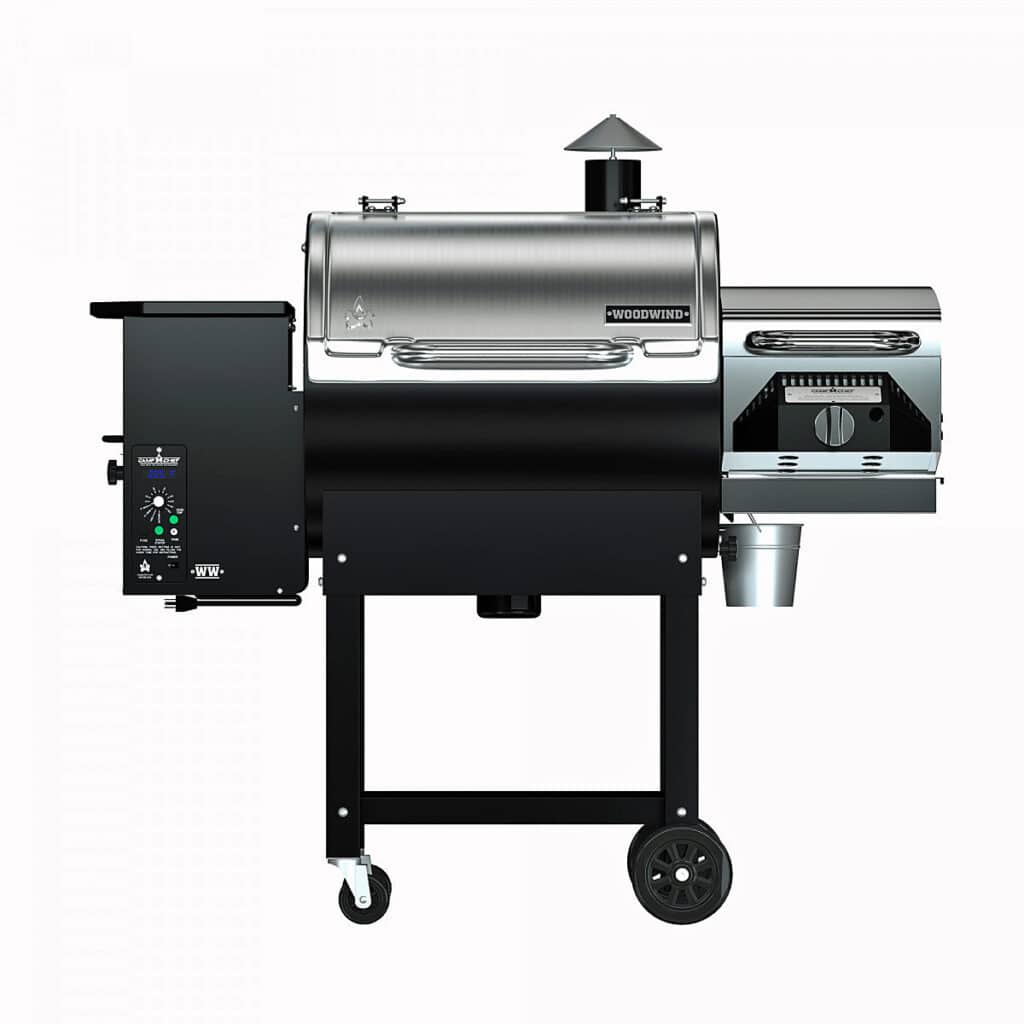
Bottom line: It’s all about control. And convenience. Oh yeah, taste, too. Set it and forget it. Great flavor. No brainer. Pellet burners are a real revolution.
This is an exciting time for pellet smokers. There are numerous new designs and they come packed with convenient features.
Pellet burners are amazing tools and they are blazing a path to better and easier outdoor cooking.
In 1982 Traeger Heating in Oregon began experimenting with a furnace that would burn wood pellets made from compressed sawdust, a byproduct of the area lumber mills, and before long introduced a home heating system that they sold mostly locally. Since furnaces sold mostly in cold months, before long they began experimenting with a grill that would burn pellets, too. Eventually they created a device with an auger to feed the pellets and a blower to help them burn.
They had the field to themselves for a few years, but the idea was too good to go unimitated, and with the digital age came the electronic controller that allowed Traegers and others to create a system that had a thermostat in the cooking chamber that would tell the fan and auger when to do their thing. Today there are more than a dozen manufacturers making increasingly sophisticated machines.
They are often called grills, but, at the time of this writing, I consider them to be primarily smokers. Almost all of them cook with indirect heat and those that try to grill over direct flame don’t do it well. If you love steaks, there are far better ways to cook them. But if you love smoked turkey, ribs, salmon, pork chops, brisket, and smoked foods, a pellet smoker may be the best solution available.
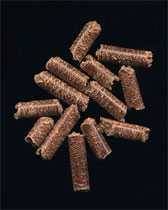
Pellets look like rabbit chow. They are about the width of a pencil and as long as a couple of erasers. If they get wet they turn into a pile of sawdust. The beauty of pellets is that they have none of the additives and fillers in charcoal briquets, so they combust almost completely. Almost zero ash. The pellets provide the heat as well as flavor. No need to add wood chips. Surprisingly, they do not produce overly smoky food. If anything, the food is undersmoked to some people because the combustion is so complete.
Their behavior is sometimes counterintuitive. The hotter they get, the less smoke they produce, and at their top settings, they don’t produce much smoke at all. This is good for when you are baking cakes or pies or doing dishes that don’t need smoke. But down under 250°F, they produce plenty of mild, elegant smoke. And even though the fuel is wood, it is hard to oversmoke with a pellet smoker. Burning wood on a charcoal grill produces much more intense smoke flavor.
The searing issue
Manufacturers advertise that these are both smokers and grills, but it is best to think of these devices as superb indirect heat convection smokers, not grills. Most just don’t do as good a job of searing a steak as a charcoal grill or even a gas grill with a sear burner. I can sear steaks better on a $20 hibachi than on most pellet smokers.
To sear a steak you need direct radiant heat. I don’t care if you can heat the air to 1000°F, it is still indirect heat and that does not deliver as much energy as direct radiant heat. It’s physics, but not hard to understand. In short, heat is not the same as temperature. It feels hotter at 80°F if the sun is shining on you than if it is 80°F in the shade. I discuss the concept in more detail in my article on thermodynamics of cooking.
To solve the problem, several pellet burners have come up with ways for you to expose food to the flameand can actually get a nice sear. Still not as good as charcoal or sear burners in my opinion, but a lot better than the ones that are strictly indirect. Check out the Memphis Pro, Cookshack Fast Eddy, and MAK 2 Star.
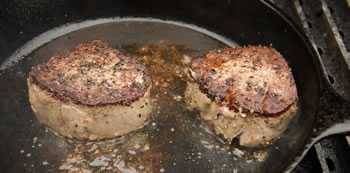
One option is to put a griddle or a frying pan on the grill, high heat, get it blistering hot, add just a little oil to prevent stickling, and sear by conduction on the metal. It should only take two to three minutes per side. This is a good technique for reverse seared meats. You start them indirect, low and slow, with a little smoke, and then Maillard the outside in a hot pan or on a griddle. No, it’s not cheating. It’s making food better.
How they work
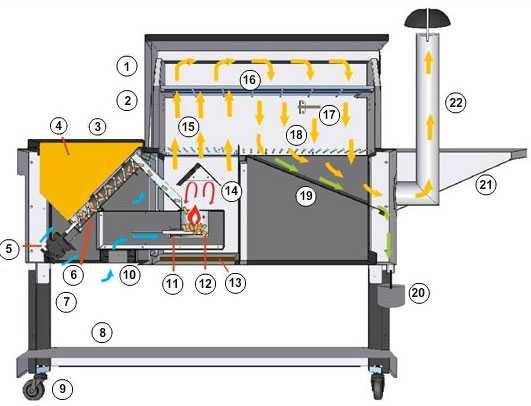
Central to all pellet cookers is a digital controller similar to the controllers on modern indoor ovens. You select a temp you want, and there is an LED display that tells you the actual temp. Some of the controllers also are programmable so you can cook at a certain temp for a determined time. Some have leave-in meat probes that can dial back the ovento a holding temp when the meat hits its mark.
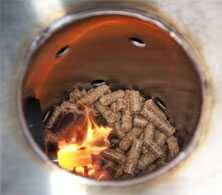
Pellet cookers usually have an auger or another feed mechanism that pushes the pellets into a burn pot typically about the size of a beer can ripped in half. An igniter rod sits in the bottom of the pot and when you turn on the grill it glows like the element on an electric stove. As the pellets ignite, a fan blows to feed them oxygen, and the igniter shuts off. The Traeger L’il Tex, an inexpensive model, draws 300 watts while the igniter rod is on in the first four minutes, then it drops down to 50 watts for the duration of the cook session, less than a standard light bulb.
The small burn pot is covered with a large deflector plate that absorbs the heat and spreads it out below the cooking surface making them essentially wood-fired convection ovens. Flare-ups are a thing of the past. You need to keep the plate clean because it is right below the food and if you leave sauce and grease on there, it can smolder and leave soot on your food. Carbon buildup will also diminish its heat transmission.
Because the burn pot is small, there is usually a hot spot directly over it. Some units have an optional perforated section above the burn pot so you can put the meat over direct flame, but the ones I’ve tested still do not sear properly. And there is no way to set up a 2-zone cooking system with a cool zone. As with most other grills and smokers, the differences between lower and upper racks is not huge, so think of it as one heckuva indirect heat convection smoker with precision temperature control.
Controllers
On the better models, a temperature probe in the oven area tells the controller what the temperature is and if it is below the target it tells the controller to feed more pellets and air. The best manufacturers, like MAK and Memphis, have designed their own versatile custom controllers that are easy to use and can hold a temperature within 5°F, tighter than many indoor ovens.
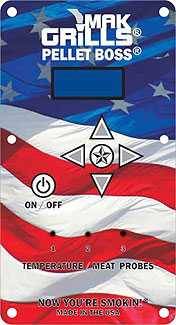
The MAK Pellet Boss will increase or decrease with the press of a button in 5°F increments and has a probe in the oven that keeps the temp pretty solid. As with any thermostatically controlled oven, even your indoor oven, the thermostat cycles heat on or off as needed. So it you set it for 225°F it cycles on til it hits 225°F, then off until it drops to 220°F, then on to 225°F. There are three meat probes and the Boss can be programmed to change the cooker temp when the meat hits a target. I’ve had one for several years outdoors in the Chicago winters and summers without a cover and no problems.
You may need an extension cord and not any cord will do. Read this article to calculate the size and capacity of the cord you will need.
Beware of the LMH controllers
Some cheaper models, such as the Brinkmann, have a controller with only three settings, Low, Medium, High (LMH), and there is no temperature probe in the oven to create a feedback loop. We do not recommend these units. You actually have less control over temp than you do on a gas or charcoal smoker. The whole reason to buy a pellet grill is because it is set-it-forget-it and it hits a temp and holds it regardless of the ambient air temp outside, winter or summer. On these LMH controllers, the temp fluctuates widely and it cannot correct itself for the weather. They just aren’t as smart as a digital device. Whether you’re smoking a few slabs of ribs on a scorching summer day, or six pork butts during a blizzard, the three position controller only knows auger on and off times for Low, Medium, and High. It has no information on the temperature inside the cook chamber.
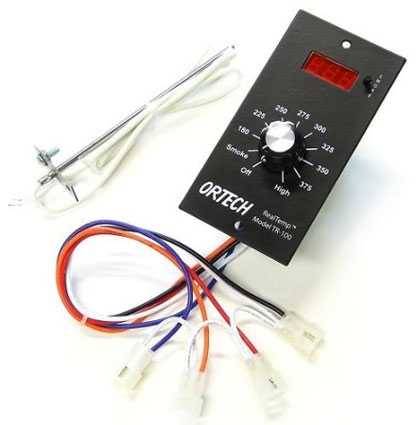
The good news is that if you are stuck with one of these dogs, Ortech makes a controller that can be used to upgrade Brinkmann and Traeger controllers. If you own another brand and are interested in upgrading to a digital controller, contact the manufacturer of your smoker or Ortech.
Understanding the Ortech Controller
Many of the rest of the manufacturers have come to the grill industry having first built home heating devices that burn pellets. This is a technology particularly popular in the Northeast and Northwest, but selling furnaces is seasonal, so they all seem to be making grills on the side now.
Rather than design their own digital controllers, they buy them from a company named Ortech. Ortech’s RealTemp TR-100 Digital Controller is shown here and its operation is not intuitive so let’s take a little time to explain it.
The Ortech has two knobs. The large one, the “Cook Control” has settings for: Off, Smoke, 180, 225, 250, 275, 300, 325, 350, 375, and High. One smoker manufacturer says that the “Smoke” setting is about 160°F and “high” is about 525°F, but both can vary due to ambient temperature, humidity, fuel type and quality of the smoker. Another knob, a teensy weensy knob to the right of the LED screen looks more like a push button. Labeled “SMOKE” and called the “Smoke Control Knob”, it is meant to turn, not push, and it controls the pellet feed rate with auger on/off sequences indicated by “P settings”. The P settings range from P0 to P15.
Turn it on to “Smoke” mode and use the P settings, or cook mode by selecting a temperature. When you select smoke or a temp setting you start the ignition sequence. The fan, igniter and auger motor turn on. The fan stays on until the smoker is turned off. The auger motor continuously delivers pellets to the red hot igniter rod in the firebox for two minutes under normal conditions. Then the igniter rod shuts off and the pellet fire burns with only the assistance of the auger and the fan.
In cook mode the thermometer in the cooking chamber sends info to the microprocessor which controls the auger. When temperature is correct the auger motor is idle. When the temp drops below a set threshold, the auger motor kicks in and delivers pellets until the desired temperature has returned.
In smoke mode the controller is no longer controlled by the thermometer, it merely switches the pellet feeding auger on and off. On time is 15 seconds, off time ranges from 45 seconds at P0, to 165 seconds at P15. Temp and smoke are controlled by the duration of off time: the auger always runs at the same speed. More smoke is produced at higher P settings and lower temp settings because longer off times allow the pellets to smolder. At P0 in smoke mode or “High” in cook mode the auger replenishes the pellets at a faster rate, creating more flame, less smoke.
Use of the P settings in smoke mode is easy to understand. But one can also use them as a dual function feature in cook mode. Remember, in cook mode the auger idles when the temperature is correct, but the P settings continue to function in idle mode. Ortech recommends the P2 setting as the default idle rate in cook mode. However, as one gains experience, the P settings can be used to improve the grills performance. For example, when using high temperature settings, select P1 or P0 to reduce auger off time and maintain strong, steady heat. If you have trouble hitting low temperatures on a sweltering day, increase the P setting to increase auger off time. It does not have a significant effect on smoke production. The basic rule remains: Low heat = more smoke, high heat = less smoke.
There are no food probes with this controller as there are on the MAK Pellet Boss, and the controller is mounted to the surface with two screws and no gasket so I fear rain could get into the electronics, but after more than a year of sitting out without the cover in rain and snow, the controller on the IPT I tested is still working fine. Ortech recommends covering your smoker.
Pellets
Wood pellets are an all natural product. No petroleum products in them, no fillers, chemicals, or binders. They are an excellent source of smoke flavor and compact energy, 8,500 BTU per pound. No hot coals, no flareups. There is also very little ash: 10 pounds of pellets will produce about 1/2 cup of ash. All the rest is converted to energy and combustion gases. I clean out the bottom of the ones I tested after about 10 cooks. At high temps there is very little smoke, at low temps the pellets smolder and produce superb but understated smoke flavors. Click here for more about pellets.
According to Bruce Bjorkman of MAK, his cookers use about 1/2 pound of pellets per hour when set on “Smoke” (about 175°F). At 450°F, the high temp, they burn about 2.3 pounds per hour. This is about the same average as I have experienced on a variety of pellet eaters. The burn rate will vary somewhat depending on the outside air temp, and how much cold meat is loaded in the grill, but cooking load should not have a major impact. Cooking pellets run about $1 per pound depending on the wood flavor, brand, if you get them on sale, and if you have to pay shipping. As a point of comparison, Kingsford briquets list for about $0.75 per pound, but they don’t pack the same BTUs because there are fillers. I usually buy 40 pound bags of BBQr’s Delight pellets.
Pellets are available from a number of sources because they are popular for use in home heaters, so if you are worried that you will be buying a gizmo that might be worthless someday if the pellet supply runs out, it is unlikely. As more and more pellet grills appear, and word of their excellence spreads, sources for pellets will become numerous. I’ve even heard of a few Home Depot’s carrying them. The bad news is that I have tried several brands and I always return to BBQr’s Delight. They seem to have the least sawdust, so they are less likely to clog the auger, and they have a higher percentage of the flavor wood on the label.
But you cannot burn home heater pellets in a cooking grill. Cooking pellets are hardwoods. Heater pellets often contain softwoods such as pine, they can have treated lumber and other chemical contaminants in them. The smoke they put out is potentially hazardous in food.
Pellets are made from different woods, each of which imparts a distinctive flavor to the meat. Hickory, oak, maple, alder, apple, cherry, hazelnut, peach, and mesquite are among the flavors available. For more about pellets, read my article, The Science of Wood. There is a pretty good forum for people who have pellet cookers at PelletSmoking.com and of course our Pitmaster Club has a lively discussion on them with many active users.
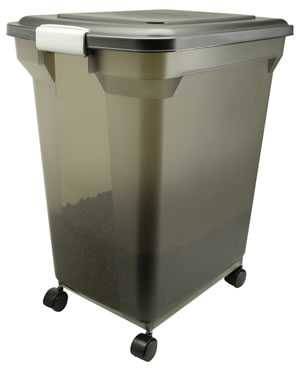
I store my pellets in an airtight pet food container
Cleanup
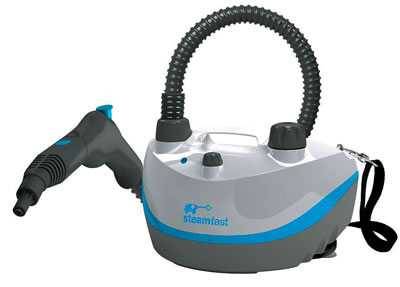
The biggest cleanup issue is the buildup on the heat deflector under the cooking grates. You’ll need good gloves and an apron. On most models, a thorough cleanup means a 30 minute process of taking out the greasy grates and the gooey deflector plate, scraping them and washing them. You should do this when the carbon and grease cover the deflector plate. Stainless parts can go in the diswasher, but I wouldn’t do it. That grease is like tar and it could get all over the insides of the dishwasher and hang on for dear life. I use a handheld steamer like the Steamfast Cleaner shown here.
After about 10-15 hours of cooking, you should remove the burn cup and dump the ash. If the ash builds up it can prevent ignition. Ash also accumulates in the bottom of the unit, but doesn’t impact cooking. A vacuum cleaner with a hose makes short work of it. Only a few manufacturers, such as Blaz’n Grill Works and Camp Chef have a slide out combustion cup that makes cleanup much easier, but you still have to get underneath the deflector occasionally and suck out fly ash that has scattered around the lower part of the grill body.
A few words of caution
Maintenance is an issue. There are moving parts on these grills. Moving parts eventually break. There is an auger with a motor, and a fan with a motor. There are proprietary electronics systems on these babies. Augers clog. Motors burn out. Electronics have bugs or fail. Especially when exposed to rain, snow, hot, and cold. When they fail, will the manufacturer have a replacement part?
In 2008 there were only two consumer pellet grill manufacturers. Today there are dozens. The market for these relatively expensive devices is small but growing fast. Not all of these small manufacturers will survive. Forget the warranty and ask “When it breaks will the manufacturer still be in business?” They do not have repair shops near you. When it breaks will they be able to diagnose the problem over the phone? They may be able to figure it out, but then you have to buy the replacement parts and do the repair work yourself. Are you up to the task?
On the flip side, the parts are not complex, and you may be able to get them from another source. If you are handy, repairs should not be too hard. Some brands have tech support online. MAK leads the pack in this with numerous helpful videos. Are you getting the sense that I am a fan of MAKs?
Extension cords
The built-in cords on outdoor cooking devices are often not long enough, and although regular household extension cords will work for rotisserie kits, they will not carry enough juice to keep you pellet smoker or electric smoker going. They could become a fire hazard as they heat up trying to deliver power to the unit. To extend the cord you need a large capacity cable as measured in amps. Here’s how to figure out what you need:
Watts ÷ Voltage = Amps
If your smoker needs 500 watts, and typical household voltage is 110 to 120 volts,
500 ÷ 110 = 4.5, so you need a cable that has a capacity of 4.5 amps.
For home models, get at least a 10 amp, 12 gauge, three prong cord (oddly, 12 gauge is higher capacity than 14 gauge). That’s more than you need, but better safe than sorry. Commercial models may have different requirements.
The best solution: Have an electrician custom make a cord the proper length for you. Don’t buy a cable much longer than you need it because the longer the cable, the higher the resistance and the power diminishes. You don’t want to see the equations for that.
Not enough smoke from your pellets?
Most owners are crazy about their pellet cookers, but some say the flavor is different than they are used to from charcoal and gas grills, and more than one has told me they do not like the flavor because it is too mild. They are a minority.
I have found that using the upper shelf gets more airflow around the meat than the lower shelf. I asked the AmazingRibs.com science advisor Prof. Greg Blonder about the problem (he has a MAK 1 Star). He explained that smoke sticks to cool surfaces and wet surfaces, and the surface of meat warms and dries out after a few hours. When he wants more smoke flavor he uses a strong smoke wood like hickory or mesquite, he starts with cold meat, and then he keeps the meat moist by painting or misting it with apple juice or a mop like Lexington Dip or East Carolina Mop or Texas Mop Sauce. A awter pan can help because the water condenses on the cool meat and attracts smoke. Read his detailed research on the subject in my article on the Science of Wood and my article on Basting.
The bottom line
Because they burn wood, pellet smokers are popular in BBQ competitions and they have been winning top prizes at many of them. Fast Eddy Cookshack Smokers have won the top prize at numerous competitions, enough to make some traditionalists cry foul and try to get them disqualified. They’re too easy, opponents claim.
Before buying, please note that pellet smokers need access to electricity to run the digital controller, the auger that transports the pellets to the firebox, and the convection fan that circulates the air in the cooking chamber. These cookers can use a lot of pellets at high temps. At high temps there is little or no smoke, and at low temps smoke is unavoidable. So if you want to cook, say, a chicken breast low and slow to retain juices, but you don’t want any smoke flavor, you’re outta luck. If you want to torch a thin burger to get a crunchy crust and add a little smokiness, you’ll get great smoke flavor, but it is hard to get the crust. But if you want killer ribs, bacon, smoked salmon, etc., pellet burners are hard to beat for convenience and quality.
Click here to see all the pellet smokers currently in our database


Before you can post a comment or question you must sign into our commenting partner, Disqus. This helps make sure everyone hanging around the grill is civil. We do not tolerate nastiness, racism, porn, inappropriate language, or attacks on others. All comments are the property of AmazingRibs.com and we reserve the right to quote them, edit them, delete them, and block people from making future comments.
Please leave comments and questions on the same page that is devoted to that subject so others can see questions and our answers when they are reading about the subject. You must enable JavaScript to use the comments section, and you must accept cookies to post comments. Note: the software that runs Disqus is different from the Pitmaster Club, so members need to sign into the Pitmaster Club separately.