

Order The Award Winning AmazingRibs.com Temperature Guide Magnet
Related articlesMagic happens within the meat at different temps. Click here to learn some basic meat science. Click here to learn the thermodynamics of cooking. Click here for a cooking log that will make you a better cook. The first thing to do is season and calibrate your grill or smoker by doing a few dry runs without food. Grommets (but no Wallaces)
On a Weber Kettle or Smokey Mountain you can dangle them through the vent hole, but you're never quite sure where the tip of the probe is and if it is touching meat or metal. Then you forget about it, lift the lid, and you thermometer goes flying into the neighbor's yard. I put this problem to the folks at Maverick. I told them it would be nice if I could drill a hole in the side of a grill, like a Weber Kettle, and insert a probe. They now sell two temperature resistent silicone grommets, little silicone rings, perfect for the job. Just drill a hole in the grill, insert the grommet which fits snugly to the inside of the hole, and then push the tip of the probe through the hole. It will stay in place and hover above the lower grate at just the right height. Click here to order two grommets, one for each grate on a WSM. Our science advisor, Dr. Greg Blonder, says "The steel is very hard. Create a dimple to help center the drill by hammering a concrete nail or center punch into the side. I also cut a small block of wood to fit behind the spot you are drilling, clamped or held tight. Helps prevent shredding on the inside of the drilled hole, and drops vibration while drilling. Use a newer, sharp high speed bit." |
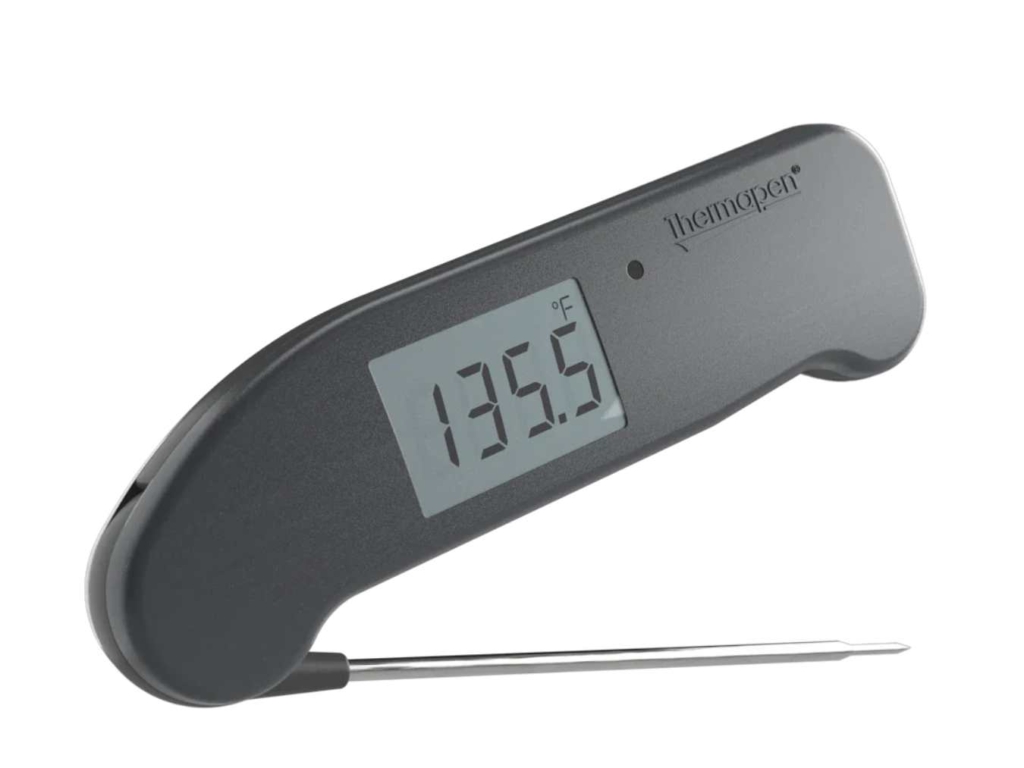
Meathead's recommendationsThere are hundreds of good digital thermometers out there and I have not tried them all. Many I have tried and do not recommend. Below are the ones I have tried and that I do recommend. If you don't see it here, I have either not tried it or I don't like it. Thermoworks Splashproof ThermaPen
Although it was designed to read food temps, it can even read air temp if you insert it through a hole in your grill or smoker, but it can take up to 30 seconds to give a good reading and you want to make sure you place it at the so the plastic body does not melt and the tip is near the food. It comes in a variety of colors. Another nice thing about the ThermaPen is that the company stands behind it. My first (an older model) began to malfunction after eight years. Probably had nothing to do with the fact that I had dropped it half a dozen times. I called them, gave no indication that I was a writer, described my problem, and rather than hit me up for a repair bill, they told me how to fix it. My only real complaint is that it is hard to read at night. Made in England. Here's a video that demonstrates the Thermapen's speed compared to the competition: Click here to order Thermapen.
Click to order a padded vinyl pouch that fits your Thermapen with or without a silicone boot. |
Cooking Thermometers: Buying Guide, Reviews, And Ratings. The Most Important Page On This Website
"The instant-read thermometer, used frequently, solves most issues." Mark Bittman, New York Times food columnist and cookbook author
By Meathead
A radio host once interviewed me and asked "What is the single most important advice you can give a barbecue cook?" My answer, without hesitation, was "Get one good digital thermometer for your cooker and another for your meat."
Only sissies think thermometers are for sissies. They are as important as knives and forks. Proof: Of the thousands of barbecue teams competing for prize money every weekend across the nation, I have never ever seen one that didn't use a digital meat thermometer, and the majority also use digital oven tehrmometers.
Most grills and smokers come with bi-metal dial thermometers, and they're usually crap. Look at the picture above. It is not unusual for this design from the 1800s to be off as much as 50°F like the one above (on an expensive and otherwise superb grill). You cannot trust them. I have readers tell me that when they bought a good digital from my list below that they learned their grills were off by as much as 100°F! This is a recipe for well done steaks, late meals, cold food, embarassment, shame, and ostracism.
So-called "instant read" bi-metal dial meat thermometers can take up to 30 seconds to read accurately. Digitals can read in 1 to 6 seconds with much greater precision! Don't take my word for it. Alton Brown, Food Network Star, author of multiple cookbooks, and mypersonal hero says "Bimetal coil thermometers are about as accurate as a sniper scope on a nerf gun."
Cooking without good digital thermometers is like driving at night without headlights. Spend the money for good thermometers. Right now! They will pay for themselves by saving your meat and your face.
Without good digital thermometers there's a good chance you'll be making lame excuses for overcooked meat, undercooked meat, or, worst of all, apologies at bedside in the hospital as your guests recover from food-borne illness.
Here's what the US Department of Agriculture (USDA) says: "The color of cooked meat and poultry is not always a sure sign of its degree of doneness. Only by using a food thermometer can one accurately determine that a meat has reached a safe temperature. Turkey, fresh pork, ground beef or veal can remain pink even after cooking to temperatures of 160°F and higher. The meat of smoked turkey is always pink."
Dispelling some myths
You can't gauge temp with your hand. I don't care what the TV chef said, you absolutely positively definitively without doubt no way no how cannot tell anything about the temp of a grill is by holding your hand over the grate and counting "1001, 10002, 1003" until until your palm starts to smoke. Each of us reacts differently to heat, and the heat 1" above the grate can be significantly different than 6" above. Maybe an old pro who cooks 100 steaks a night can do this parlor trick, but most backyard cooks cannot.
You can't gauge temp by poking the meat. Likewise, you may have also heard that you can tell the doneness of a steak by poking it and comparing the bounciness of the meat to the tip of your nose or the flesh between your thumb and forefinger. As if everyone's hand has the same firmness and bounciness! As if a filet mignon has the same firmness and bounciness of a sirloin! Lookit, almost all professional chefs carry a meat thermometer in their chef's coat. There's a reason: Only sissies think thermometers are for sissies.

You can't rely on pop-up thermometers. They have a compound in the tip that melts at a determined temp and releases a spring that pops the stem up. Although they can be accurate, they can also stick, they read only one part of the turkey, and they are usually set too high. Pop-ups are why your turkey tastes like cardboard. Throw them out.
Using a thermometer will not make your meat dry. Meat is about 75% water. It is not a balloon. When you stick in a probe a few drops of juice may escape but it is nothing compared to the total amount of juice. In an 8 ounce steak 6 ounces are water. If you lose 1/4 ounce, and you probably won't, there are still 5 3/4 ounces of juice left. That's 95%. Stop worrying.
To be a good outdoor cook you need three thermometers:
#1 - You need an oven/grill/smoker thermometer
Can you imagine cooking indoors if your oven did not have a thermometer? Then why do you try to cook outdoors without a good oven thermometer? If you hope to be king of the grill, you've got to know what the oven temp really is. And this may come as a shock, but your indoor oven is probably waaaay off too. It probably needs adjusting, so when you buy a good digital you can calibrate and adjust your indoor oven. So if you buy a good oven/grill/smoker thermometer, you can improve your indoor cooking too. I recommend the the Maverick ET-732, described below, because it is both an oven thermometer and a leave-in meat probe. Two for the price of one.
#2 - You need a food thermometer
The difference between a medium rare and well-done steak is pretty narrow. The diff between moist tender fish and dry chalky fish is even less. Seconds matter. And two pork chops sitting side by side can cook at different rates. The only way to deliver properly cooked meat to the table and protect against food borne illness is to take its temp. If you hate apologizing for overcooked meat or having to take chicken off your guests' plates and sticking it in the microwave, then you've got to get a good meat thermometer. There are two types, instant read and leave-in. I recommend you have both, but if you get only one, go for a good instant read.

1) Instant read. These babies are great for spot checking when you have 10 burgers on. They all cook at a different rate. Or a piece of salmon with a thin part and a thick part. Or a turkey that has dark and white meat that cook at different rates. Just open the grill, poke a thin probe into the meat, and in seconds it tells you the temp. A fast thermocouple is best for this task. I strongly recommend the Thermoworks Thermapen, which reads in 2 seconds, updates itself every 1/2 second, and is extremely accurate.
2) Leave-in probe. A leave-in probe is inserted into thick cuts of meat and left there throughout the cook. It lets you monitor the progress of the cook without having to open the lid and stab the meat. They are essential for pork shoulder, hams, whole hog, pork loin, beef rib roasts, tri-tip, and turkey. I strongly recommend the Maverick ET-73, described below, because they are both a leave-in probe as well as an oven thermometer. Two for the price of one.
#3 - You need a refrigerator thermometer
It is crucial for your budget and your health that your refrigerator be set properly. If your fridge runs too hot, food will spoil, need to be discarded too soon, and there is a risk of food-borne illness. Most fridges have a way to adjust the temp. The ideal temp is just above freezing, from 35 to 38°F. Below 35°F, frost may form and above 38°F, microbes grow too fast. Because the temp can vary from top to bottom and in the drawers, a good refrigerator thermometer that you can move around is important. A liquid thermometer is just fine for this task. It is pretty accurate and it will run forever since there are no batteries involved.
Thermometer shopping checklist
Here is a checklist of things to look for when you go shopping for a good thermometer:
Accuracy. Bad data is worse than no data, so it's important to know where the reading is coming from. For a food thermometer, you want the sensitive part of the meat thermometer to be small and in the tip of the probe. The temp just below the surface can be a lot different than the temp in the center of a chicken breast. For an oven thermometer, you want the temperature reading from right next to where the food is being cooked. A thermometer in the dome of your grill will not tell you the temp that the meat is experiencing 6" below the probe on the grate just over the coals. It can be a lot hotter down there. Dial thermometers are just not reliable and they are usually located way above the food (see the sidebar at right). Good thermocouples are usually accurate within 1°F, and thermistors are usually accurate within 5°F.
Speed to read. How long does it take to get a good reading? This is especially important for instant read meat thermometers. Five seconds or less would be nice. The best work in 3 seconds or less. Now you have to be careful about the time manufacturers quote on how fast they read. They are misleading.
If they quote a "time constant" that is the time it takes to get to 63% of a full reading, and a full reading is five times that. So if they say the time constant is 0.6 seconds, as is the Thermapen, it will be pretty close to done in twice that, but not precise for 3 seconds. Another factor is how fast the display refreshes itself. The Thermapen refreshes every 0.5 seconds. This means you can slowly insert it and remove it and it will give you a new reading every 0.5 seconds. The Fast Response Meat Probe #113-151 which can be plugged into different meters is slightly faster with a time constant of 0.5 seconds, precise read in 2.5 seconds, slightly faster than the Thermapen. But the meters in the kits I recommend refresh every second, so the probe is actually faster than the meter.
Another factor is the conductivity of the medium you are measuring, food, which is mostly water, reads faster than bread, which is mostly air.
Temperature range. If you're going to spend money on a thermometer, it would be nice if it could read the temperature of the meat, the oven, a hot grill, in your freezer, or in an ice bath, and in boiling oil.
Length of the probe. Meat thermometers need to be able to get the temp in the middle of big roasts such as hams and pork shoulders.
Adjustable. Some thermometers can be calibrated (see the info on calibration elsewhere of this page).
Water resistant and easy to clean. You don't need barbecue sauce and soapy water in the inner works. Braided cables can fail if they get wet or if they are crimped or if they are smashed by the grill lid.
Ease of use. Is it easy to read? If it has lots of buttons and settings, can you remember how to use them? Is there a backlight for night use?
Price. There are some decent units for under $20 and others can cost almost $200 with attachments.
Timer. Although not necessary, some digital thermometers also have timers with alarms. Very handy.
Warranty and customer service. What is the warranty? Does the manufacturer have replacemet parts and sell them at a reasonable price? Do they have a good reputation?
How they work:
Thermocouples: The best instant read and all-purpose thermometers
Thermocouples are the best food thermometers because they're fast and precise. Some thermocouples can read accurately in fewer than two seconds, faster than any other sensor. They're thin: They have two tiny wires in the probe, so the tip can be very small and thin. The sensitive area is very close to the tip so you know just what you're reading and they can be used to check the temp in several locations easily. They're accurate: Their margin of error is usually less than 2°F. Some can be calibrated. You can get thermocouples that are great for instant metering, or others that can be left deep inside a roast like a pork shoulder or a ham for hours.
Thermistors: Good for continuous readings for large roasts and oven thermometers
Thermistors are digital thermometers with a small resistor in the tip. They are not as quick as thermocouples, they tend to be thicker, and they can be slightly less accurate, usually within 5°F. Some have a leave-in probe on a wire that allows you to insert it into the meat and get the readout from outside the oven so you can monitor the meat temp continuously.
Why most bi-metal dial thermometers are not reliable
Most bi-metal coil dial thermometers should be called heat indicators, not thermometers. These dial-and-needle readouts use two strips of metal bonded together and rolled into a coil. Each metal expands at a different rate, turns a shaft and this provides the reading on a dial.
They are slow and because the helix can be 0.5" long or more it is not as precise at reading a specific location as the tiny sensor in the tip of a digital. I don't recommend them for measuring food or air temp.
Most thermometers built into grills and smokers are bi-metal, but they are often low quality in order to keep the grill price down. Also, these grill themometers are mounted in the dome where the temp can be very different from the temp at the cooking surface making them both unreliable and misleading.
They can easily become unreadable if they fill with smoke and or water. If you get condensation or water under the glass of a bi-metal thermometer, put it in a zipper bag with a couple of cups of rice or dried pasta and seal it up. In about a week the grain will have absorbed the moisture and your thermometer should be back to normal.
Some bi-metal thermometers are rated as oven-safe and can be inserted into meat and left in during cooking, but the sensitive area may be up to one inch or longer, so they are useful only for meat thicker than 4", such as pork shoulders.
Now that I have slammed bimetals, I should tell you that there is one brand that a lot of the pros use on their big pits and they tell me it is pretty accurate. Tel-Tru. It comes with a wingnut, a range from 150°F to 700°F, 1.75" dial, and a 2.13" stem. As good as they are, that dial face is just not as accurate as a numeric readout that is precise to within a degree or two.
Other thermometers: Not recommended for cooking
Old-fashioned liquid filled thermometers are very accurate so they make good oven and refrigerator thermometers, but they cannot read a small area such as the center of a hunk of meat well, and they are very slow.
I'll tell you where to stick it
Most grills come with cheapo thermometers that are an afterthought to manufacturers and are usually bought bulk from cheap producers. To make matters worse, the probe is located high in the dome well above the food. Unless you plan to eat the dome, this is a bad place for the thermometer. You need to know the temperature where the food is. So put the probe about 2" to the side of the food (it is cold), and about 1" above the grate (it is hot).

Some thermometers, like the Maverick, come with a handy clip that does the job just fine.

If you don't have a clip, use a ball of foil. Make sure the tip, where the sensitive parts are, protrudes from the foil.

Listen to this email from a reader "I had been clipping the probe on the underside of the upper rack. That had the probe about 3" to 4" above the top of the meat. My food was taking much longer to cook than your recipes say. So I tried the probe in that location for about 1/2 hour and then moved the probe to the cooking surface, clipping it to the cooking grate about 4" to 5" below the previous location. The difference in temperature was about 25 to 30°F cooler at the cooking grate location! I never would have believed it! So in actuality, when I thought I was cooking at 225 to 230°F, I was actually cooking at 195 to 200°F! No wonder everything was undercooked!"
Just how hot is it?
When measuring the oven temp (remember, a grill or a smoker is just an outdoor oven that is poorly insulated, has no thermostat, and a lousy thermometer), put your probe near the food you are cooking! But keep it about 2" away from the food because tehre is a bubble of cold air surrounding it when it first goes on. Don't put your probe above the food in the dome, or below it close to the fire. Put it to the side.
When measuring meat temp, take the temp in more than one location because the composition of the meat and the unevenness of the grill can fool you. Insert the tip of the thermometer into the thickest part of the meat and go past the center. Slowly pull it out. Read the coldest temp. Test other locations. Here's are two other tricks for taking the temp of a thick cut of meat.
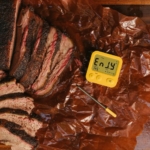
1) Line up the probe tip on the outside of the meat (that's a brisket below) until the point is past the middle. Then slide your finger tip until it touches the top of the meat (top photo). Now slide the probe into the meat until your finger touches the meat. The tip will be past the center (bottom photo). Now pull it back slowly and read the lowest temp. If any modeling agencies need a hand model my wife is available. Ain't that a purty finger?

2) Another option is to insert the probe from the side as in the porterhouse below. Use your finger to locate the center of the meat as above. Stay away from the bone which heats at a different rate than the muscle.

Thermometer calibration
Thermometers are essential tools. Buy good ones and take care of them. Here are some tips on caring for them.
Calibration. You should check a thermometer's accuracy soon after you buy it, then once every year, and again if you drop it. You can check your thermometer's accuracy with boiling water and with ice water.
Boiling water. Bring a pot with about 3" of water to a boil and insert the probe. It should read about 212F. Notice the key word "about". The exact reading can vary slightly with air pressure (factory calibration is based on one atmosphere, about 30" of mercury). Minerals in tap water can cause minor variations, so use distilled water if you want to be absolutely precise. I just use tap water. Remember that water boils at lower temps at high altitudes. The ThermoWorks website has a nifty calculator that helps you determine what your boiling point is.
Ice water. Fill a tall glass with ice cubes, not crushed ice, add cold water, and let it sit a minute. Insert the probe and make sure it is not below the ice or touching the ice. The temp below the ice can be several degrees above 32F (0C) and the temp of the ice can be below 32F. The experts at ThermoWorks say "Make sure the probe is in the middle of the ice water mixture and then gently stir for best results." The ice water test does not vary with altitude.
Customizing the Thermapen
You can personalize your Splash-Proof Thermapen by changing the factory default settings. Here are the instructions from the Thermoworks website on how to:
- change the display units from °F to °C
- change the display resolution from 0.1° to 1°
- disable the auto-off feature
To make any of these changes, open the battery compartment and, using the tip of a bent paper clip, flip the appropriate switch:
Switch 1: Display Units. The factory setting for your Thermapen display is for °F. To display °C, move the switch numbered “1” to the “off” position—towards the batteries.
Switch 2: Display Resolution. The factory setting for your Thermapen display is to show temperatures to tenths of a degree (0.1°) for both °F and °C. To change to whole numbers (1°), move the switch numbered “2” to the “on” position—away from the batteries.
Switch 3: Disable Auto-off. The factory setting for your Thermapen is with the auto-off feature enabled. This means your Thermapen will turn itself off ten minutes after you extend the probe and turn it on, to preserve battery life. Once off, you will have to close the probe and extend it again to turn the Thermapen back on. To disable this auto-off feature while taking lengthy readings, move the switch numbered “3” to the “on” position—away from the batteries. Remember, with auto-off disabled, your Thermapen will stay on and continue using battery power if you forget to close the probe.
Switch 4: Trim Adjust. This feature allows you to set an offset that will automatically add or subtract a number of degrees from your Thermapen readings. It should NOT be needed for normal use.
Common malfunctions, troubleshooting, and some important warnings
Lately I have been noticing comments on Amazon from disgruntled thermometer buyers complaining their units have failed. They are mostly about thermometers with flexible cables. As I read their comments carefully, I have come to the conclusion that most of the problems are because the owners did not read the instructions.
Failures are usually probe or cable failures rather than electronics failures. With proper care, probes should last years. I have numerous braided cable thermometers (I test a lot of thermometers) and only one has failed and then it was after several years of abuse. I was able to buy a replacement at a reasonable price.
I raised the subject with a bigshot at Maverick and he told me this story: "I had a consumer drive [to our office]. He advised he got HHH on his probe [an error message]. I assembled unit and turned on. I saw the HHH. I pushed the probe jacks into the meter a little harder to make sure they were making good connection. Solved problem. Consumer stood in my office with mouth open."
Apparently this is a common problem. Make sure you have crammed the jack all the way into the meter and twist them back and forth so they make better contact.
If the unit still displays an error or cryptic message like HHH or LLL, let the probe tip come to room temperature. The error may have been because you exceeded the range of the probe. If the problem still persists, remove the batteries and put them back in so the device can reset itself. If there is still a problem, it is likely the probe wire has shorted out, not a failure of the electronics.
Keep probes dry. Thermometer probes with braided cables like the ones on the otherwise excellent Maverick ET-732 occasionally fail if water gets into the place where the solid probe and the braided cable connect. That means you absolutely cannot submerge them when you wash them. The braid can get wet in a drizzle because the wires within are coated, but the junction between the braid and the solid probe is vulnerable.
Cleaning. If the probe has shorted out it is probably because you submerged it when washing it. After using a meat probe, get a sponge wet with soapy water and sponge off only the tip that was in the meat. Then rinse under the faucet or with a wet paper towel being careful to keep water off the braid and especially out of the junction. To clean a smoker probe, use a soapy sponge and focus only on the lower 1" since the sensor is usually within the lower 1/4". You don't have to clean the smoker probe after every use, just don't let it build up an opaque coat.
Order spares. Probes are like hard drives. They can fail and they will fail at the most inopportune times. Fortunately most are cheap. If you depend on your thermometers, and you should, keep a spare probe or two in inventory because you know for sure yours is going to die on Christmas Day when you are cooking a 16 pound Wagyu Prime Rib that cost you $400.
Don't drop them. DOH!
Don't smash or crimp the cable. If the lid on a grill smashes the cable it can break the internal wire. Crimping it can also break the internal wire.
Don't leave them out in the rain. Many of the best digitals are not water resistant, no less water proof. If it looks like it may rain, put your meter in a zipper plastic bag.
Stay within the temp ranges. Pay attention to the specifications in the manual. Each unit has a temp range. Don't go over it! You can damage the probe.
All this raises the question: Why can't manufacturers come up with a fully submersible probe and cable? And those manuals! Would you please hire a professional writer rather than asking your English major daughter to write it? C'mon guys! Get with it!
K-Type thermocouples are the best for pros, competition teams, and really serious cooksThermoworks makes several excellent thermocouple gauges that can take a wide range of specialty interchangable probes called K-probes. The meters are inexpensive (the fast accurate Mini at left is only about $45), but the probes are expensive, $30 to $60. You can buy the parts a la carte, or order one of the package deal kits they assembled at my request, also below. A word of caution: Thermoworks sells a number of other probes that I have tested. These are the ones I recommend for barbecue and grilling. Cheap out if you wish, but it would be a mistake. Available from ThermoWorks. |
||
ThermoWorks Mini Handheld Thermocouple Thermometer #MTC (far left) is the instant read thermocouple meat thermometer I use the most. And I mean instant. It refreshes every second.
|
Two-Channel Thermocouple Thermometer with Alarm #TW8060 (near left) is my go-to for reading smoker and grill temps in more than one location. Or you can put an oven probe on one slot and a leave-in probe on the other. It has an alarm that will go off if your oven or meat exceeds your prefered temp or drops below. It refreshes the reading every second. It does everything that the Maverick ET-732 does except transmit the temps to you on the couch, only it is more versatile and precise. Available from ThermoWorks. |
|
ThermoWorks Pro BBQ Kit: Perfect for BBQ competition teams, restaurants, serious backyarders
At my request, Thermoworks has put together a kit and a bargain with everything a BBQ pro, competition team, or restaurant will ever need. There are two meters and three probes. Both meters use the universal K connector (the yellow thingy with the two prongs) so both meters can take any of the three probes included, as well as scores more from Thermoworks and others.
The Pro Kit includes the TW8060 Thermocouple Alarm Thermometer, described above in detail. It has two ports for probes, so you can use the Armored Smokehouse Penetration probe to monitor the meat, and the High-Temp Flexible Ceramic Fiber-Insulated probe to keep tabs on the temperature of the oven, grill, or smoker. All are described above.
There is also a fast MTC Mini Handheld Thermocouple Meter with a very thin Fast Response Meat probe so you can spot check different parts of the food or use it on small cuts of meat. The kit is $30 less than the items individually. Click here to order from Thermoworks.
ThermoWorks Semi-Pro BBQ Kit: Perfect for the backyard cook
Also at my request, Thermoworks has assembled a kit and bargain for the serious backyard cook. It comes with a superfast Mini Handheld Thermocouple Meter (MTC) that you can plug into any of the three temperature probes in the kit.
Place the Armored Smokehouse Penetration probe in meat to monitor its progress, and place the High-Temp Flexible Ceramic Fiber-Insulated probe in the oven, grill, or smoker to keep tabs on it. You can move the meter from probe to probe and get rapid readings. And then there's the super thin Fast-Response Probe to spot check your meat or to use on thin cuts with precise readings in less than three seconds. The kit is $25 less than the items individually. Click here to order from Thermoworks.
Thermostats
With the introduction of the BBQ Guru in 2004, we entered the thermostatically controlled cooker era. Regardless of the weather outside, just set it and forget it has come to the back yard, just like in your kitchen. Originally expensive, more modestly rpiced models are appearing. They all are designed for charcoal and wood fired grills and smokers, but I predict thermostats for gassers cannot be far in the future. Every pellet smoker/grill has one and they are a joy to use.
They all work on a simple feedback principle. A thermometer in the cooking chamber tells a blower to turn on and feed more air to the fire when the temp drops below the target. It then tells the fan to turn off when the temp gets too high. Simple.
But the devil is in the details. You need a tight cooker so air doesn't leak in or out. Weber Kettles and Weber Smokey Mountains work well, as do most ceramic and kamado grills.
BBQ Guru PartyQ
Introduced in October 2011, the PartyQ is a very clever inexpensive thermostat device made by BBQ Guru, the pioneering inventor of thermostat controllers for grills and smokers. Their high-end models are popular on the competition circuit, and I'm sure this one will catch on big with that crowd because it is simple and inexpensive. But it also belongs in your back yard. It is the perfect companion to any grill or smoker that can be close to leakproof near the coals, like a Weber Kettle, Weber Smokey Mountain, all Kamado Smokers, and many cabinet style cookers. Their website lists a number of grills it fits.
You place the thermocouple thermometer probe into the cooking chamber and attach it to the cooking grates with its alligator clip. The other end is attached to a controller that you can set for whatever temp you want. The controller is attached to a small blower that turns on and off depending on the air temp temp in the cooker. The PartyQ runs on four AA batteries. Its competitor, the iQue (below), needs to be plugged into a wall outlet.
On the Weber Kettle, the blower needs to go through a 1" hole that you drill in the grill. Their website and printed materials show it mounted at the bottom, below the charcoal grate, but that is on a Weber Smokey Mountain. I had problems with ash getting into the fan and with it blowing ash around down there. Since then I have drilled several holes in my old trusty 15 year old kettle testing locations (now I have an excuse to buy a new Weber Performer Kettle!), and, if your lid fits tightly, it can go pretty much anywhere between the cooking grate and the charcoal grate (right). I have had great luck with pairing this device with the Smokenator (right). The two make your cheap kettle into a serious smoker.
Important. When used with the Smokenator, do not place the Smokenator over the PartyQ, it could melt some of the plastic parts.
On a Weber Smokey Mountain the PartyQ fits into an intake hole in the bottom without drilling, you just have to block off the other holes with aluminum foil or the heat resistant tape they include in the box. Many ceramic grills have ports built in for this type of device. They have a deflector for the PartyQ that keeps ash out, but it requires drilling a much bigger hole.
Mounting it is a cinch once the hole is located or drilled, then all you need to do is switch it on, set the target temp on the LCD readout, and place the probe near your meat. Close the intake vents, but leave the exhaust vent open at least partially unless your grill is leaky, in which case you can close it. Set the temp you want in 1 degree increments (F or C), let it run for about 30 minutes to stabilize the temp, and you can put the meat on. You can read the actual temp with the LED. Once things are stabilized, you want to keep the lid on to keep excess oxygen from reaching the coals.
The PartyQ can be calibrated in case it ever veers from true. Just insert the probe in boiling water and push some buttons and it will lock in to boiling temp. It can also be set to read in F or C.
The only negatives: It is not water resistant, so if it is raining or snowing, you need to duct tape a plastic bag around it being careful not to block the fan. There is no backlight so you need a flashlight in the dark. You must keep the unit running so the fan keeps itself cool otherwise heat buildup could melt it. Leaving it run for long cooks will use up batteries, so rechargeables may be the way to go. You need to make sure the batteries don't die or your blower might melt and your pit could go out. Also, the installation instructions and manual look to be slapped together and could be better written, and it sure would be nice if they would make the type in the manual a little larger for old farts like Meathead. I actually needed a magnifying glass to read some of the instructions for the Setup Menu.
Best of all, the PartyQ sells for $129 plus $10 for special adapters for certain grills.
Cyber Q Wifi BBQ Guru for Big Green Egg, Kamado Joe, Primo
BBQ Guru also makes a number of more complex and feature-laden controllers. They have a dizzying list of features and options, some with the ability to read both the cooker and meat, multiple cookers and meats. Some can be programmed to start at one temp, rise to another, drop, and hold as well as change temps depending on the meat temps. They also sell adapters for practically any pit you can imagine, commercial, competition, and backyard. With optional probs, adapters, and accessories.
The best of the lot is the Cyber Q which has a built in Wifi web server to allow remote access from your mobile device or PC. It can even send you email alerts. It has a pit probe and three food probes that come standard with the controller. The range is 32 to 475°F range with +/- 2°F accuracy. Runs on 100-240v AC or 12v DC so you can run it off your car battery at competitions.
Pitmaster iQue 110
The Pitmaster iQue has a blower that puffs air through a 1" flexible tube. The tube attaches to a stainless steel bowl that covers one of the air intakes on the bottom of the grill. The thermometer probe has a gator clip that attaches to the cooking grate. The blower and controller must be plugged into the wall althoughthere is an optional adapter available to plug the unit into a car battery cigarette lighter.
The setup begins by removing all the ash from the cooker. On my ancient Weber Kettle I had to wipe the bottom outside to block two of the three air intakes with heatproof tape, a small amount of which is supplied. The tape must be removed after the cook if you want to use the grill for normal high heat grilling, so you'll probably want to buy a roll of tape. On my Weber Smokey Mountain the bowl covers one of the inlets, and the other two dampers can be closed in the normal fashion. The bowl screws on easily with a toggle bolt. For kamado or ceramic grills, there is an adapter that fits the intake on the bottom.
On the Kettle I was then instructed to place foil on 2/3 of the charcoal grate above the air inlet to keep cold air off the meat and the temperature sensor. This is a bit of a pain. On the WSM the setup was normal. The controller unit comes with a rope to hang it from the grill's handle, but the heat from the body of the cooker could melt the controller, so I lay it on a chair. It is not rain or snowproof, and because the blower is in the middle of the controller, there's no way to protect it with a plastic bag.
There is an adjustable intake damper so you can control inflow. Finally, you set the controller with a dial from 175°F to 375°F (F only). Unlike the PartyQ, there is no readout telling you what the actual temp is, but there are LED indicators that give you feedback. - Meathead
Rock's Stoker
This device is an incredible hi-tech solution. It has a thermometer that goes into the cooking chamber and sends the info to a digital controller. The controller turns on and off a blower that regulates the airflow to the charcoal combustion chamber and thus controls the temp extremely accurately.
You can even insert another probe in the meat and plug that into the controller. You can program the controller to manage the temp on a variety of criteria. You can set it cook high for half an hour and then drop the temp or the inverse. Or you can have it cut back the temp when the meat hits a mark. It can even be connected to a wireless router and you can even control it with your computer or smart phone's web browser. The manual was clearly written by an engineer, and the settings and menus were decidedly not designed by a user interface expert from Apple, and you still have to make sure your grill doesn't run out of fuel, but thermostats are where it's at, Jack. I would give it a gold medal if the programming were not so difficult. Hey, this is the age of the iPhone, Rock, can you make this a bit easier, please?
About this website
AmazingRibs.com is all about the science of barbecue, grilling, and outdoor cooking, with great BBQ recipes and tips on technique. Learn how to set up your grills and smokers properly, the thermodynamics of what happens when heat hits meat, as well as hundreds of excellent tested recipes including all the classics: Baby back ribs, spareribs, pulled pork, beef brisket, burgers, chicken, smoked turkey, lamb, steaks, barbecue sauces, rubs, and side dishes, with the world's best buying guide to barbecue smokers, grills, and accessories, all edited by Meathead.
Advertising on this site
AmazingRibs.com is far the most popular barbecue website in the world and one of the 50 most popular food websites in the US according to comScore and Quantcast. Visitors and pageviews increase rapidly every year. Click here for analytics and advertising info.
| Weights, Measures, Conversions | Tips & Techniques | Recipes | Equipment Reviews | BBQ Culture & History |
| My Ingredients | BBQ Joints | About Us | Blog | Links | Newsletter | BBQ Tunes |
| Privacy Promise, Code of Ethics, Other Legal Terms | Advertising & Sponsorship Opportunities |


GrillGrates amplify heat, eliminate hot spots, and block flareups. This is the concept behind the expensive new infrared grills. A must add-on for all gas grills.


This unique guide shows you both USDA recommended temperatures for all your favorite meats as well as the temperatures recommended by chefs (they are not always the same). This 8.5" x 5.5" magnetic card
One of the problems with a lot of grills is that you have to thread thermometer cables under lids and hoods and then find a way to attach the probe to the grates without letting the tip touch the metal. The lids often crimp or cut the cables.
This is the thermocouple thermometer you see all the cooks on TV using. I highly recommend it for anyone serious about cooking meat or baking bread properly.
Click here to 


There are two probes and cables, one to insert into the meat and leave it in, and another to leave in your oven/grill/smoker. Both probes plug into a transmitter module that sends temperatures to a receiver module that you can take into the living room with you and place on the coffee table next to the beer and chips. That's right, with the Maverick you can monitor your grill and your meat while you watch the game or cut the lawn. You can also set the timer to remind you when to start the side dishes or wake you up if the game is really boring, or set it for a target temp, and an alarm will let you know when the meat is ready.
What a really cool idea!
It has a folding stand that doubles as a hook so you can hang the unit from the side table on your grill or a nearby hook. It will only go from 32 to 400°F (0 to 204°C), so you need to be careful that you don't put it in a really hot grill. I have tested it against a lab instrument in a smoker and it is pretty close to precise.
This thermocouple and timer combo is pretty handy. The thermometer works from 32°F to 392°F, and the timer can be operated with the thermometer or separately.

Infrared laser guns are really kewl looking, but they are not a necessity for the outdoor cook. They are designed to read the temperature of a hot surface like a griddle or a frying pan. They are not good for reading meat temp nor can they measure the temp of a grate or the air inside a grill. You point the gun at a surface like a frying pan, pull the trigger, and it puts a laser beam on the target. Don't let the laser fool you, it is only a targeting aid, the actual surface being read is larger than the laser, so it cannot measure something narrow like the grates on your grill.
Where it has really come in handy is for locating cold spots on exterior walls of my house and areas around my windows that leak. If you use a griddle or cast iron pan a lot, or an old house, then this is a useful tool. Otherwise, save your money.

The two cables attached to the probes are plastic coated, and although they are rated for 14 to 392°F air temp, they will probably melt if they make contact with hot metal on a grill. Also, this is one of those therms that has alarms set for different meats, and the alarm temps are waaaay to high. The minimum temp for beef is set to 140°F, well past medium rare. Pork is set 160°F even though the new USDA recommended is 145°F, etc. There is a program mode where you can set you own temp, thank goodness. You can set two timers, and it has a magnet so it can attach to your oven.


Please please please read this before posting a comment or question:
1) Please use the table of contents or the search box at the top of every page before you ask for help.
2) Please click the "Follow Conversation" button or the "Email" button below your comment so you will be alerted when we reply.
3) Please don't ask any questions that involve temperature unless you tell us that you are using a digital thermometer! Dial thermometers are often off by as much as 50°F! If you are not using a good digital you have no idea what the temp really is so we can't help you. Please read this article about thermometers, then buy one of our recommendations, and then, if the problem persists (chances are it won't), hit us with your questions.
4) Please tell us everything we need to know to answer your question like the type of cooker you are using.
5) If you are shopping for a grill or smoker and need help, tell us your budget!