




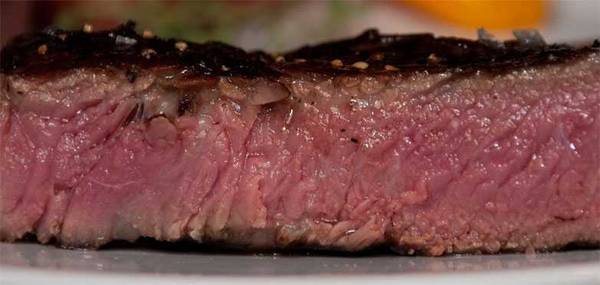
On 5/24/2011 the US Department of Agriculture (USDA), with much fanfare, finally changed its cooking temp recommendations which were waaaay out of date and universally ignored by Chefs and skilled cooks. There has been a lot of press over this, but they really only changed one thing of significance, the recommendations for pork chops and pork roasts. I’m guessing the pork lobby spent big bucks and a lot of time camped at Secretary Tom Vilsack’s door. Makes me wonder where the beef lobby is sleeping.
Organic is no guarantee
If the meat is very fresh and if it was handled very carefully during slaughter and butchery, there may be very few bad bacteria if any. Scientists call this the “load” and that is also an important factor in food safety. The more bugs there are, it takes longer and/or more heat to kill them all. But there is no way for most of us to know precisely how fresh a steak is and how the carcass was handled.
Now I know a number of you are going to tell me how safe you feel eating pastured chicken and their eggs, or rare burger from the grass fed organic steers you bought at the farmer’s market, but the fact is that pastured chickens wander on grass contaminated by droppings from birds, field mice, rabbits, and deer, and they can be just risky. Organic pastured chickens can be just as dangerous as factory chicken. Ditto for other fruits and vegetables. Everyone must be informed and careful about food safety, no matter who their supplier is.
And while I’m goring sacred cows, here’s one for the vegans who always spam any article I write about meat in my weekly column on Huffington Post with their drive-by invective: According to food safety experts, the most dangerous food around is probably sprouts! The seeds are often grown in fields contaminated by critters and sewage, often overseas in unregulated farms, sit in burlap bags in warehouses with rodents, and then they are soaked in warm water until they pop open. Well guess what else is sprouting in this warm moist incubation climate? The FDA website is teeming with tales of sprout recalls. And growing them at home is just as dangerous.
Sous vide doesn’t play by USDA rules
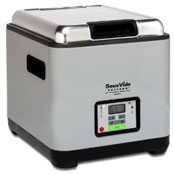
Heat kills bacteria, but bacteria don’t all die at once when the meat hits 145°F. They start croaking at about 130°F, and in theory, if you hold a piece of beef at 130°F internal temp for about two hours, you can kill all the bugs.
This is the whole theory behind the latest and most exciting emerging concept in cookery, sous vide. Yes, I know it is not new, but is is newly affordable. Sous-vide is French for “under vacuum”, so named because the cook puts a steak in a plastic bag, add seasoning, perhaps a marinade, and suck out all the air with a vacuum sealer. The bagged meat is then put in a water bath and held at 130°F for hours until it is an even 130F throughout for two hours making it perfectly sterile, and amazingly tender because at that temp enzymes kick in that make the meat extra tender. The problem is that the meat lacks the rich flavor and crisp texture from the Maillard chemical reactions that happen to amino acids and sugars on the surface when you grill a steak, so sous vide chefs often sear the exterior in a pan, under a broiler, or on a grill for a few minutes before serving.
Sous vide can even be used on burgers and poultry, making it safe at much lower temps.
Until recently sous vide systems were bulky and expensive, suitable only for restaurants, but in the past couple of years they have gotten smaller and cheaper.
Check these sous vide systems and books on Amazon.com.
The best way to keep safe: Get a good digital thermometer
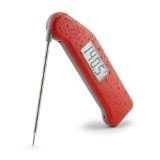
You will also notice that the whole system is based on internal temperatures of meats at their thickest part. Good cooks use a thermometer as their guide, not a clock. A recipe that says “cook at 325°F for 2 hours” is a recipe for disaster because you oven is probably way off. Even new ovens are often not calibrated properly. There is no substitute for a good digital oven thermometer coupled with a good digital instant read meat thermometer. This is especially true for outdoor cooks. The dial thermometers on most grills, even the expensive ones, are worthless, often off by 50°F or more.
The internet and a lot of cookbooks tell you that you can tell when a steak is ready by poking it and comparing its resistance to the flesh on your hand. THIS IS NONSENSE!!!! Unless you are an experienced pro, you cannot tell the doneness of a steak by poking it! The resistence of the steak is going to depend on what cut of meat you are poking, the grade of meat, how thick it is, the age of the steer, the breed of steer, the age of the meat, and what the steer was fed, among other things. A prime grade filet mignon feels a lot more tender than a choice grade sirloin. A 3″ ribeye feels different than a 1″ ribeye.
In addition, the resilience of our hands differs from young to old, from thin to fat, from exerciser to couch potato. OK. It is true that top steakhouse chefs can tell a steak’s internal temp just by poking it. But they have poked thousands of steaks, all from the same supplier, all the same thickness, all cooked at the same temp.
The rest of us need a food thermometer. Food is expensive. It is costly and embarrassing to overcook it. Friends and family are priceless. It is not nice to sicken or kill them.
Doneness and color are controlled by one thing and one thing only, the temperature of the food. For home cooks, there simply is no substitute for a good digital instant thermometer like the ones I recommend in my Buying Guide to Thermometers.
Here’s what USDA says, and I heartily agree: “The color of cooked meat and poultry is not always a sure sign of its degree of doneness. Only by using a food thermometer can one accurately determine that a meat has reached a safe temperature. Turkey, fresh pork, ground beef or veal can remain pink even after cooking to temperatures of 160°F and higher. The meat of smoked turkey is always pink.” In addition, smoked meats are often pink due to a chemical reaction with the smoke, rare hamburgers can be brown, and chicken cooked well above the safe temp can still have bloody splotches.
Here are the temperatures a cook needs to know (click on it to make it larger. I recommend you download it and pin it to the fridge. You also need to know that these temps are not exact. Some cuts may go medium at a lower temp than others, and certainly the dividing line between rare and medium rare (etc.) is not hard and fast.
One thing has not changed: If you follow USDA recommendations 100% you will be 100% safe and doomed to terrible steaks and lamb chops. And as usual, in its effort to make one set of easy to understand rules suitable for a refrigerator magnet, the government has oversimplified.
Here are the USDA’s new rules of thumb: 145°F for whole meats in the thickest part plus three minutes of rest, 160°F for ground meats and 165°F for all poultry.
The whole story, it should not surprise you, is a bit more complicated. In recent years there has been widespread contamination of our food supply, both animal and vegetable, with bacteria such as Salmonella, Escherichia coli O157:H7, Shigella, Listeria, and Clostridium botulinum as well as parasites. I understand the concept that simple rules are what most people need to battle this evil army, but it would have been nice if USDA had at least added a statement like this: “These are important guidelines and only knowledgeable and experienced chefs with high quality thermometers should veer from them. To understand all the facts, click here” with a link to an article like this one. As we dive into this important discussions I should point out here that I am not a food safety scientist, but my wife is, and she is also the editor of a food microbiology magazine, and we have discussed these matters at length.
Pork chops and roasts
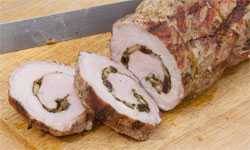
The new recommendation for whole cuts of unground pork is 145°F (63°C) as measured with an accurate food thermometer placed in the thickest part of the meat, then allowing the meat to rest for three minutes before carving or consuming so the temp will rise a few more degrees.
This is a major breakthrough for pork quality. Pork chops are just plain juicier and more tender at the new “safe” temp of 145°F (they will probably rise to about 150°F during the 3 minute rest). At that temp pork will be very pale pink. You can make chops even better with about 30 to 60 minutes in a brine of about 5%. That’s about 1 cup of table salt or 2 cups Morton’s kosher salt, to 1 gallon of water. For more on brines and how to amp them up, click here.
There is good reason to make this change. Once upon a time it was easy to get the parasite trichinosis from undercooked pork. Today trichinosis has been all but eradicated in developed countries. Trichinosis is caused by eating raw or undercooked pork and some wild game infected with the larvae of a species of the parasitic worm, trichinella. The annual average is now fewer than 40 cases per year in the US, most associated with eating undercooked wild game such as bear. Trichinosis from pork was about five cases per year in 2006, mostly from eating uninspected home grown hogs. The number of cases in pork has decreased because of improved farming and processing methods as well as public awareness of the importance of proper cooking. Trichinosis is killed at 138°F.
- Click here for my stuffed pork loin recipe (above).
- Click here for my recipe for Kermit’s Second Favorite Pork Chop.
Poultry
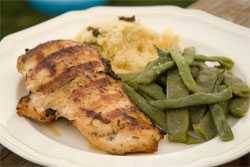
USDA has not changed its recommendations for poultry products, including ground chicken and turkey, which remain at 165°F. Salmonella is common in commercial chicken, and it is often found in free-range and organic chicken, and every technical reference I have ever seen says that this temp is pretty much ironclad with one minor exception, sous vide, which I will discuss below. Poultry white meat, like “the other white meat”, also benefits from a short swim in salt water before cooking.
Other whole muscle meats
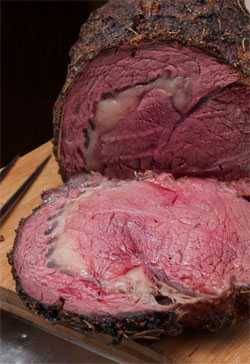
Alas, USDA still tells us to cook steaks, lamb chops, and roasts to 145°F with a 3 minute rest. This is actually a step backwards because they have added the three minute rest during which the meat temp will rise! It wasn’t in previous recommendations! At 145°F a steak is medium well, mostly tan/gray with a tinge of pink. At this temp it takes more effort for teeth to cut through the muscle fibers, much of the juices have congealed, and those juices are what carry most of the flavor to your taste buds so the meat is less tasty. If it rests for 3 minutes it gets mighty close to well-done, a terrible waste of good beef.
The optimum temp for tenderness, juiciness, and flavor of a steak is medium rare, about 130 to 135°F. Most steak lovers know this, and no steakhouse could stay in business if they followed the 145°F plus 3 minute guideline. At this temp you could trash all the prime rib carving stations in the nation. It is mindblowing that USDA has not come to grips with this reality.
As far as I can tell, there is little risk in eating medium rare or even rare steaks. I hope someone at USDA reads this. I’d like to see the data on food-borne illnesses from whole muscle meat steaks cooked to 130 to 135°F.
The biggest problem
The problem is that bacteria, especially virulent strains of Escherichia coli such as E-coli O157:H7 live in the intestines of cattle. E-coli comes out in their poop and get on cattle hides, especially when they are in close quarters like feedlots, called CAFOs. They can also be spilled on the slaughterhouse floor when cattle are slaughtered and the occasional sphincter lets loose. They also spill out if a butcher’s knife accidentally slits open an intestine and then they get on the blade. The nasties then get on the surface of the meat, but they do not get very far into the meat. But when you cook steaks, and most of us cook at much higher temps than 145°F, grills and frying pans and broilers are usually well over 300°F, e-coli and other bugs die almost instantly. That’s why it is a bad idea to use tenderizing devices like the Jaccard or a fork that puncture the skin and soften the meat by plunging into it. They are very effective inoculators, pushing contamination deep into the center.
Other ground meats
Ground meats other than poultry must be cooked to 160°F and do not require a rest time. This number has not changed and it means that you should not be serving pink hamburgers, especially to children and the elderly. Again, an ironclad line you should not cross, unless the meat has been irradiated. E-coli is not a trivial adversary. It can debilitate, kill kidneys, and even kill loved ones.
The problem is that if meat is contaminated in the butchering process, when it is ground, unlike steaks, the yucky stuff gets distributed throughout. So ground meats just must be cooked hotter or longer to kill the buggers down in the center.
Now I know a lot of you like red or pink burgers, but let me ask you to do a blind taste test next time you are in a favorite steakhouse. Order two burgers, one medium rare and one at 160F. Blindfold yourself and taste the two. It will be very hard to tell them apart. That’s because the meat has been pre-chewed! It has been supertenderized by the grinder. Unlike well done steaks, well done burgers are not significantly tougher. And since the best burgers are not made from lean meat, since they contain about 20% fat, even a 160F burger can be bib worthy.
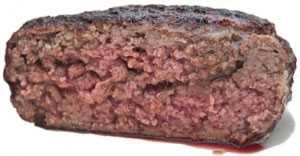
But if you must have red or pink burgers, either buy irradiated meat (it is sterile), or pasteurize it yourself: Food scientists say that if you dip a piece steak in boiling water (212°F) for 10 seconds before grinding it yourself, it is made safe. I have tried it, and although the exterior turns gray, it grinds well and makes fine flavorful rare patties.
Moral: Unless your meat has been sterilized, cook burgers to 160°F. Why take the risk? Also, remember to wear your seat belt, and no smoking in bed. Same thing.
Before you can post a comment or question you must sign into our commenting partner, Disqus. This is helps make sure everyone hanging around the grill is civil. We do not tolerate nastiness, racism, porn, inappropriate language, or attacks on others. All comments are the property of AmazingRibs.com and we reserve the right to quote them, edit them, delete them, and block people from making future comments.
Please leave comments and questions on the page devoted to the same subject so others can see them and our answers when they are reading about that subject. You must enable JavaScript to use the comments section, and you must accept cookies to post comments. Note that the software that runs Disqus is different from the Pitmaster Club so members need to sign into that separately.
Moderators