




In my article on how to make great steakhouse steaks I discuss the importance of getting a good sear on the exterior and how to do it best. Here are some offbeat methods that work amazingly well: The Afterburner Method, the Vigneron Method, the Caveman Method, and the Stripsteak Method.
The afterburner method
So I was doing some 3/4″ ribeyes the other night. I started some charcoal in a chimney to toss on my trusty Weber Kettle because I wanted max heat for that great dark whiskey colored exterior.
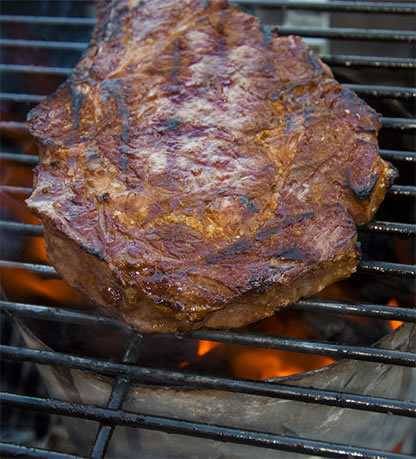
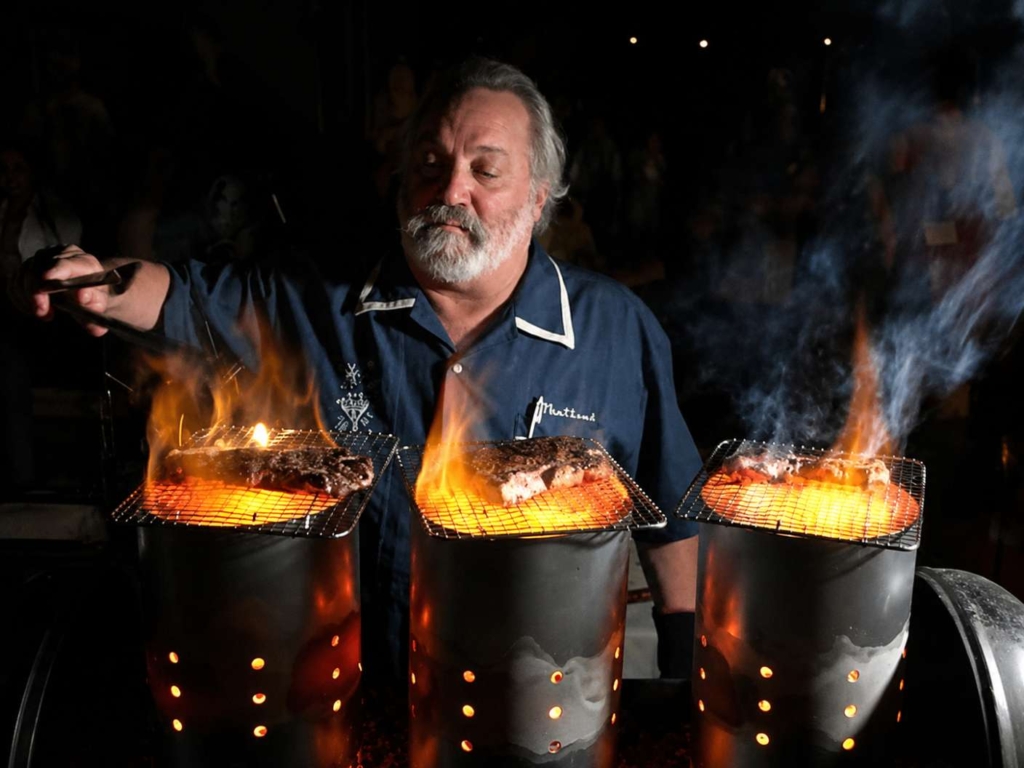
When I looked at the chimney and noticed it looked like the afterburner of a fighter jet. Big blue and red flames, hardly visible. So I put a cast iron frying pan on top and read the temp in the pan with an infrared laser thermometer. Almost 800°F! So I took the pan off, put a wire rack right on top of the chimney, and tossed the meat on. I now use this method for searing steaks cooked sous vide.
Perfect dead on sear, deep mahogany brown, in less than three minutes per side and cooked perfectly to medium rare in the center!
Above you can see me cooking some 3/4″ ribeyes on the afterburner. Thanks to Rob Lusk for the great photo, taken on steak night on the Pitmaster Club Meat-Up in the Bahamas in 2017.
Recently America’s Test Kitchen posted this improvement on the concept, they skewer the steaks so the practically levitate over the flame, solving a problem with my method: The hot grates often burn the surface of the meat.
Now keep in mind that cooking at Warp 10 is not right for all steaks. It works best only on steaks 1/2 to 3/4″ thick. It is ideal for skirt steaks for fajitas. Anything thicker and it will burn them before they cook the center. The secret is that it puts massive amounts of heat on one surface at a time and cooks it so quickly that the interior doesn’t get too hot. At lower temps the heat progresses through the surface to the interior, and by the time you have a good dark sear on the outside, the inside is overcooked. That’s the problem with fajitas. You have such a tasty piece of meat in the skirt steak, but the center is almost always grey. Nevermore.
A few tricks: You will need only half a chimney of charcoal. Make sure to salt the meat but don’t pepper it. The heat will carbonize the pepper and make it bitter. Make sure you pat the meat dry first otherwise it will steam the surface. In fact, if you want to paint the surface with a little oil, that will help crisp it even more. When the meat is on, move it around a bit because the wire grate can brand the meat with some serious black grill marks, too black. Just make sure you have all the side dishes cooked before you put on the meat because it cooks in about 2 to 3 minutes per side. For slightly thicker steaks, you can cover them with a metal bowl so the meat will cook from the top by convection.
A few skeptics on social media have expressed concern that the metals in the chimney could produce dangerous gases. Galvanized steel chimneys are coated with zinc which can create hazardous vapors under high temperatures. If your chimney is old and rusty, you probably burnt off most of the zinc starting fires. So it is likely safe as a grill, especially for the short 3 to 5 minutes it takes to sear a steak. But if you are shopping for a chimney, we recommend chimneys that are stainless steel like this or this or this folding model, or aluminized steel like the Weber Rapidfire.
Others say the flame can cause bitterness. Well you may have been taught this myth but it just plain doesn’t. I did this once for 500 chefs at a sous vide conference and they loved it.
Postscript: I’m a huge fan of the Food Network’s Alton Brown, and readers have pointed out that in a 2010 episode titled “Porterhouse Rules” he attempted to duplicate the extreme heat that steakhouses use to broil steaks with heat from above. He took a chimney, fired it up, lifted it, dusted off the grate, placed the steak on the grate, placed the chimney above the steak, cooked for 1 minute, flipped the steak and repeated. Well I tried this and, as AB warned, the steak got a light dusting of ash and a coal fell onto it. Sorry, AB, my method is better. I can flip the steaks often on top, and there is no ash.
The vigneron method
Then there is a method I call the vigneron method. I learned it when visiting wineries in Bordeaux, the French region that makes wine perfectly designed for steaks.
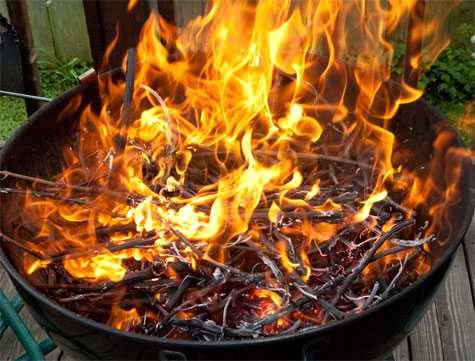
In the winter vineyard owners prune away most of the branches, called canes. They then have huge piles of grapevine wood, much about the thickness of a pencil. During the fall harvest season vignerons, grape growers, will take a big stack of dried canes, and set them on fire. They quickly burn down to a glowing mound, and the workers grill meats over the scorching hot embers. The flavor is exquisite. My hosts called this method sarment (pronounced sar-MOHN).
In many states in the US, grapevines abound wild in the woods and grow on fences along the roadside. You can harvest grape cuttings there. To insure a steady flow of grape wood, I planted five Himrod vines (the best green table grapes I have ever tasted). I get enough fruit for a few snacks and enough wood for about three cooks. I’ve also done this with twigs from my neighbor’s cherry tree. Of course he expects to be fed in exchange.
To start, I take out the bottom grate from my Weber Kettle and open the lower vents. I crumple two sheets of newspaper and put them in the bowl. Then I stuff as many dried vine prunings as I can fit on top of the paper, all the way to the level of the upper grate. On goes the top grate. I light the paper through the bottom vent holes, and the whole thing goes poof in about two minutes with very impressive 5′ flames. I once came close to melting the television cable running overhead.
But you don’t want to cook over those giant flames. I wait until I can no longer see yellow flame. Within a few minutes I have glowing white hot embers. You want to cook over those embers. They are gone in a hurry because the canes are about the size of kindling. There’s a window of about 15 minutes between the time the flames disappear and the embers go cold. Then I scrub the grate and on goes the meat. Here’s how I cooked a flank steak over grapevines for Bloomberg Business. To read the excellent article they did about AmazingRibs.com click here.
In France I had small butterflied quail over grape wood, but at home I completely blackened Cornish game hens when I tried it. The skin is too fatty. Even though they’re smaller than standard broiler chickens, they’re still too thick, so steer away from poultry. I now use this method primarily for flank steaks because they are about the right thickness, under 1″, and beef loves heat and smoke. I pat the surfaces dry so they don’t steam, and use only salt. Pepper just scorches. Never any marinades. They just steam the meat.
I leave the lid off, turn the meat every minute or less, and it’s usually done in less than 10 minutes. The burning fruitwood creates temps in the 800 to 1,000°F range and gives beef a fine flavor. That’s Warp 10, Mr. Spock. Enjoy this video of the method.
Caveman steaks
Here’s a showstopper. A bit of a parlor trick, but I know you will want to try it. Once you get your fire down to glowing embers, take a magazine and fan the coals so any loose ash is blown away.
Take a steak about 1″ thick, pat it really dry, salt it, and lay the meat right on the coals. You heard me. Right on the coals.
Surprisingly, when you turn it in about three minutes, there will be very little ash stuck to the meat, and it produces a very dark all-over sear in a hurry. But the operative words are very little ash. Every time I’ve tried it, small amounts of ash and even whole coals have stuck to the surface and there have been scorched dry spots. The ashes are easily brushed off, but I still can’t recommend this method. It is much better to place a wire rack on top of the coals or very close to them. Then you can check the meat, and there is less scorching and no ash. Live in the stone age if you wish, but know things are better in the iron age.
The Stripsteak method
In the Mandalay Bay Hotel in Las Vegas, Chef Michael Mina’s Stripsteak has a unique technique for reaching perfection on thick steaks.
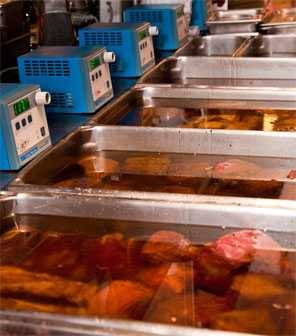
Stripsteak begins by immersing the meat in baths of clarified butter at about 120°F. This is a technique called sous vide. Clarified butter is unsalted butter that has had the water and milk solids removed. It is also called ghee. Click the link for info on how to make it.
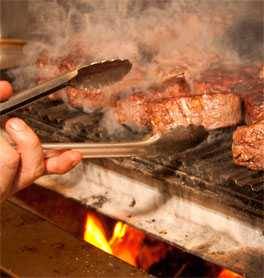
After about an hour the meat is an even 120°F throughout, and when an order comes in he lifts it gently from the butter, shakes a bit off, turns around, and lays it it on a screaming hot topless Santa Maria style grill burning mesquite logs.
After a few minutes and several turns, the meat comes off the grill a deep dark almost black, but never burned, and the center, as you can see, is perfect medium rare, about 130 to 135°F, with almost no color variation.
Interestingly, the butter does not penetrate much so the butter flavor is minimal. It does contribute to a deep brown nutty crust, however. The steaks are among the finest I’ve ever tasted.
Watch 5 minutes of me on WGN-TV cooking a skinny steak on the Afterburner and thick steaks with reverse sear. And they were perfect! Whew!

Before you can post a comment or question you must sign into our commenting partner, Disqus. This helps make sure everyone hanging around the grill is civil. We do not tolerate nastiness, racism, porn, inappropriate language, or attacks on others. All comments are the property of AmazingRibs.com and we reserve the right to quote them, edit them, delete them, and block people from making future comments.
Please leave comments and questions on the same page that is devoted to that subject so others can see questions and our answers when they are reading about the subject. You must enable JavaScript to use the comments section, and you must accept cookies to post comments. Note: the software that runs Disqus is different from the Pitmaster Club, so members need to sign into the Pitmaster Club separately.