




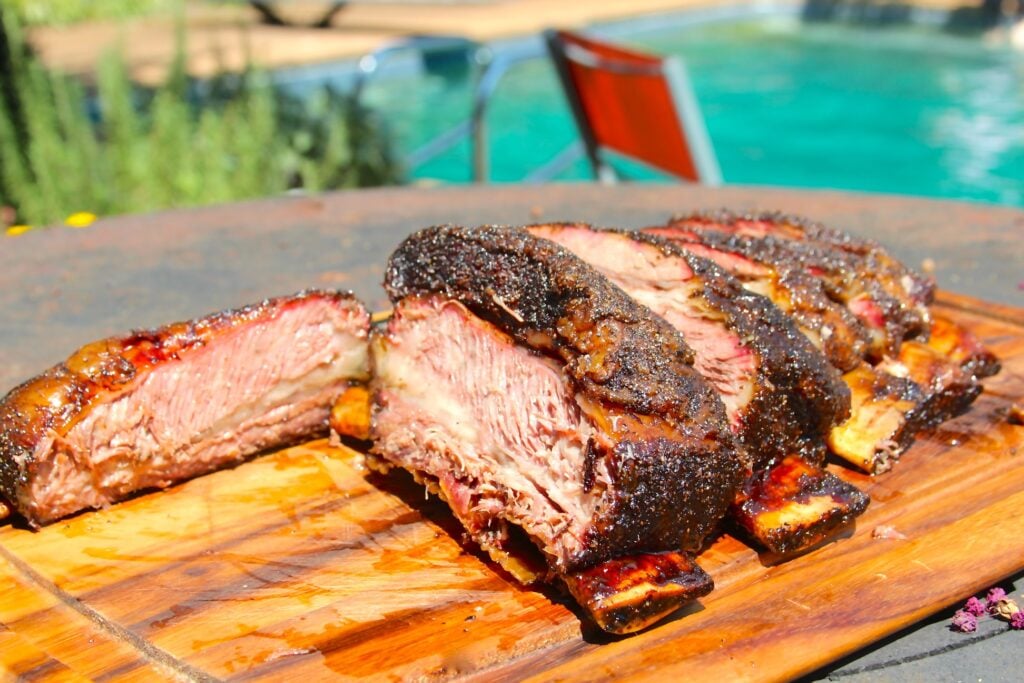
When I was a boy the most common form of beef I ate was beef ribs. Dad loved them because they were cheap and their Jurassic size was impressive. He cooked them on a hot grill and they were ready in about an hour. I remember them being sooooo fabulously beefy, and I sooooo loved gnawing on those bones. Problem was, the meat was sooooo chewy. But at the time I thought that was what all beef was like. But not all cuts are made equal. Read on to learn all about beef rib cuts. Or if you’re extra hungry, jump straight to our monster Texas beef ribs recipe!
Beef ribs, like pork ribs, are not so cheap anymore because more and more of us are onto them. But they are a lot cheaper than the meat they lie near, ribeye steaks. Like ribeyes, beef ribs are well-marbled with fat which is why they are rich in classic beef flavor. But these muscles get a lot more work so they are full of the connective tissue and sinew that make this scrumptious option almost unchewable unless prepared properly.
In addition, the chewy meat is attached to the bone by a tough, thick, leathery layer of connective tissue, and there is another leathery membrane on the bone side. As a result, beef ribs demand special strategies to tenderize and release all their flavor.
Hungry for more ribs recipes, tips, and techniques? Click here to download our ebook “Amazing Ribs Made Easy” $3.99 on Amazon (free Kindle app runs on all computers and devices). Or, get this book and others FREE as a member of the AmazingRibs.com Pitmaster Club. Click here to join.
Four paths to tenderness
This tough cut can be made tender and delicious by four different preps:
1) Barbecue them. When roasted low and slow with dry heat and a bit of wood smoke, you get a dark brown exterior, and flavorful, tender meat. Click here to learn how to make BBQ Beef Short Ribs Texas style.
2) Galbi (Kalbi) them. When the meat is cut thin, marinated, and grilled hot as they do in Korean Kalbi, you get relatively tender, powerfully tasty meat, with both beef and marinade mingling to perfection. Click here for my recipe for classic Korean Galbi from beef short ribs.
3) Braise them. When simmered low and slow in a flavorful liquid, as they do it in France, you get very juicy, very tender, flavor packed meat that has absorbed the richness of the braising liquid. In return, the meat has given up most of its innate essence to the greater good of the stew. Click here for my Braised Beef Short Ribs Provencal recipe. It’s a classic.
4) Tenderize them. First you sprinkle meat tenderizer, and then you pierce the flesh with a Jaccard meat tenderizer. The Jaccard has razor sharp blades that penetrate the meat and drive the tenderizer into it. This method results in very fine pieces of rare meat, very juicy and beefy, equivalent to $6-8 per pound meat or more. It also drives any E. Coli 0157H:7 on the surface down into the meat. These bad bugs from the gut of the animal get onto the surface of meat during the butchering process, and can get into the interior of the meat if you grind it or drive it in using the Jaccard. But they are killed if you cook the meat well done, to 160°F or higher.
Back ribs vs. short ribs
There are 13 ribs on each side of a steer, and the rib cage of a steer covers a lot of territory, from the backbone to the breastbone, perhaps 3 linear feet, and from the shoulder to the last rib, another 3 feet or more. So it matters a lot where the ribs come from.
You can buy beef ribs in large racks, like pork ribs, or more commonly small sections. A complete rack, usually from the 2nd to 10th rib, can have bones up to 18″ long, and is almost never sold as a whole at retail. Buying ribs is tricky so it is important you klnow what you are looking for.
There are two major sections, and they are very different: Back ribs and short ribs.
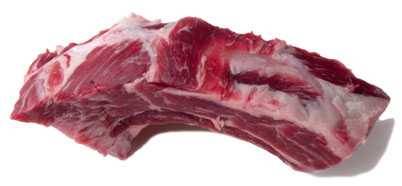
Back ribs: The meat is between the bones
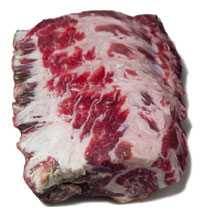
Back ribs are popular for barbecue, but I prefer shorties. The ribeye steak (above right) is among the most expensive cuts of beef, and that’s a back rib on the steak in the photo. The ribeye is a fabulous hunk of meat that is tender and juicy, in my humble opinion the best steak on the cow. Ribeyes lie in the dorsal area, on top of rib bones near the spine, towards the front of the animal, just behind the shoulder.
Ribeyes and are often sold boneless which leaves the back rib bones available for sale separately. The bones usually are 6-8″ long, slightly curved, with very little meat on top and a nice finger of meat between them. Why so little meat on top? Because it is so valuable the steaks are cut “to the quick” off the bone, leaving little meat behind. The bones often show through, and are called “shiners”. They usually come in sections of about seven bones.
Back ribs are good for braising because the marrow is a stupendous source of flavor for stews, and they are popular for barbecue, but they are not my favorite cut for barbecue because they have so little meat and they must be cooked to well done to be made tender.
They can be barbecued by following the same method as for short ribs. They will just cook faster.
Short ribs: The meat is on top of the bones
The best cuts of beef ribs comes from the lower, ventral, section, from the 2nd through 10th rib, roughly the same cut as the St. Louis cut of pork ribs. The muscle is the serratus ventralis and it has a lot of connective tissue as well as marbling which means big flavor. Although there are technically two different cuts, (chuck short ribs and short plate ribs) they both are similar and are commonly called “short ribs.” They are good for barbecue, kalbi, and braising. Shorties are my favorite cut for barbecue.
Chuck short ribs. Ribs 2 through 5 (4 bone sections) are meatier, well marbled, and they are called “chuck short ribs” (in butcher speak they are NAMP 130 in the US and Canada). The bones are almost straight, they typically run 6 to 8-inches long, and they have 1 to 2″ of meat on top. The meat is thicker on one side from near the shoulder. Brazilian steakhouses like to skewer the whole shortplate and rotisserie it. They then slice the meat off across the grain, parallel to the bone.
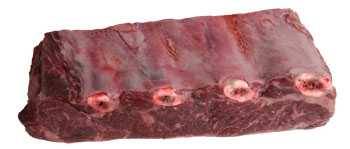
Short plate ribs. Ribs 6 through 8 (3 bone sections) have less meat on top but they run up to 12-inches long ( butcher speak they are NAMP 123A in the US and Canada). This cut is commonly called the “short plate ribs.” The short plate is located right in front of another inexpensive, chewy but flavorful cut, the flank steak, and just behind another favorite cut for barbecue, the brisket.
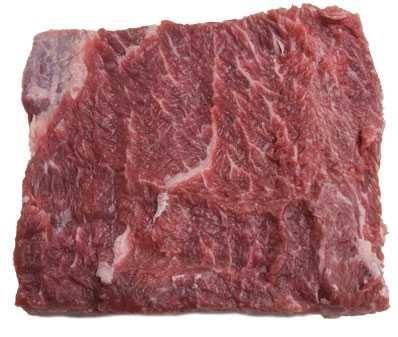
Short ribs are fabricated several ways:
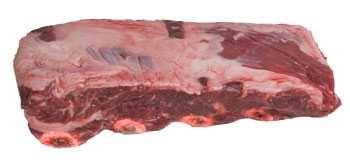
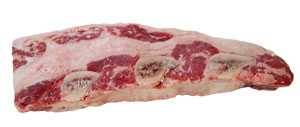
English Cut Short Ribs
Shown below, this is the most common cut. There are usually 4 bones about 3″ long, 7 to 8″ wide, and about 1″ to 2″ thick. They can be sold as a rack or as a package of individual ribs. Short ribs often have a layer of fat on top, although some butchers remove it. This is the way I like to buy them. You can see the thin leathery membrane which can be left on to help hold things together. It will get tough and nobody will eat it.
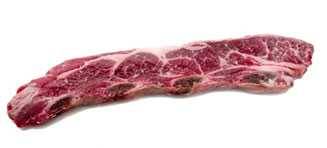
Flanken Cut Short Ribs
Flanken cut rib bones are typically only 1/2″ to 1″ long and they are popular in Asian and Mexican groceries. There is a lot of hard fat but the meat absorbs marinades well and is tasty if grilled. Try the Korean Kalbi marinade. This cut is also good braised. and I’ve even cut it off the bone and used it for stir fry.
Short Rib Riblets
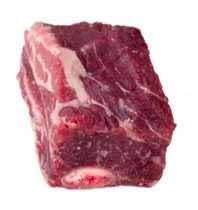
Often shorties are sold in individual bone sections ranging from 1″ to 6″ long. Here is a typical riblet, a section of a single bone about 2″ long and 1.5″ wide. These are very versatile and they’re great for braising, for slow cookers, for barbecue, and for Korean Kalbi. Just try to select a package with meaty hunks. Butchers usually try to hide sections that are mostly fat among the good ones.
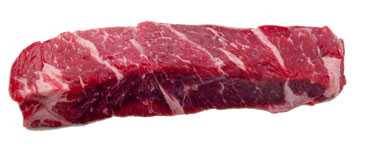
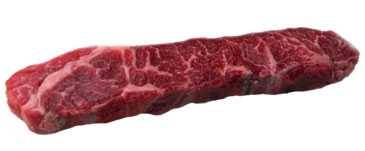
Boneless Short Ribs
You can occasionally buy boneless rib meat, but interestingly they are not cut off the bone, the come a little higher up tha animal’s side from a muscle called seratus ventralis. The cut on the left was about 1/2″ thick and 8″ long when I bought it. The cut at right was about 2″ thick and 8″ long. Both cuts work well on the grill but they can be tough at high temps. I recommend a Jaccard meat tenderizer.
Buying short ribs
Buying short ribs requires attentiveness. There are often 1/4″ thick veins of fat running through the muscle layers, so you need to inspect the package carefully. Butchers seem to like slipping a nasty one or two in each package like the section of flanken cut, pictured.
Beef grades
To further complicate things, there are several grades of beef, listed here in increasing quality and price: Select, choice, prime, and kobe (aka wagyu). The higher grades have a delicate web of fat threaded in with the muscle making the meat more tender, rich, and juicy. Click here for more info on beef grades.

Before you can post a comment or question you must sign into our commenting partner, Disqus. This helps make sure everyone hanging around the grill is civil. We do not tolerate nastiness, racism, porn, inappropriate language, or attacks on others. All comments are the property of AmazingRibs.com and we reserve the right to quote them, edit them, delete them, and block people from making future comments.
Please leave comments and questions on the same page that is devoted to that subject so others can see questions and our answers when they are reading about the subject. You must enable JavaScript to use the comments section, and you must accept cookies to post comments. Note: the software that runs Disqus is different from the Pitmaster Club, so members need to sign into the Pitmaster Club separately.