




What would we do without ketchup (or is it catsup)? We put it on burgers, we plunge French fries into it, and we make barbecue sauces from it. And really, when you think about it, most barbecue sauces are just a form of pumped up ketchup.
But historically ketchup did not always contain tomatoes! Tomatoes were native to Central America and the word ketchup probably came from Asia long before tomatoes made their way out of the New World. Some think the word came from ke-tsiap a Cantonese word that meant roughly “fish pickled in brine”. Others think it came from Indonesian kecap made of pickled fruits and vegetables. It contained no tomatoes and was probably more like soy sauce or Chinese fish sauce. Slather some of that on your burgers, bucko.
Much like canned anchovies and sardines, these sauces were loaded with amino acids that pack a lot of the savory umami flavors.
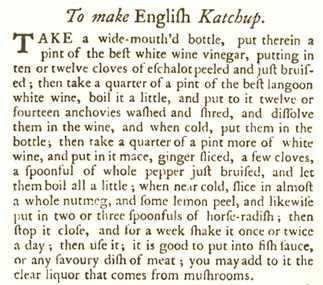
Eliza Smith’s recipe for “English Katchup” in The Compleat Housewife: Or, Accomplished Gentlewoman’s Companion may have been the first published when it appeared in England in 1727. It was also probably the first cookbook published in the US in 1742. It used white wine vinegar, shallots, anchovies, white wine, vinegar, pepper, lemon peel, horseradish, cloves, ginger, mace, and nutmeg (at right). It was used as an ingredient in fish sauce or meats.
Another recipe was published around the same time by Richard Bradley in “The Country Gentleman’s and Farmer’s Monthly Director.” It contained port wine, the juice of boiled mushrooms, mace, and cloves and was rally just a red wine sauce. Thin and translucent mushroom ketchups became quite common and popular.
In 1867 Mrs. A.P. Hill, a Georgia widow, published Mrs. Hill’s New Cook Book. It has recipes for several “catsups” that were used to flavor meats and other sauces. Her recipes included tomato catsup, pepper catsup, cucumber catsup, mushroom catsup, walnut catsup, lemon catsup, and a boozy pudding catsup that was made with nut liqueur, sherry, curaçao, and lemon peel. Now there’s a base for a barbecue sauce!
Heinz introduced its tomato ketchup in 1875 and its recipe has become a standard for all ketchups. An 1876 advertising slogan promoted it as “Blessed relief for Mother and the other women in the household!”
Today, by law, all American ketchups contain tomatoes, vinegar, sweeteners, salt, spices, and herbs. Yes, the definition of ketchup is defined in the Code of Federal Regulations, Title 21, Volume 2, Part 155, Section 194 (21CFR155.194). You can look it up.
And for the record, tomatoes, botanically, are fruits, not vegetables, even though, in 1981, under President Ronald Reagan, in a bureaucratic bumble, the USDA attempted to classify ketchup as a vegetable when served in school lunch programs. The whole thing blew up with a little help from the Democrats, especially after Reagan’s agriculture secretary, John Block, attempted to defend the new rules.
If you want to learn more, I recommend Andrew F. Smith’s book Pure Ketchup: A History of Americas National Condiment.
Although there are slight differences in flavor, Heinz and Hunt’s are interchangeable in my recipes. But if you want a treat, make my Zombie Blood homemade ketchup recipe. Rich, thick, sweet, spreadable, Zombie Blood is great on fries or sandwiches, especially burgers, or as a glaze on meatloaf. But it is not a clone of grocery store ketchup. It is made to my taste.


Homemade Ketchup Recipe
Rate this RecipeIngredients

Method
- Prep. Remove the stems, tips, green cores, and any black spots or discolorations from the tomatoes. Chop into 1/2" (1.3 cm) cubes. Chop the onions and mince or press the garlic.
- Cook. Mix everything together in a pot and simmer for 1 hour with the lid off so it will reduce and thicken. Stir periodically to keep it from burning.
- Strain. Force it through a food mill, chinois, or mesh strainer to remove the seeds and other solids. If you are using a mesh strainer, a ladle makes a good pusher. .
- Simmer. Put the ketchup back on a burner and simmer, lid off, until it is thick, like ketchup. Taste it and adjust any seasonings to your taste.
- Bottle it. Let cool then pour into a squeeze bottle, and chill. Keep refrigerated.



Why We Require You To Sign In Before You Can Post Comments
Before you can post a comment or question you must sign into our commenting partner, Disqus. This is helps make sure everyone hanging around the grill is civil. We do not tolerate nastiness, racism, porn, inappropriate language, or attacks on others. All comments are the property of AmazingRibs.com and we reserve the right to quote them, edit them, delete them, and block people from making future comments.
Please leave comments and questions on the page devoted to the same subject so others can see them and our answers when they are reading about that subject. You must enable JavaScript to use the comments section, and you must accept cookies to post comments. Note that the software that runs Disqus is different from the Pitmaster Club so members need to sign into that separately.
Moderators