



Salt is the single most important flavor enhancer of them all. Period. Just a small amount can really wake up a dish. This tiny water soluble rock required by your nervous system, reduces the taste of bitterness, balances sweetness, physically expands taste buds, alters protein so it can hold more moisture, inhibits microbial growth, and slightly tenderizes meats (see my article on brining). As we know, there are also health issues associated with its overuse. Salt is the magic rock.
Salt is a natural mineral, NaCl, a crystal made of one ion of sodium (Na) and one ion of chloride (Cl). There are many kinds of commercial salt, but all salt is sea salt. That’s right, all salt originally came from sea water which is about 4% saline containing about 1/4 pound per gallon.
Salt is so vital to society and health that the words salt, saline, and salary have the same root, the Latin word salarium which was the money paid to a Roman soldier to buy salt.
The different kinds of salt
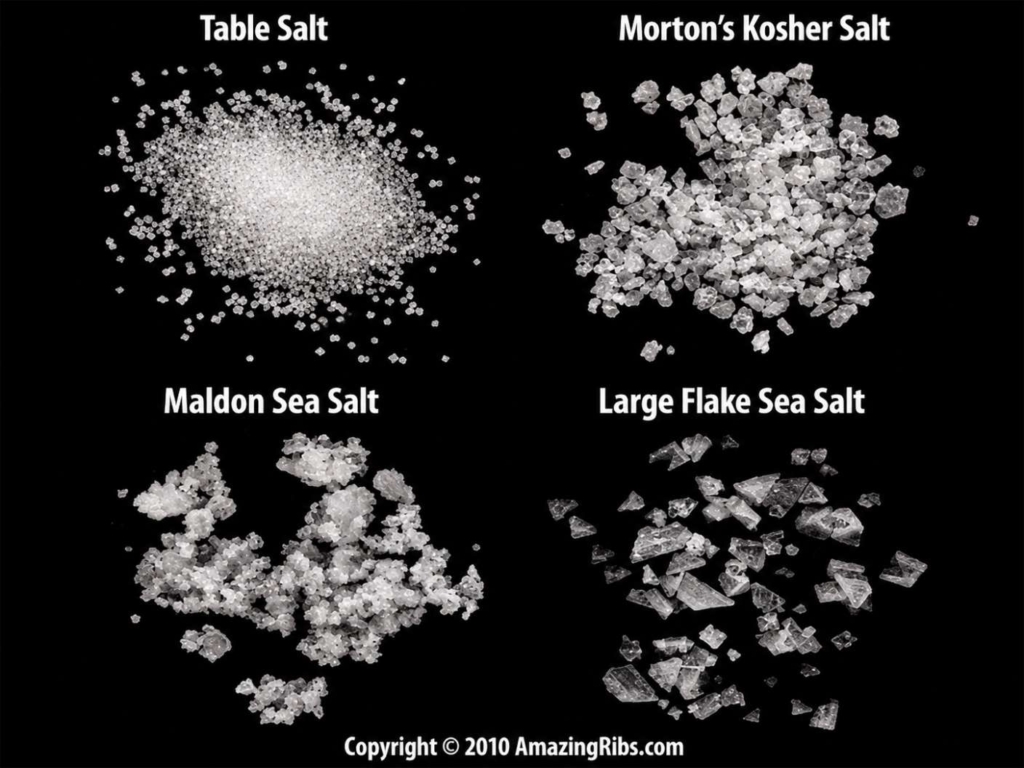
There are many types of salt, but when they are used in cooking it is impossible to taste the differences. But there is an important reason to pay attention: All salts are the same when you measure by weight, but most recipes measure salt by volume (teaspoons, tablespoons, cups, etc.) and this can cause a problem if you are not careful.
Recipe writers who don’t specify which salt to use are guilty of malpractice
Let me explain: One teaspoon of Morton table salt, which is made of small cubic shaped grains, contains less air than one teaspoon Morton Coarse Kosher Salt, which is a larger flake and has more air between the grains, or Maldon Sea Salt which is larger still. So if the recipe calls for a teaspoon (a volumetric measurement) of Morton Coarse Kosher Salt and you use a teaspoon of Morton table salt, the food will be saltier than it is supposed to be. If a recipe calls for kosher salt and doesn’t specify which brand it is a bad recipe because Diamond Crystal Kosher Salt has almost half the salinity or Morton Coarse Kosher Salt.
Most commercial salts are made by pumping water into underground salt beds deposited there in prehistoric times as oceans receded and dried out. The water dissolves the salt and makes a brine which is pumped to the surface and the water is evaporated. The evaporation process and what comes after determines the size and shape of the grains.
Table salt is sea salt that has usually been mined from salt deposits found underground. It is dissolved in water, refined and “purified” and ground into small uniform cube shaped grains. Anti-caking agents have been added so it works well in salt shakers. Some also also have iodine as an additive to help prevent iodine deficiency, a leading cause of mental retardation, thyroid problems, decreased fertility rate, and increased infant mortality. Not all table salt has iodine. Morton is by far the most common brand.
Kosher salt has slightly larger flake shaped grains than table salt and also has small amounts of anti-caking additive but no iodine. Many chefs prefer kosher salt because the larger grains make it easier to pinch. There are two popular producers of kosher salt, Morton, and Diamond Crystal. In order to make life easier on you and provide consistency from recipe to recipe, we have standardized on Morton coarse kosher salt. We like it because it is easy to pinch and sprinkle, because it doesn’t clump easily, and because it is in practically every grocery store. You cannot substitute Diamond Crystal because there is a difference in strength, or salinity, between them if you measure by volume. By weight, there is no difference. But because most homes do not have accurate digital scales capable of measuring in quantities of less than a teaspoon, we are sticking with volumetric measures for most things.
Pickling salt (a.k.a. canning salt) dissolves well in cold water so it is a good choice for brines. It lacks iodine and anti-caking additives, so it is the best choice for pickling. Some brands contain calcium chloride.
Sea salt. The aura surrounding sea salt is a bit of a scam. All salt comes from the sea, so all salt is sea salt. But in the marketplace nowadays, the term is usually used to describe salt that has been made by humans creating shallow ponds and allowing the water to evaporate. It does not just happen naturally. Usually the grains are large.
If you’ve noticed the rainbow colors on the water on the south shores of San Francisco Bay as you fly into SFO, you’re looking at salt drying ponds (below). Sun dried sea salt usually has minute amounts of minerals from the sea that can give it subtle flavors and colors ranging from pink to black. According to Castro and Huber’s, Marine Biology textbook sea salt usually contains sulphate, magnesium, calcium, potassium, bicarbonate, bromide, borate, strontium, and fluoride, in descending order. It can also contain other impurities including metals, pollution, fish poop, microbial spores, and even radioactive elements such as radium, uranium, and polonium. Whatever is in the sea. But what the heck, the label says it is “natural”. The kicker is that some “sea salt” is refined in a similar fashion to table salt.

Grain size can vary significantly from producer to producer, but large grains can provide pops of flavor when used at the table. But beware, large grains don’t dissolve easily and can feel gritty, even rocky, between your teeth. But in the same bag of large grains there can be fine powder. That is why I don’t use it in cooking. It is impossible to regulate quantities. I use it only as garnish at tableside. Sea salt can also be very expensive.
In taste tests there can be a slight difference when they are tasted straight, but when sprinkled on foods or mixed into sauces, the differences are impossible to detect. When pickling, however, the bacteria and trace elements can significantly alter the flavors. Often for the better.
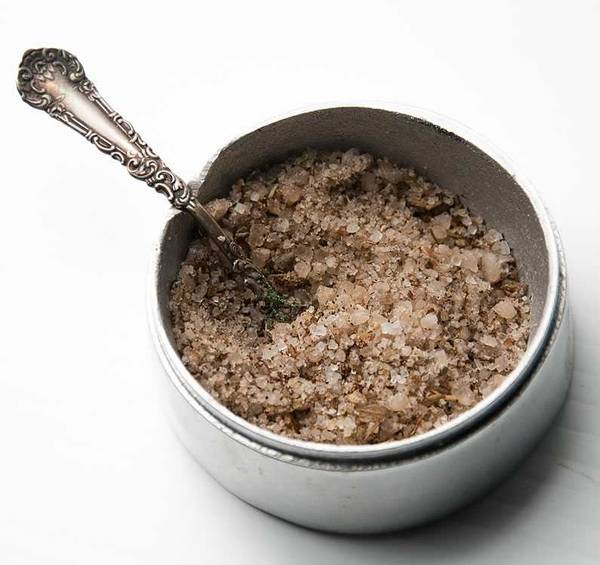
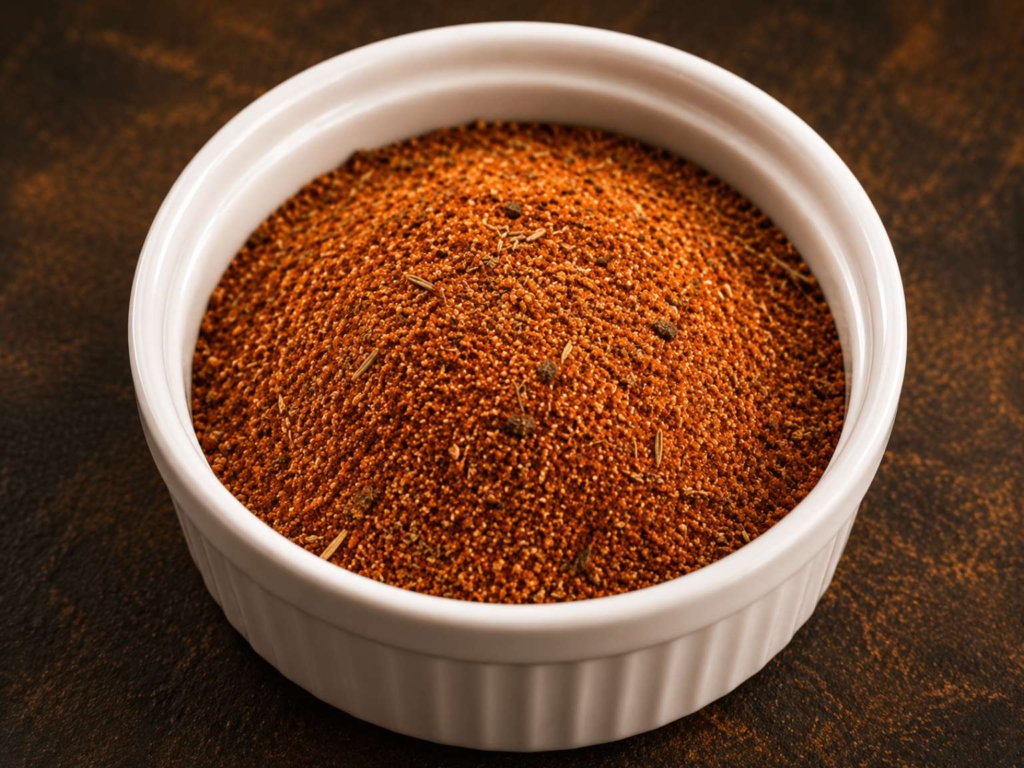
Seasoned salts. Grocery stores sell seasoned salts like garlic salt (approximately 3 parts salt to 1 part garlic powder) and celery salt. I never use them in cooking since I prefer to control the amount of all ingredients. That said, I make a seasoned salt with herbs and large grain salt and I place them on my dining table as a finishing salt. It is super on potatoes, pastas, veggies and other dishes. Click here for my recipe for Seasoned Salt.
Pickle salts. Another fun technique to make unique salts is to take pickle juices, dry them in a dehydrator or by just leaving them in a non-reactive pan to evaporate. Then scrape them up. You can use them like this, or grind them in a mortar and pestle, coffee grinder, or blender. Try making them from the juices left after you empty a jar of dill pickles, sauerkraut, pickled mushrooms, pickled peppers, onions, whatever you can find!
Curing salts
Curing salts should never be used to season food in the cooking process or at the table. Curing salts were created centuries ago, before refrigeration, as a method of preserving meats such as bacon, hams, and corned beef. They all contain salt and nitrite, and some contain both nitrite and nitrate. Both these preservatives are very effective against the deadly botulism bug, a common problem with improperly cured meats. Most curing salts are colored pink with a small amount of red dye so you don’t confuse them with table salt. The small quantities used in curing meats is harmless, but in large quantities can be lethal. Pink salts must be stored where children cannot get at them. Pink curing salts are not the same as pink Himalayan rock salt which is pure salt from Pakistan with trace elements that give it the pink color!
You can skip the curing salts and just replace them with table salt, but I strongly recommend that you do not. The meat will taste pretty much the same, but it will be tan in color and you will need to smoke it at more than 200°F and keep it refrigerated or frozen. A lot of people fear nitrites and nitrates based on research that has been contested. Click here for more info on nitrites and nitrates.
Some important words of caution. Curing meat is not like any other recipe. It is not like brining a turkey or chicken for a few hours. Please read my article on the science of curing meats.
Prague powder #1 or Insta Cure #1 or Pink curing salt #1 or Sure Cure. This is the standard for quick curing meats. It is mostly plain old sodium chloride with approximately 6.25% sodium nitrite with some anticaking agents and a touch of red dye that makes it pink so you won’t mistake it for table salt or sugar. It’s not easy to find this stuff in groceries, but butcher shops, sporting goods stores where they sell sausage making gear, and this link to Amazon.com
Prague powder #2 or Pink curing salt #2. This has 6.25% sodium nitirite, 4% sodium nitrate, and the rest is plain old sodium chloride with some anticaking agents and red dye. The exact precentages may vary from manufacturer to manufacturer. It is usually used in sausages and other meats that will be kept for weeks or months. The nitrate breaks down into nitrite with time so it remains active over months.Like a time-release capsule. It is used to extend shelf life. It is mostly used for long warmer cures, like the dry cures used to make prosciutto and country hams.
Insta Cure #2 has only about 1% nitrate.
Saltpeter. Another name for potassium nitrate, saltpeter was once used extensively in curing meats. It has been replaced by curing salts. It cannot be used as a substitute for curing salts in any of my recipes.
Morton Tender Quick contains 0.5% sodium nitrate and 0.5% sodium nitrite, and anticaking agents. Despite the misleading name, it is a curing salt and is not a tenderizer.
Readycure is common in Canada and it is only 1% nitrite, so it is not a good substitute for curing salts that are typically 6% nitrite.
Brines
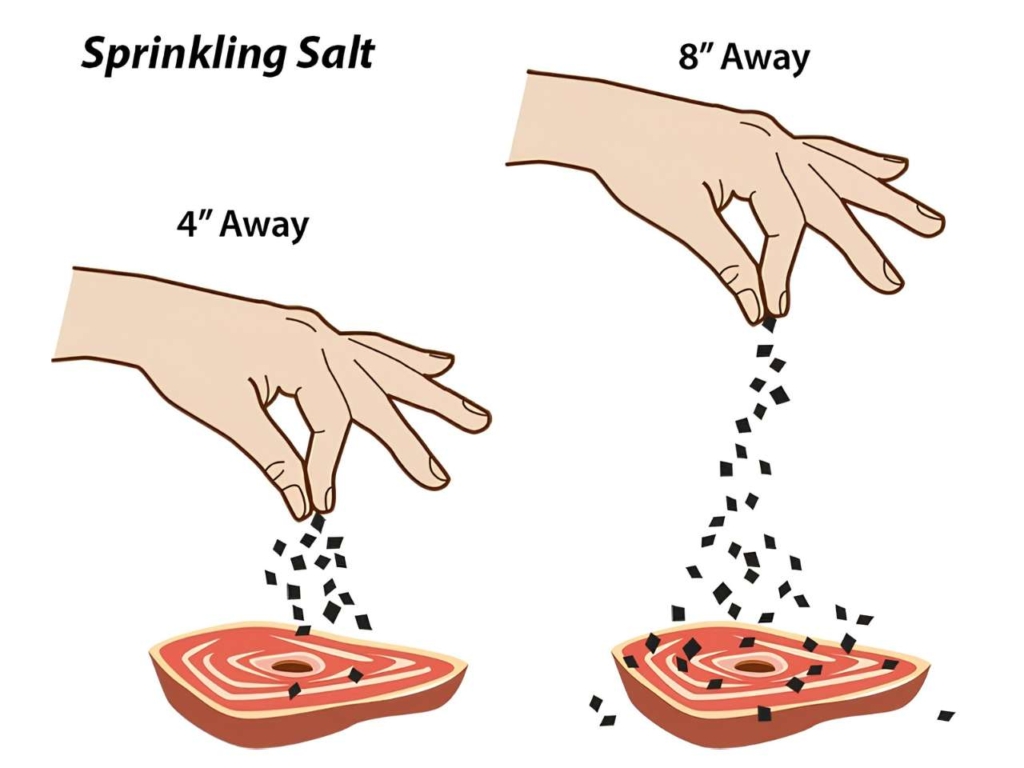
Dry brine. Sprinkle the meat with about 1/2 teaspoon of kosher salt per trimmed pound, wrap in plastic wrap to keep other foods from contacting meat juices, and refrigerate for 2 to 12 hours depending on thickness.
Basic wet brine. Add one cup of hot water to a two cup measuring cup. Then pour in salt, any salt, until the water line reaches 1.5 cups. Add this to 1 gallon of cold water. Produces a 6.3% brine.
- 1/2″ thick meat should be brined for about 1/2 hour in the refrigerator
- 1″ thick meat should be brined for about 1 hour in the refrigerator
- 2″ thick meat should be brined for about 4 hours in the refrigerator
- 3″ thick meat should be brined for about 12 hours in the refrigerator
Briners beware of double salt jeopardy!
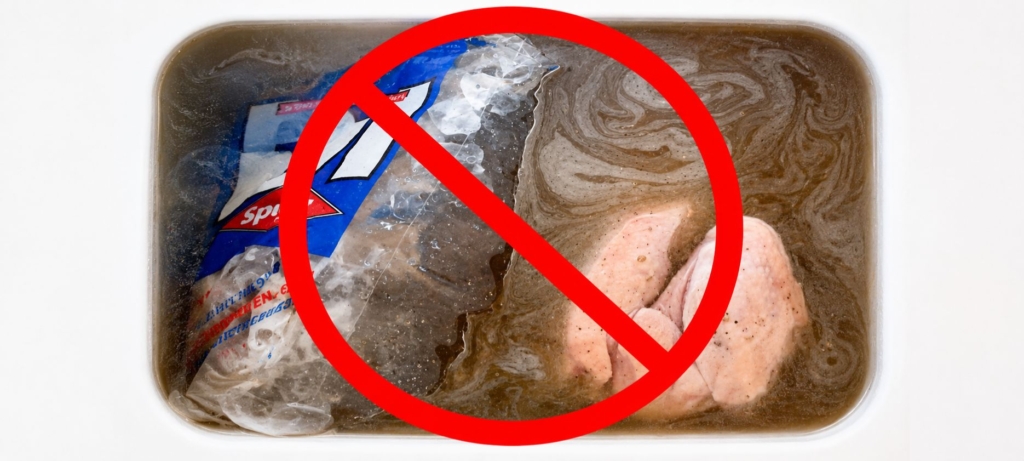
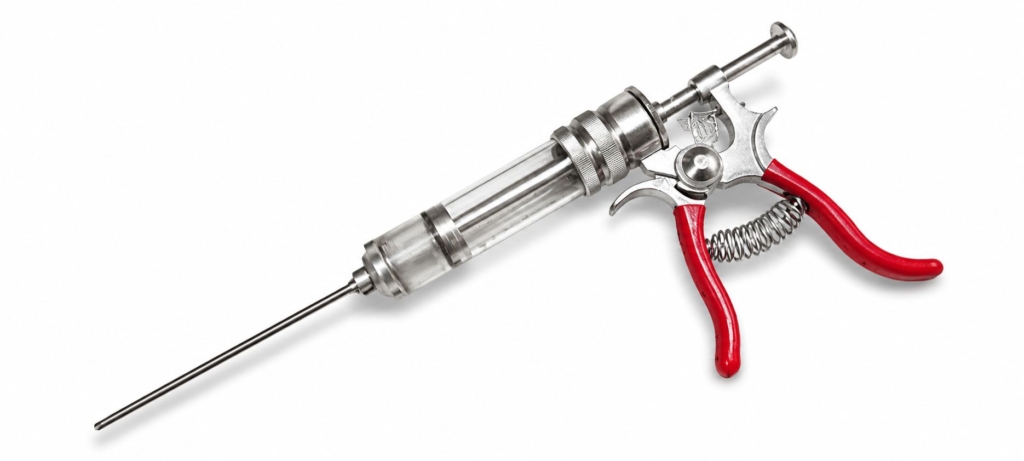
Rubs are a great way to add flavor to meat. Brines are also a great way to add flavor as well as moisture. Rubs often contain a lot of salt. You can use both a rub and a brine, but beware of double salt jeopardy. If you use a brine and then a rub, you should make your own rub mix and leave the salt out of the blend. A salty rub on top of brined meat can make the meat unbearably salty. Never brine meat that is labeled “enhanced” or “flavor enhanced” or “self-basting” or “basted” because they have been injected with a salt solution. Remember, you can always add salt, but there’s no taking it away.
Adding salt to pasta and potatoes
It is common to add salt when cooking pasta or potatoes and many other foods. If you add the salt while the water is cold it can sink to the bottom and cause pitting. All-Clad and other manufacturers recommend adding the salt after the water is boiling.
Measuring different salts
You need to be aware of which type of salt you are using when you follow a recipe that measures by volume because the grain size can make huge difference on the amount of sodium, i.e. saltiness or salinity. For example, one teaspoon of table salt, which is made of small cubic shaped grains, contains less air than one teaspoon kosher salt, which is a larger flake and has more air between the grains. So if the recipe calls for a teaspoon (a volumetric measurement) of Morton coarse kosher salt and you use a teaspoon of table salt, the food will be almost twice as salty. And believe it or not, Morton coarse kosher salt has a higher salinity than Diamond Crystal kosher salt, almost twice as much! Now I ask you, is that kosher?
If a recipe calls for salt by weight, let’s say eight ounces, it doesn’t matter which salt you use, the volume may be different, but the amount of sodium will be the same! For this reason, it is far better to measure salt (as well as sugar and flour) by weight rather than volume. If I knew that every kitchen had a good digital scale I would switch to salt by weight in all my recipes in an instant. So get a scale! I use the OXO Good Grips Stainless Food Scale with Pull-Out Display.
The AmazingRibs.com Salt Converter ©
Here's a conversion table for when you are measuring salt by volume. Where it says "Salt Amount by Volume" just enter the units of salt in the recipe whether they are teaspoons or cups or whatever (not weights). Then select the type of salt the recipe calls for and you will see the ratio for all the other salts you might have on hand.
Calculations
Information
- Remember, these are conversions only if you are measuring by volume such as teaspoons or cups. If you weigh any of these salts the sodium content is the same if the weight is the same regardless of which salt you use.
- 1 cup of table salt weighs 9.6 ounces.
- Within a box of salt there is some slight variation. Larger crystals tend to float to the top like Macadamia nuts floating to the top of a jar of mixed nuts.
- There is also variation from batch to batch from the manufacturer.
- Measuring spoons are often inaccurate and measuring ups depend on your eye. The oceans are about 3.5% salt.
© 2016 by AmazingRibs.com.
Some useful weights
Morton coarse kosher salt (our default) weighs about 8.13 ounces per cup so round it off to 1/2 pound per cup.
Morton table salt weighs about 11/17 ounces per cup so round it up to 3/4 pound per cup.
Salt is not evil
I know that a lot of health experts are taking potshots at salt because it makes food taste better and can entice us to eat too much. I know that many of us have been told to limit salt intake because it can raise your blood pressure, but before you swear off the stuff and start posting the “you idiot” comments below, know this:
Salt is vital to all living things. It is called an “essential nutrient” for humans, which means that our bodies do not make it, so all our salt must be ingested. From the Mayo clinic: “Your body needs some sodium to function properly because it: Helps maintain the right balance of fluids in your body; Helps transmit nerve impulses; Influences the contraction and relaxation of muscles.”
When dissolved in water, salt conducts electricity and it is essential for aiding the transmission of signals along your nervous system and in your brain. It also regulates the amount of water in all your millions of cells. On average we all have about seven tablespoons of salt in our systems. That’s why all your bodily fluids are salty: Blood, sweat, and tears.
Salt is also a preservative and antimicrobial, which is why so many meats and vegetables were brined, pickled, or packed in salt before refrigeration. Think prosciutto and corned beef. Salt raises the temperature at which water boils and lowers the temp at which it freezes, and it is also a heckuva stain remover.
On the flip side, too much salt in your diet can increase the blood pressure of some people (but many people are not impacted), a condition that has been implicated in cardiovascular disease. Because of this, there are a lot of people worried that we consume too much salt, especially because prepared foods like frozen dinners and fast food from restaurants have a lot added. But the correct amount of salt consumption is still not known, varies from person to person, and its impact on our health is still being explored.
In 2013 an expert committee, organized by the Institute of Medicine at the request of the Centers for Disease Control and Prevention, studied the research, especially recent research, and reported that there is no reason to aim for sodium levels below 2,300 milligrams a day (about 1/10 an ounce) as some doctors recommend. In fact, the group said low sodium diets may be as risky as high sodium diets, although it would be hard to avoid enough salt to endanger yourself. Click here to read an analysis of the report in the New York Times, and click here to read the original report. In addition, my article on undertanding what you read about diet and health might be helpful.
If you remain worried about too much salt in your diet, the secret is to control it yourself. The secret is to cook! Buy unprocessed foods and season them yourself. If you avoided fast foods and processed foods, you will never have to worry about too much salt in your diet.
We recommend about 1/2 teaspoon of Morton Coarse Kosher Salt per pound of meat. That’s equivalent to 1/4 teaspoon of table salt. Table salt weights 5.69 grams per teaspoon. But most of us don’t eat a whole pound of meat. Say you eat 1/2 pound of salted meat, that’s 1/8 teaspoon of table salt which is about 40% sodium, or 284 milligrams of sodium. If the recommended daily intake is 2,300 mg, that is about 12% of your recommended daily intake.
Other cool things about salt
Salt reduces the sensation of bitterness in foods. Test it by adding 1 teaspoon Morton Coarse Kosher Salt to three tablespoons coffee grounds.
Coarse salt with a little water makes a gritty paste that can be used to clean cast iron and carbon steel pans.
Soak stained clothes in a salty bath. It can often remove wine, blood, grass stains, even sweat stains. Often, not always. For wine, dilute the spill with lots of water, then coat it with a thick layer of salt and let it sit for 20 minutes. Rinse and repeat.
When making whipped cream or meringues, a pinch of salt whips up quicker and higher.
Did you know
There is a salt museum in Hutchinson KS and they have mine tours?




Before you can post a comment or question you must sign into our commenting partner, Disqus. This helps make sure everyone hanging around the grill is civil. We do not tolerate nastiness, racism, porn, inappropriate language, or attacks on others. All comments are the property of AmazingRibs.com and we reserve the right to quote them, edit them, delete them, and block people from making future comments.
Please leave comments and questions on the same page that is devoted to that subject so others can see questions and our answers when they are reading about the subject. You must enable JavaScript to use the comments section, and you must accept cookies to post comments. Note: the software that runs Disqus is different from the Pitmaster Club, so members need to sign into the Pitmaster Club separately.