



There are few BBQ or grilling main courses that command more attention than this one. Now learn how to smoke a whole hog the way the pros do it!
But before you commit to smoking a whole hog, keep this in mind: It is a lot of work. If you screw up you are embarrassed in front of a large crowd, and it is easy to screw up. But most importantly, keep in mind that this is not the best way to cook pork. There are lean tender muscles like the loin and tenderloin that are best at about 145°F (62.8°C), and tough sinewy knots of muscles like the shoulders and hams that won’t get tender until they hit 200°F (93.3°C) or so. What you end up doing is cooking everything to the higher number and then shredding it, dousing it with sauce, mix in some crunchy skin, and have a massive pile of pulled pork.
The best way to cook pork is to break the animal down into individual cuts just like your butcher does: Shoulder (make Perfect Pulled Pork), ribs (make Last Meal Ribs), loin (stuff them or make chops), tenderloin (make Sweet & Sour Pork On The Grill), hams (smoke ’em), belly (make Maple Bacon), skin (make Cracklins), cheeks (cure them for guanciale), scraps (make Italian Sausage), and bones (roast them to make soup and stock).
But when it comes to whole hog, there is no place that takes it as seriously as the folks in the Carolinas. When you order “barbecue” in the eastern parts of North or South Carolina, you are usually ordering chopped meat from a whole hog, and many joints in the Southeast feature a “Pig Pickin'”, a sumptuous buffet featuring a whole hog on display. You just sidle up to the table and pluck off whatever you want. When lunch is over, there is nothing but a few bones. Even the skin is gone because, when it is cooked the way I describe below, fabulously crisp “cracklins” become an essential part of the feast.
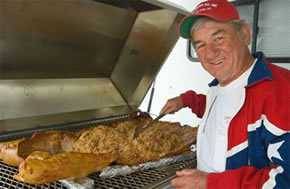
Hog roasting is a time consuming meticulous process that requires vigilance and more than one person. But there is no meal you can serve that is more impressive. And if you don’t want to cook a monster hog, you can cook a suckling pig. I describe the methods below.
The pit
If you want to serve a whole hog, you have several options:
1) Hire a pro
2) Get a portable pit from a rent-all service
3) Borrow a pit
4) Buy a pit
5) Build a pit
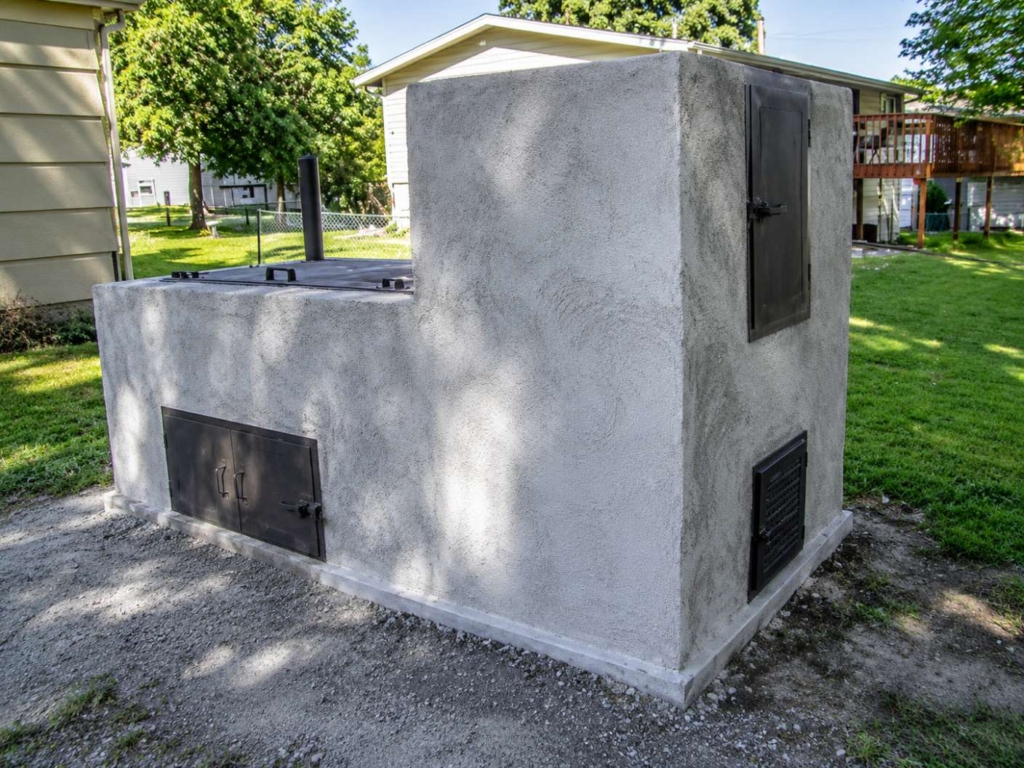
Nowadays most caterers and restaurants use specialized cookers for hogs, but a handful of old timers like Skylight Inn in Ayden, NC, and Jackie Hite’s Bar-B-Q in Batesburg-Leesville, SC, still do it old school, on concrete block pits, with log embers for heat. You can do it old school too for very little money. Just click here and follow my design for an old school hog pit (and see a picture of Jackie Hite and his pits).
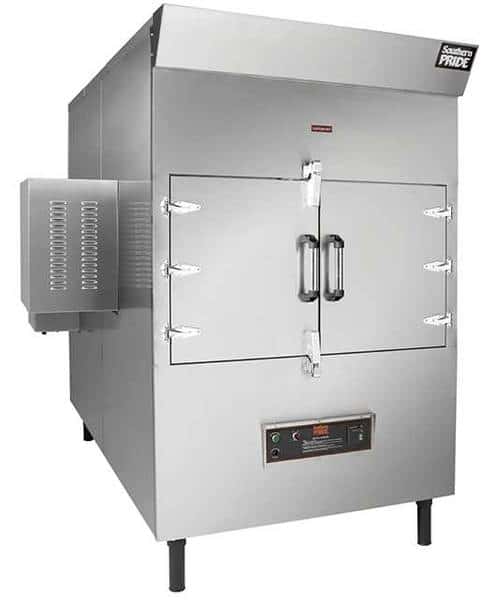
If you rent a pit, consider gas. Gas pits are really easy to control, and you can still add wood for smoke. Charcoal and wood require non-stop vigilance.
Why hog cooking is tricky
Ask people if they’ve ever had roast pig and, if they have, their response usually is “Feh. Nothing special.” That’s because it was not cooked properly. And cooking it properly is tricky. But you can pull it off with some planning, some help, and my instructions.
The challenge with whole hog is that there are so many muscles of different thickness with different degrees of fat, sinew, and collagen. The hams, the large rump muscles on the rear legs are the thickest and most dense muscle group. They are best when smoked to about 145°F (62.8°C) and sliced. The shoulders are slightly less thick, and they have large fatty deposits within. They are best when cooked to about 203°F (95°C) and shredded. The loins are lean and tender, not nearly so thick, and they are best at about 145°F (62.8°C). Tenderloins, thin tubes of the most tender meat on the hog, are also best at about 145°F (62.8°C). The curved ribs are on top of the loins, and they are heavy with fat and collagen and connective tissue. They’re best at about 190°F (87.8°C). The bacon is mostly fat and it can go to 200°F (93.3°C). To make matters worse, there is a lot of sinew, globs of fat, chewy membrane and silverskin that can seriously get in the way.
It is impossible to hit all these numbers so you must compromise, but there are tricks to get everything tender and juicy.
Cooking times at 250°F (121.1°C)
Cook low and slow. Normally I tell readers to cook most foods at 225°F (107.2°C) and to learn how to peg their cookers at that temp, but if you don’t crank the temp up a bit a hog can take forever. So we’ll take it up to 250°F (121.1°C) or so. That’s the temp recommended by the late Mike “The Legend” Mills of 17th Street BBQ in Murphysboro, IL, a whole hog whisperer. Don’t worry, it won’t dry out. There’s lots of fat in there to keep things lubricated and sealed.
At that temp, here’s how long it should take. Approximately. Give or take an hour. Maybe. Hopefully. The pig is ready when the pig is ready. The pig is in control, not you. The pig abides. Remember, the cooking time depends on the thickness of the meat, not the weight, but since thickness is related to weight, we go by weight. Plan on these times, and if piggy is ready early you can shut down the heat on the pit and hold it there for an hour or two safely.
40 pounds (18.1 kg), gutted, head on: 3.5 hours
75 pounds (34 kg): 9 hours
100 pounds (45.4 kg): 12 hours
125 pounds (56.7 kg): 15 hours
150 pounds (68 kg): 18 hours
175 pounds (79.4 kg): 21 hours
200 pounds (90.7 kg): 24 hours
Approximate timetable for a 75 pound (34 kg) dressed hog
The day before. Build the pit, or clean your pit if you already have one. Pick up the hog and keep it chilled.
A week or two before. Order the hog.
6:00 a.m. Dress and clean the hog, inject and season, prep it for the pit. Fire up the pit. Aim for 250°F (121.1°C). Drink some strong coffee as you work.
8 a.m. Find an assistant/pigsitter and move the pig to the pit, skin side up. Remember to remove the pit lid before hoisting the hog. Monitor pit temp closely, add lit charcoal if the temp is declining. Have a mimosa.
9:00 a.m. through 2 p.m. Monitor pit temp closely, add lit charcoal if the temp is declining and check to make sure dinner isn’t burning. Switch to beer at 12:01.
10:00 a.m. Remove the foil from the ears and tail.
2:00 p.m. 6 hours into the cook, check the meat temp, and with some help, flip it skin side down if it is ready. Have a beer.
4:00 p.m. 8 hours into the cook, check the meat temp, paint the entire cavity with one coat of your favorite barbecue sauce. Have a beer.
4:30 p.m. One more coat of sauce. Have a beer.
5:00 p.m. 9 hours in, check the meat temp, remove the hog if it is ready, and serve dinner! Have a beer.
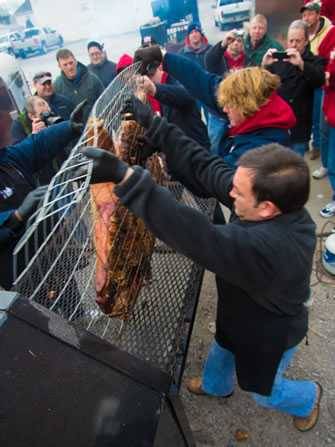
Want to learn more? Take a class and see how the top pros do it.
Amy Mills runs OnCue, a consulting service for barbecue restaurants, and her Dad is Mike “The Legend” Mills. They conduct an annual two-day “Whole Hog Extravaganza” at the family restaurant, 17th Street BBQ in Murphysboro, IL, about two hours east of St. Louis. The year I attended they had a luminous faculty: Sam Jones of Skylight Inn in Ayden, NC; Brad Orrison of The Shed Barbecue & Blues Joint in Ocean Springs, MS; John Delpha of The Belted Cow Barbecue Bistro & Grill (CLOSED) in Essex Junction, VT; as well as The Legend himself. Many of the photos on this page are from that event.
So the cattle wouldn’t feel slighted, they had three cooks demo their brisket techniques: Wayne Meller of Louie Mueller Barbecue in Taylor, TX; Barry Sorkin of Smoque BBQ in Chicago; and Mills.
Many of the photos on this page were taken at the Whole Hog Extravaganza. Best of all, we got to eat the demonstration hogs and briskets! Click here for more photos of the event.
Video: Here’s how Sam Jones does it in North Carolina
Video: Here’s the whole process in a video from Hungary
Suckling pig: Small enough for your grill
So you don’t have 50 friends or a place to build a pit? You can still do a pig roast and create magical meat with a young pig. Technically suckling pigs have not been weaned are less than two months old, weigh less than 25 pounds (11.1 kg), but butchers call anything under 50 pounds (22.7 kg) a suckling. The muscles haven’t toughened yet, and the milk-fed meat is melt in your mouth. There is much less fat in proportion to muscle although the fat can be somewhat reminiscent of an aged brie, a bit funky for some.
The procedure is pretty much the same as for an adult hog. If you wish, you can lay the little critter on its side for roasting and stuff the cavity with fresh herbs, garlic, onion, and citrus rather than a spice rub.
You must cook with indirect heat or you will burn the skin and get to meet the fire department. Cook at 225°F (107.2°C) until the temp in the deep center of the hams is only 145°F (62.8°C). You don’t need to cook it hotter because the muscles and sinew haven’t gotten tough. Depending on the thickness, it could be done in four hours or less.
I’ve been known to serve this meal cave man style. No knives and forks. Just fingers and plenty of paper towels. Flesh fest.
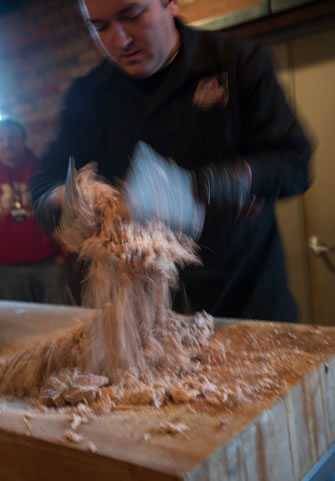
Skylight Inn style hog
Sam Jones’ family has been doing it pretty much the same way since 1830. He starts with a 160 to 180 pound (72.6 to 81.6 kg) hog, a weight that he feels has the best fat-to-meat ratio and produces his ideal yield of finished meat and optimum juiciness.
He just salts the meat liberally, flips it, wets the skin with water, salts it some more, and puts it on the pits, about 2′ (61 cm) above the bottom, skin side up with oak coals pushed off to the sides, never under the meat. Wetting and salting the skin makes it blister and easier to chew. You don’t get shiny showy skin, but the skin is scrumptious.
The hogs go on at about 4 p.m. at about 275°F (135°C) and he and his staff tend them closely til midnight adding coals as needed. They then cruise unattended, while the temp declines slowly, til 6 a.m., get flipped, and come off around 2 p.m., 22 hours after going on.
He seasons it when it comes off the pits with a gentle hand using nothing more than salt, pepper, Texas Pete Hot Sauce, and cider vinegar. No fancy rubs, brines, mops, marinades, or sauces. Then he chops it fine, mixes in some chopped crunchy skin (which he call’s “God’s natural potato chip”), and serves it on a bun on top of hashed slaw, or on a paper boat with another boat of slaw and a thin slab of cornbread. That’s his entire menu. Pure Americana, man. Tastes like history. As he says “It is what it ain’t”.

Competition style hog
The Memphis Barbecue Network (MBN) sanctions a number of competitions, the largest and grandest being Memphis in May with hundreds of teams smoking it out in three categories: Pork ribs, shoulder, and whole hog.
When learning how to cook a whole hog for competition, realize that special attention must be paid to many of the different sections of the hog. Whole hog cooks must present the judges with a showy animal and then serve them tastes of the hams, shoulders, and loins. It is here that cooks demonstrate the most impressive range of hog cooking styles imaginable, and showmanship.
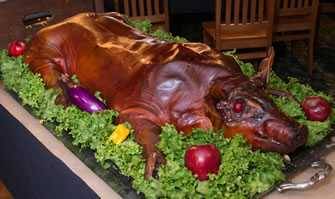
Some cook the hog on its back, butterflied flat or cupped “boat style”, some sit the hog on its haunches, some lie the animal on its stomach, and a few cook “running style” – standing up – the most impressive display.
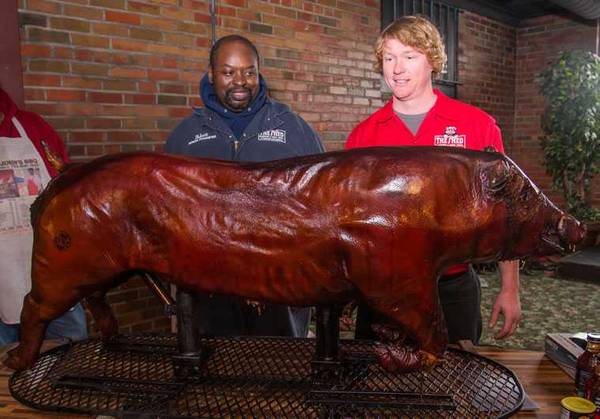
Brad Orrison’s team from The Shed BBQ & Blues Joint restaurants in Ocean Springs, MS, Gulfport, MS, and Mobile, AL, produce a magnificent specimen, running style, shown at the top of this page. Pitmaster Hobson Cherry expends serious time and energy to get the back straight and make the mahogany critter look as if it is heading somewhere, which I suppose it is. They even have a stainless steel armature that they have built allowing them to adjust the back, head, height, etc. This method means a little less bark because the inside is shielded by the side flaps, and the skin is not very chewable, but she is a beauty! That’s Cherry on the left, Orrison on the right, and the gal in the middle is Dinner.
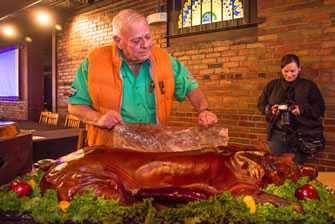
To serve, they use a razor blade knife to remove a square of skin on their side of the table and reach in to pull out the loins, shoulder meat, ham meat, ribs, etc. That keeps one side showy. Here she is about 30 minutes later.
For catering events, Mills flips a 150 pound (68 kg) animal on its belly and presses it into a squat, head up, legs pointing forward, similar to the way a dog lies in the “down” position. This gets more heat into the cavity and creates a better bark, Sections of wire coat hangar hold the ears up, and balls of foil hold the flaps of side skin out so she looks nice and plump.
The whole upper body is wrapped in foil to prevent the skin from burning. After about six hours at 250°F (121.1°C) the foil is removed so the skin is exposed and it takes another two to four hours to finish. To serve, he also cuts a window along the spine above the loins and reaches in from there.
Whole Hog Chinese style
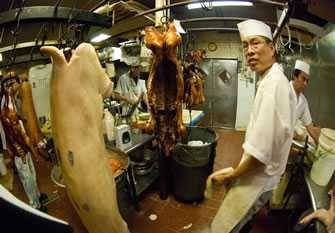
Many Chinese cooks roast their hogs by hanging them by the rear legs in their large cylindrical ovens shown in my article on Chinatown Char Siu Ribs. Here is the kitchen of Sun Wah BBQ on Chicago.
Porchetta: Whole hog Italian style
Across Italy, they make some of the tastiest pork you can imagine, called porchetta. The concept goes back to the Roman Empire and it is sold everywhere from white tablecloth restaurants to street vendors.
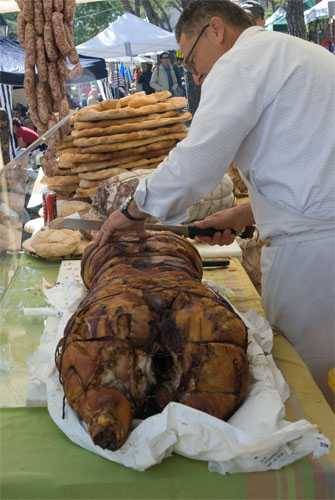
If you want to learn how to cook a whole hog this way, it is worth noting that they make it a little differently in each region. In the areas around Rome, porchetta is usually made from a whole hog, with the torso gutted and deboned and then stuffed with herbs, tongue, heart, liver, and kidneys. It is then stitched up like a giant football, and cooked on a rotisserie in a wood-burning stove over a pan that collects the juices which are used for basting. The skin is left on encasing the meat in crunchy cracklins. Think of it as a giant sausage.
That’s the way it is done in Costana in Umbria, near Assisi, where they have an annual festival to celebrate the dish, the Sagra della Porchetta, in late August.
Just south of Rome, the town of Ariccia is to porchetta as Kansas City is to ribs, and commercial producers there ship it all over the country.
Lechon: Whole hog Filipino style
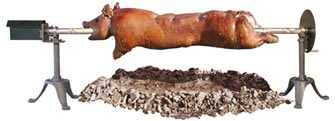
Cebu is one of the largest islands in the Philippines and is renowned for its whole hog called lechon. Learning how to cook a whole hog, Filipino style, begins with the seasoning. The cavity is rubbed with spices including star anise, salt, pepper, and stuffed with herbs, onions, peppers, other vegetables, lemon, and more. The pig is stitched up tightly and turned slowly on an open air bamboo spit by a “lechonero” who rolls the bamboo spear back and forth along the lip of the pit until the meat is cooked and the skin golden and crisp. If you chose to cook a hog by rotisserie in the open air, beware it will take a lot longer than if it is roasted in a closed pit because the heat is hitting one side at a time, then it cools, heats, cools, etc. There are several commercial rotisseries available at a reasonable price shown in our equipment review section.
Here’s a link to Anthony Bourdain’s visit to Cebu and the lechon they cooked for him. Here’s some more on the topic and still more.
Kalua Pig: Whole hog Hawaiian style
Kalua pig is the Hawaiian variation on a traditional Polynesian method of cooking a whole hog. The ritual is practiced daily in many restaurants and every night for the benefit of tourists. Interested in learning how to cook a whole hog, Hawaiian style? First you dig a hole at least three feet deep and five to seven feet wide. Then you line it with softball size rocks, cover them with logs or charcoal, start a bonfire, wait til the rocks are heated through and the logs have burned to glowing embers, then you cover the rocks with fresh moist banana leaves or corn husks, and then a layer of wet burlap. This in-ground oven is called an imu.
The hog is lowered into the pit on a wire stretcher, hot rocks are placed in the cavity, it is covered with more leaves, husks, or wet burlap, then a large wet canvas, and finally the whole shebang is covered by the dirt from the hole.
The meat steams in the underground almost oxygen-free oven and when it is unearthed it is extremely moist, tender, and falls off the bones. Alas, the skin does not get crispy as it does in dry roasting.
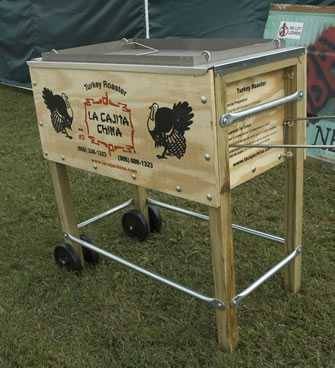
The Cajun Microwave
In the past few years, at least two companies have introduced “Cajun Microwave” type hog roasters. Learning how to cook a whole hog using one of these is actually quite simple. Each is a large metal lined box, the hog rests on a grate within, and the lid holds the charcoal on top. The heat radiates down from the top and cooks the hog very quickly. It produces tender, juicy meat, but there is no smoke flavor. Read about them on our page devoted to pig roasters in the equipment reviews section.
A North Louisiana pig roast
This is excerpted from Deltablues.net:
When learning how to cook a whole hog like it is done at a North Louisiana pig roast, the normal procedure is to start roasting the pig at the crack of dawn. The fellow throwing the pig roast calls a couple of buddies, and they spend the afternoon killing and cleaning the pig.
The next morning and usually with a hangover, they build a fire, wrap the pig in fence wire, and then hang the pig beside the fire. Since they have nothing to do the rest of the day but stand beside the fire and season the pig and turn it every once in a while and, since it’s a cold winter morning, that’s a damn good time to pass around a bottle of Old Stumphole 90 proof sour mash. At lots of pig roasts, the fellows who started the pig to roasting are sound asleep at eating time.
The best place to have a pig roast is any place but your place. That brings up an unwritten redneck cultural law. Everybody is invited to a pig roast. If you’re driving through North Louisiana redneck country and you notice what appears to be a bunch of drunks gathered around a fire over which hangs what appears to be a burnt pig, stop your car or tourist bus and join the party. You’re welcome. Just bring your own beer and whiskey. And don’t say anything bad about George Jones or Hank Williams.
Shoat: Whole hog Civil War style
This recipe is from Civil War Interactive and spelling is correct as quoted.
Ingredients
1 quarter of a young pig
Salt and pepper
Lemon juice
Melted butter
Wine
Method
Take either a hind or fore quarter, rub it well with salt, pepper, and a small portion of molasses, and if practicable, let it lie for a few hours; then rinse it clean, wipe it dry with a cloth, and place it on a large gridiron, over a bed of clear coals. Do not barbecue it hastily, but let it cook slowly for several hours, turning it over occasionally, and basting it with nothing but a little salt water and pepper, merely to season and moisten it a little. When it is well done, serve it without a garnish, and have the skin taken off, which should be done before it is put down to roast, squeeze over it a little lemon juice, and accompany it with melted butter and wine, bread sauce, raw salad, slaw, or cucumbers, and stewed fruit. Beef may be barbecued in the same manner.
The first roast pig
The first roast pig was probably a wild animal caught in a forest fire, but there is an alternative theory as told in this marvelous story: Dissertation on Roast Pig.
It was written by Charles Lamb, an English writer whose essays often ran to the fanciful and humorous. His version of the discovery of roast pork was first published in 1822. It is believed to be the source of the common idiom “burn the house to roast the pig”, meaning, essentially, overkill. It is probably also the source of the name cracklings for cooked pork skins, and explains why so many barbecue cooks are called Bubba. Clearly Mr. Lamb was a pork lover.
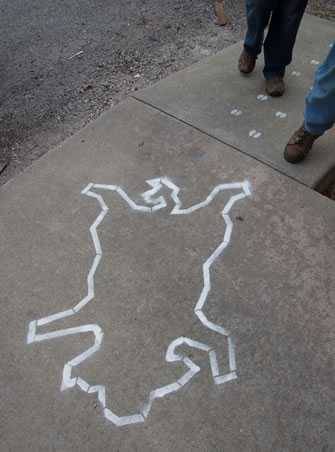
Scape pig
You’ve heard of a scape goat? Here’s a scape pig:
An aged farmer and his wife were leaning against the edge of their pig pen when the old woman wistfully recalled that the next week would mark their golden wedding anniversary. “Let’s have a party, Willard,” she suggested. “Let’s kill a pig.”
The farmer scratched his head. “Jeez, Ethel, I don’t see why the pig should be punished for something that happened 50 years ago.”
Let’s get cooking!
Now that you understand the basics of how to cook a whole hog, it’s time to fire one up yourself using the recipe below. As you get started, also be sure to read my article on planning for a party. I have rounded up the quantities below so you won’t run out.

How To Roast A Whole Hog Or Suckling Pig
Special Tools
Ingredients
Method
- Clean the carcass. Everything. Ears, nose, mouth, tooter, feet. Make sure all the hair has been removed. You can visually inspect the skin and burn off any strays with a butane lighter or shave them off with a disposable razor.
- Fire up. Before you start operating on the patient, fire up your pit and get it up to 250°F (121.1°C) and stabilized. Start the fire by crumpling at least six sheets of newspaper and placing them in the bottom of the wheelbarrow or grill. Squirt some cooking oil on them, not charcoal fluid. Dump one 18 pound (8.2 kg) bag of charcoal on top and light the newspaper in several locations.I recommend charcoal briquets because they ignite easily, burn steadily, and they are consistent batch to batch. Read more about your fuel options in my article on the Science of charcoal.When they are covered in a thin layer of ash, shovel them off to the side of the pit, but never under the space where the hog will lie. You want to cook this baby with convection heat flowing up and around it rather than under it. Put a few extra coals in the four corners so the hams and shoulders get a bit more heat.You can use hardwood, but you need to burn it down to glowing embers. Don't put raw logs onto the fire. After about 10 minutes, use your shovel to shuffle the coals around so they all light evenly. When the coals are ready, shovel them into the four corners of the pit with a little extra at the end where the hams will go.Getting the temp right, and keeping it there is tricky. If you can do a dry run the day before, without the hog, that would be ideal. Set a probe on the cooking grate in the center and walk away for at least 30 minutes. Shoot for 250°F (121.1°C) but you will not suffer if it runs up to about 275°F (135°C). Adjust the temp by adding coals and by adjusting the access the coals have to oxygen. If it is running cool, open the intake vents at the bottom and put a stone under the lid so hot air can escape and create an upward draft that pulls in more oxygen. If that doesn't work, light more coals and add them. You can just throw in unlit coals, but the temperature will stabilize faster with fully engaged coals.If it is running hot, close off the intake vents, but not all the way, and put a weight on the lid. But don't leave the lid sealed tight for long. You need draft or your fire will die. If it is still running hot, it will slowly cool as the coals are consumed.
- Prep the skin. Get a work table and cover it with a plastic table cloth. Then put plastic table cloths under it to protect the ground. There will be splatters and spills. Wear old clothes and an apron.Place the stretcher that you will use to carry the meat to the cooker on the table, and place Miss Piggy belly down on the stretcher.As much as I like the shiny lacquered look of the competition hogs, the skin is leathery and not really good eats, so I prefer the blistered crackling Cheeto-textured skin that Sam Jones and Jackie Hite get (below with mustard BBQ sauce). It ain't pretty, but my guests love munching on it, and I chop some of it up and sprinkle it on the meat on a sandwich.Now wet the skin thoroughly. Splash it on and wipe it all over. Don't be shy. Soak the skin. Then take kosher salt and sprinkle it all over generously, about two tablespoons per square foot. You're not oversalting. Much of it will fall off during the rest of the prep and the cooking.
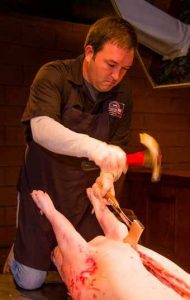
- Dress the carcass. If your butcher can't fully dress the hog for you, you can do it yourself in about an hour.If it arrived with the belly slit, but the ribcage connected at the chest, you can cut it open by extending the belly cut with the hatchet and hammer, a sawzall, a handsaw, a cleaver, pruning shears, or a heavy chef's knife.Here's Sam Jones splitting the breastbone with a hatchet and hammer. Cut slightly off center. It is easier to get through the cartilage between the breastbone and the ribs than it is to split the breastbone.
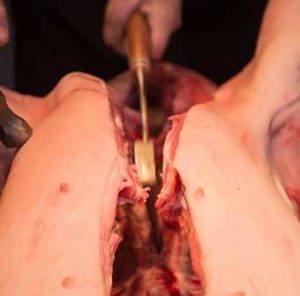
- Now you need to lay open the chest cavity by pushing the two sides apart. Put some weight behind the effort. To make the hog lie flat for even cooking you need to split the backbone right down the middle from the first rib all the way down to the hams.
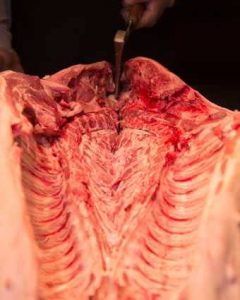
- This is what you get when splitting the spine. The spinal cord will be in one or both sides of the spine bones. Remove it with your fingers or a knife. This is important. Nobody wants to eat spinal cord.
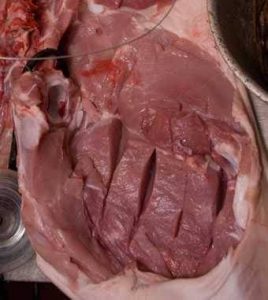
- Then bust the hip socket so the hind legs lie flat. The hind legs, the hams, are the thickest pieces of meat and they determine how long the hog must cook. Remove the skin from the thighs so you can get more rub on the hams, build bark, and speed cooking.I go one step further. I use a trick I learned from Sun Wah BBQ, a Chinese restaurant in Chicago. Pitmasters will say this is cheating, but I say, whatever works. Put some cuts into the hams, about 4" (10.2 cm) long and 1" (2.5 cm) deep and about 2" (5.1 cm) apart, as seen below. This will help them cook faster, and that keeps the other parts of the animal from overcooking. It also creates more surface for seasoning and bark. I wouldn't do this in a competition because I doubt the typical conservative judge would like the concept.
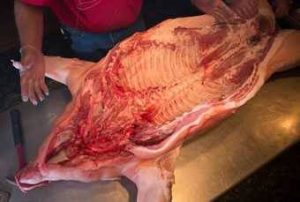
- Now you want to get in there and remove the membrane that wraps around the abdominal cavity and covers the ribs. This is the pleura, and it can be very chewy. Underneath the pleura you want to trim off any silverskin and fat cap so there is plenty of bare meat exposed. Remove any veins, nerves, or glands (which look like marble sized white lumps). With your hands, make a gap between the three or four ribs that cover the shoulder meat. Clean out any fat and silverskin down in there so bare meat can be seen. Save the fat.Now separate the ribs from the spine by running your knife at their junction. A sawzall is also a nice tool for this. I have been known to cut the rib cage in half lengthwise and leave the curved baby backs in, the part that was attached to the spine, to protect the loins, and remove the rest for cooking another day. This step leaves the bacon and the side meat open to the heat and seasoning. They are high in fat and can take the heat. Trim jagged edges from the belly flaps. The picture here shows what a hog looks like when it is prepped by Mike Mills.
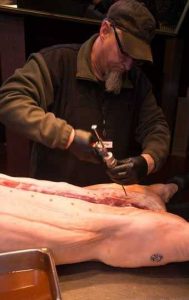
- Inject and rub the cavity. As much as I admire the old school Skylight style, no seasoning in the cavity, not even salt and pepper, I like to add interest by injecting a flavored brine, I like to cover the exposed meat with a spice rub to build a crusty bark, and, just before it is finished, I like to paint the meat with a thin coat of shiny sauce, more for show than flavor. I never use so much of anything that I mask the natural taste of the pork. Just enough to add a few instruments to the orchestra.Start by making a gallon of my Pork Brine Injection. The salt helps protein hold on to moisture during cooking, the liquids increase moisture and offset evaporation somewhat, and the extra flavor and sugar fight the bane of whole hogs, blandness. A common rookie mistake is to inject a lot of sugar, garlic, apple juice, and other strong flavors, and when you are done, that's all you taste. The pork is lost.Flip Babe onto her back. With a meat injector, squeeze as much in there as you can, poking the needle between the ribs several times to get down into the shoulders and loins as Phil Wingo is doing here. Get the hams, bacon, tenderloins, the neck, even the cheeks. Stick the needle in deep and slowly back it out, injecting as you go. Don't poke holes in the skin, inject from the inside of the cavity. Click here to read more about injecting and injectors.Some injection will leak out. Wipe it up with paper towels making an effort to wipe out any bone dust, slivers, scraps of meat and fat.
- Now pour some water or leftover injection into the cavity and lightly coat all surfaces. Sprinkle my Meathead's Memphis Dust recipe all over. Work the rub down into the slits in the hams, the gap between the spine and the ribs, and the gap between the ribs and the shoulders.
- Cover the ears and tail with foil. You will remove the foil later on, but this will prevent them from burning. Finally, pop out the eyeballs with a spoon. You can leave the eyeballs in and try to sucker somebody into eating them, but if you do, expect reprisals somewhere, someday, when your back is turned.
- Cook. Open the pit. With your assistant, sandwich Wilbur into the stretcher and flip him skin side up and lay him on the cooking surface. Make sure the handles of the stretcher are hanging outside the sides of the pit. Make certain none of the flesh is directly over coals. If some is, move Miss Piggy around and push the coals aside or insert a heat shield cut from plywood, larger than the carcass between the flesh and the flame. The heat shield is described in detail on the page with my plans for building a hog pit.
- Insert a good digital meat thermometer probe into the deepest portion of one of the hams and run the cable outside the pit. This is very important. Put another probe on the stretcher next to the hog to monitor oven temp. Working without good thermometers is like driving without a speedometer.
- Cover the pit with the lid. Toss one fist size chunk of dry wood on each pile of coals. Do not use wet wood. It just steams and cools the coals. Close the lid, discard the contaminated table cloth, pull up a lawn chair, crank the tunes, and pour a drink. You have a 9 to 12 hour wait.
- Keep a close eye on the proceedings. You do not want to leave the side of the pig for any longer than it takes to get a beer or make room for it. Dripping fat can cause a grease fire that can easily engulf the whole hog and incinerate it in minutes. Don't believe me? Watch this video of a pig roast gone wrong.
- If you get big flames, get the meat off immediately. Douse the flames with the squirt gun or watering can. Try to keep ash from flying onto the meat when you squirt and try to not extinguish the coals.
- When the smoke starts to dwindle toss another chunk of wood in each corner of the pit. That’s it for the wood. Too much can ruin the meat.
- After about 60 minutes or as soon as you notice the temp starting to drop, start another bag of coals on the side and when they’re ready shovel them in. You want to try to keep the temperature as steady as possible. That’s tricky. Keep adding pre-lit coals around the carcass every hour or so as necessary. Don’t add any more wood. Watch the meat on the underside. You want it dark golden, but not mahogany yet.
- If the meat looks like it might be ready to burn, lift the hog up and insert the heat shield. There is no need to spray, spritz, or mop the hog. We want the skin to get dry and crunchy, and we want the meat to develop a nice bark. After about 4 hours, remove the foil from the ears and tail so they can brown.
- After about six hours the temp of the coolest part of the shoulders and hams should be getting up to 160°F (71.1°C) or so. Push the skin on the hams. It should slide a bit. The skin should be hard and thump when you tap it. It is now time to flip poor Pumbaa. Get your assistant and if you can scrounge a few more hands that would be nice. Flipping is a momentous moment. Gather the troops and encourage applause. You are now on the home stretch. Have a 16 ouncer.
- When the temp in the hams and shoulders hits 185°F (85°C), the meat should be getting a nice dark crust, and look a lot like your pork butt or ribs when you cook them. If you wish, you can shine the meat with a glaze of sauce. Just one or two layers 15 minutes apart. Or you can serve the meat nekkid and let people dip into sauce if they want.
- It should only take about three hours after the flip to get the skin ready and the hams and shoulders up to about 185°F (85°C). Test the temp in several spots. Don't worry about the precise temp. No harm will be done if you go over 10°F (-12.2°C). The meat will continue to carryover cook when you remove it from the pit. Keep an eye on the skin. There's a lot of fat under it and if it springs a leak you could have an inferno. Don't let it burn.When is it done? It will be done when it is done. As Mill's daughter and business partner Amy says, "we're not baking a cake here". The pig is calling the shots, not you, at least not until you've done this a few times. The exact time it takes will depend on a lot of variables: Size of the hog, breed of hog, age of hog, weight of hog, type of charcoal, reliability of your thermometers, amount of coals, distance of the meat from the coals, color of the inside of the pit, size of the pit, type of lid, outside temp, wind, etc.
- When Piglet is ready, put a layer or three of foil on the table. Don't use a plastic table cloth, it might melt. Move her to the table skin side down. If you left the head on insert grapes or cherries in the eye sockets.
- Serve. You worked hard. You deserve a treat. Some of the choicest muscles are the tenderloins, small tapered muscles nestled against the base of the spine. When nobody is looking, eat one. Make sure you sample each of the muscle groups and the skin for "educational purposes". Test the skin. Some parts will be too hard to serve, but the skin on the back and sides should be perfect, loudly crunchy, and salty on the outside, and sinfully unctuous below. There are several ways to serve the meat to your guests
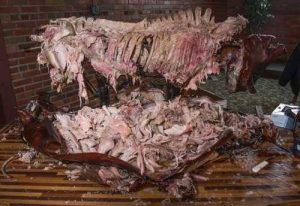
- Taste the skin. If it is rubbery or leathery, don’t use it. If it is crunchy and easy to chew, chop up sections of skin and scatter it inside the cavity. Simply put the hog on display and let your guests dig in with forks or tongs, a real “Pig Pickin'”. This way they can try different muscles and taste the differences.
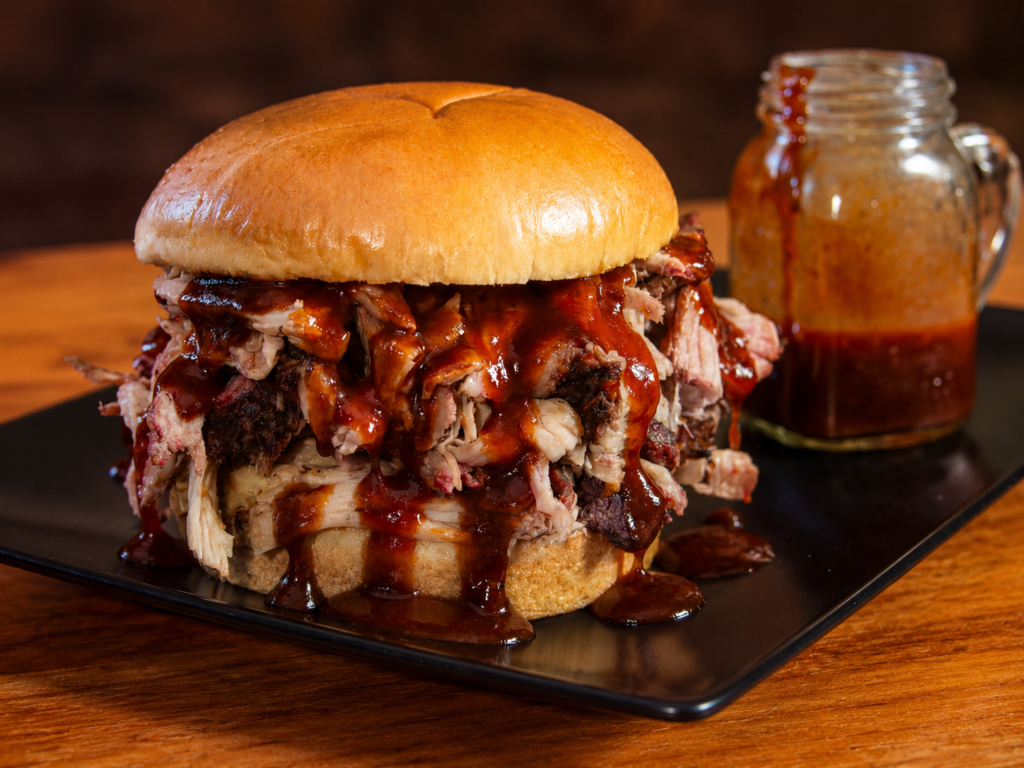
- Pull out the ribs and with Wolf Claws shred the meat or chop it with cleavers, mix all the meat together with some chopped skin, some fat for moisture, and put it on platters. Many Carolinians insist this is the best way to serve hog because you get all the different muscle flavors and textures mixed together, the crunchy unctuousness of the cracklins, and the last person in line isn't stuck with the lesser cuts.
- Another method is to remove the ribs, slice them apart, and serve them from one platter, remove the loin meat, slice it and serve it from a another platter, ditto for the hams, shoulders, and other meat. Sprinkle them with cracklins.
- Sauce. When it comes to sauce, I prefer to serve it on the side in bowls with spoons so people can taste the different meats unadorned and then add sauce if they wish. This way I can also offer several sauces. I like to serve piquant Lexington Dip, savory South Carolina Mustard Sauce, and succulent tomato based Kansas City. You can put out buns for sandwiches if you wish or just heap the meat on plates. In many places in the Southeast, barbecue sandwiches are served with a mound of sweet & sour coleslaw on top whether you ask for it or not. Do not let the meat sit out at room temp for more than 2 hours. Another option is to put the serving platters on the pit to stay warm.
- Be sure to check out this video from our friends at HowToBBQRight.com, showcasing their method for cooking a suckling pig.

Before you can post a comment or question you must sign into our commenting partner, Disqus. This helps make sure everyone hanging around the grill is civil. We do not tolerate nastiness, racism, porn, inappropriate language, or attacks on others. All comments are the property of AmazingRibs.com and we reserve the right to quote them, edit them, delete them, and block people from making future comments.
Please leave comments and questions on the same page that is devoted to that subject so others can see questions and our answers when they are reading about the subject. You must enable JavaScript to use the comments section, and you must accept cookies to post comments. Note: the software that runs Disqus is different from the Pitmaster Club, so members need to sign into the Pitmaster Club separately.