



I get emails from people all year round, but especially at Easter, asking how to cook a ham. Not so fast. First I need to know which kind of ham do you have, and there are many? A true ham is a rear leg of a hog from hip to knee. Most have a bone in it, but some are boneless. Sounds simple, right? I wish. There are exceptions, the picnic ham, which comes from the lower part of the front leg, and the turkey ham, which comes from a fowl (whose idea was this?). Let’s clarify the murk. Here’s what you need to know when shopping for a ham and tips for cooking it. Folks who follow me know my specialty is outdoor cooking, but these tips can easily be adapted for indoors.
1) Fresh Raw Uncooked Ham (a.k.a. Green Leg): Cook to 145°F in deepest center
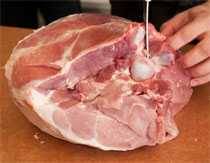
Fresh Ham (a.k.a. Leg) is a raw uncured uncooked rear leg, usually with the skin still on. The meat is the typical pale pink to beige color of raw pork. It can be roasted, skin on or off, and it is especially good with the skin removed and smoke roasted. Click here for info on some of the cuts that are available from the leg. Here are three ways to handle your own whole fresh ham:
(1) Inject and cook. Remove the skin if it is still on the leg and save it for cracklins. Inject the ham with my Pork Brine Injection. Coat it lightly with water and then dust it liberally with Meathead’s Memphis Dust. Smoke it in indirect heat at 325°F and bring it up to 145°F in the deepest part (don’t touch the bone with the probe). That will bring it in tender and moist and medium. Then put on two coats of Chris Lilly’s Spiced Apricot Glaze or Danny Gaulden’s Glaze. Start early and if it finishes early, hold it in a faux cambro. The results will be like an excellent storebought wet-cured ham, only juicier and better tasting.
(2) Cure and cook. You can also cure your raw ham. I recommend wet curing for most homes. Dry curing is tricky. Click here for my recipe and technique for curing a ham.
(3) Season and cook. Skip the injection and use my Simon & Garfunkel Rub. Start by salting it liberally since there is no salt in the rub. Apply it more heavily on the thick end. Let it sit at least three hours, or, better still, overnight. Roast on your grill or smoker over a pan of water, not in a pan of water, with plenty of smoke at 325°F and remove it when the temp is 145°F in the deepest part of the center being careful to keep your probe away from the bone. You’ll end up with something with a much more porklike flavor, like a porkroast, or smoked pork butt. But if you cook it only up to 145°F, it will be juicy and tender, more like a pork loin. If you are careful to not let the water pan dry out, you will end up with a nice flavorful broth. Taste it and cook it down into a gravy if you wish although it should not need it. Usually we determine cooking time by thickness and a rule of thumb is about 30 minutes per inch at the thickest part.But since thickness is usually related to weight, here’s a reough guide.
| Ham Type | Pounds | Minutes/Pound at 325°F |
|---|---|---|
| Whole leg, bone in | 12 to 16 | 18 to 22 |
| Whole leg, boneless | 10 to 14 | 20 to 24 |
| Half leg, bone in | 5 to 8 | 20 to 24 |
2) Wet Cured Smoked Ham, Labeled “Cook Before Eating”: Cook to 145°F
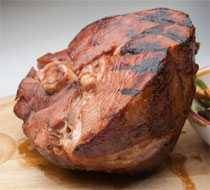
Wet-Cured Ham is the most popular ham in the US. Often called a City Ham, as opposed to Country Ham, it is meat that is skinned and cured by soaking in a cure or injecting it with a cure. A cure is a salt and water solution with some or all of these ingredients: Sodium nitrite, sodium nitrate, sodium erythorbate, sodium phosphate, potassium chloride, sugar, liquid smoke, and other flavorings. These ingredients will appear on the label. Many people fear that nitrites and nitrates are carcinogens, but recent research has contradicted early research that started the scare. Click here for more on nitirites and nitrates. Some wet-cured hams are pre-cooked and labeled as “ready to eat”. Some are sold uncooked and labeled as “cook before eating”. By law these must have prominent labeling with safe handling and cooking instructions. When you get them home, they can be roasted or smoked at 325°F. For pre-cooked wet-cured hams, use my Grilled Ham recipe with paint with Chris Lilly’s Spiced Apricot Glaze or Danny Gaulden’s Glaze heat with indirect heat to 140°F, and serve. That’s all there is to it. Yes, 145°F seems low, but that’s what USDA says is safe since it is cured.
| Ham Type | Pounds | Minutes/Pound at 325°F |
|---|---|---|
| Whole ham, bone in | 10 to 14 | 18 to 20 |
| Half ham, bone in | 5 to 7 | 22 to 25 |
| Shank, bone in | 3 to 4 | 35 to 40 |
3) Wet Cured Smoked Ham, Labeled “Cooked”: Heat to 140°F
These hams have been brined, pre-cooked, often smoked, and can be eaten right out of the bag, but they are best when heated. Since they do not need to be cooked to be safe, you should not heat them too high or you can dry them out. 140°F is enough. Then glaze with Chris Lilly’s Spiced Apricot Glaze or Danny Gaulden’s Glaze. Then brown at 400°F for 15 minutes just to cook the glaze and caramelize the sugars. Below are the standard cooking instructions for wet-cured hams, but I have a better way. Click the link for my recipe for the Ultimate Easter Ham on Your Grill.
| Ham Type | Pounds | Minutes/Pound at 325°F |
|---|---|---|
| Whole ham, bone in | 10 to 14 | 15 to 18 |
| Half ham, bone in | 5 to 7 | 18 to 24 |
| Canned ham, boneless | 3 to 10 | 15 to 20 |
| Vacuum packed ham, boneless | 6 to 12 | 10 to 15 |
| Spiral cut ham, whole or half | 7 to 9 | 10 to 12 |
4) Dry Cured Uncooked American Country Hams: Desalinate then boil
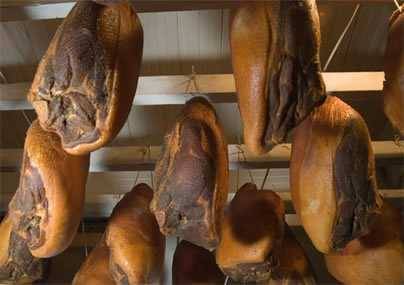
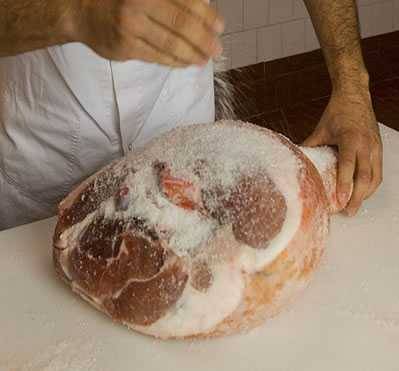
American Country Hams like true Smithfield Hams (shown here), are extremely salty because they are often buried with salt in crates. They are then rinsed and hung to age for up to three years, and most are smoked before hanging. Often they get moldy in the process, and although we cut off the mold, it apparently is safe.
Some are made in the European style and can be served in their natural state like European Uncooked Hams (below), but most need to be soaked and then cooked.
To serve, begin by soaking in an ice water bath to draw out some of the salt, and if you can, change the water several times. The length of the soak depends on the thickness. Soak a whole ham 12 to 24 hours. Ham steaks need only an hour or two. If you wish, you can inject a large hunk with apple juice in order to add moisture, but the ham producers will have a heart attack if they see you doing it. Then glaze with Chris Lilly’s Spiced Apricot Glaze or Danny Gaulden’s Glaze. Many folks serve it at room temp by giving it a quick glaze at 400°F for 15 minutes to caramelize the sugars. Steaks are usually grilled or pan fried just enough to warm them. Because they are salty, a sweet glaze is a good idea.
5) Dry Cured Uncooked European Hams: Eat raw
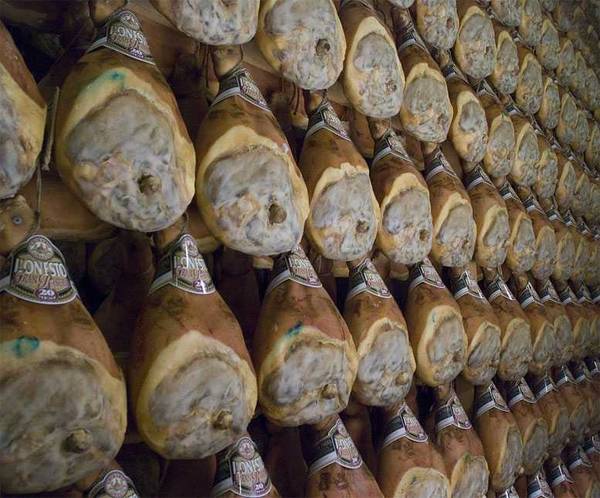
Dry-Cured European Hams like Prosciutto (photo above), Iberico, and Serrano are rich in flavor, salty, and versatile. They are usually served uncooked, or crudo as they call it in Italy. They are sliced thin, often paper thin, and eaten unadorned. Sometimes they are used in a sandwich especially with cheese (a ham and cheese sandwich with Italian dressing), or chopped uncooked in a salad like bacon, or wrapped around melon or dates, or baked on a pizza, or stuffed into a chicken breast, wrapped around a filet of fish, or used as an accent on grilled asparagus. Prosciutto often shows up on pastas in Italy too. Let your imagination run.
Some are cured by burying them in a big mound of salt or by rubbing the skin with salt, often mixed with sugar, black pepper, garlic, and other spices. In some places sodium nitrate and sodium nitrite are also added. They are then usually hung and air-dried for 6 to 18 months at cool temperatures, and they dehydrate significantly, concentrating flavors. They are usually pink to brown and can be purchased as a whole ham or half a ham, and are usually served uncooked and sliced thin. Because their production takes a lot of time, dry-cured hams can be expensive. At the top of this page we see part of a wall hung with hundreds of Prosciutto di Parma, the famous dry-cured ham of Italy.
Other important ham types
Bayonne Ham is a dry-cured French ham.
Black Forest Ham is a German dry-cured and smoked ham.
Brine Cured Ham. See wet-cured ham.
Canned Ham can contain scraps and pieces of meat pressed and formed to fit in the can and may contain up to 10% water or broth. Usually under three pounds. Canned ham labeled “shelf stable” can be stored at room temp for three years. I have no idea how to cook them and no interest in learning.
City Ham. An unofficial term used to describe wet-cured ham. It is usually sold in a plastic bag in the refrigerator case and labeled “ready to cook”, “partially cooked” or “ready to serve”. The better city hams also say “ham in natural juices”.
Corned Ham. Corning is the word for curing with salt. Corned beef is fresh beef packed with salt and aged much like the dry cured hams above but not as long. Ditto corned ham. It is popular in Maryland and the Carolinas. Basically, you get a fresh ham, remove the skin (or not), pack it with kosher or pickling salt, wrap it with plastic wrap, put it in a pot in the fridge and turn it occasionally, then after a week, rinse off the salt and roast or simmer it. In Southern Maryland, corned ham is stabbed all over with a knife and the slits filled with a mix of cabbage, kale, collards, onions, and herbs to make a dish they call Stuffed Ham.
Country Ham is the generic name for American dry-cured ham. Sometimes it is smoked, most of the time it is not. It can be served uncooked, and often is, much as prosciutto or other European hams. If it is to be cooked, it needs to be soaked in an ice water bath for 4 to 12 hours, then simmered for 25 minutes per pound or until it hits 160°F internal, then glazed, and browned at 325°F for 15 minutes. Whew.
Green Ham is not a ham covered with green mold meant to accompany green eggs and green beer, although some dry-cured hams do have a mold on them. It is a cured ham that has not been smoked. This is not an official USDA controlled definition, however.
Half Ham. Because whole hams are very large, many producers cut them into butt end and shank end. Butt half is from higher up, on the rump, and has more meat and fat. It is also easier to carve and usually more expensive. It is not to be confused with pork butt which is from the shoulder. Don’t ask. The shank half is less fatty.
Ham Steak is usually a cross section slice of wet-cured smoked ham with a round section of thigh bone in the middle. It is good when grilled quickly with or without a glaze or sauce.
Picnic Hams are not really a ham, but a front leg from the shoulder socket through to the elbow sold raw. They usually run 5-8 pounds without the skin. Follow my instructions for cooking pulled pork.
Prosciutto is Italian dry-cured ham preserved with salt, lard, and often other spices. It is occasionally smoked, but usually is not. It is made in many locations around Italy and named after the area of origin such as Prosciutto di Toscano from Tuscany. It is best when the meat is pale pink and the fat is cream colored and is usually sliced paper thin and eaten uncooked (crudo), fat and all. When fresh cut, it has a concentrated briny flavor and the fat is buttery. It is often wrapped around melon chunks, chopped in salads, or on a sandwich. There are numerous recipes that use prosciutto cooked as an ingredient such as pizza.
Prosciutto di Parma or Parma Ham is prosciutto from the Parma region of Italy. It is regarded by many as the best of the Italian hams and made according to strict regulations and supervision. That’s Prosciutto di Parma aging in the picture at the top of the page.
Pumped Ham. See wet-cured ham.
Serrano Ham (Jamón Serrano) and Ibérico Ham (Jamón Ibérico) are the most prized Spanish dry-cured hams. Ibérico Ham hogs are fed acorns and there are several grades depending on how much of their feed is acorns.
Smithfield Ham is a dry-cured country ham from Smithfield, VA. There is a potential point of confusion because the world’s largest pork product producer, Smithfield Foods, originally founded in Smithfield but now with plants all over the world, makes a range of hams, most of which are not country hams. Got it?
Smoked Ham has usually been wet-cured and then smoked. It is, sometimes, simply smoked without the cure.
Smoked Ham Rump. A big gumdrop shaped portion of a smoked ham.
Speck. Dry cured ham, like prosciutto, that is then smoked gently. The most famous are from northern Italy’s mountainous region. There is a surprising natural sweetness and bacon-like quality. It is served like prosciutto, sliced paper thin. If you see it, buy it.
Spiral-Cut or Spiral Hams are skinned, wet-cured, and pre-cooked, usually coated with a sweet glaze and vacuum packed in plastic wrap. They usually weigh 7-10 pounds. They can be cooked but be careful because they can dry out easily. If you must heat them, wrap in foil and cook at 325°F for about 10 minutes per pound. Bring it up to 140°F.
Turkey Ham is turkey thigh meat wet-cured and cooked. Why does USDA let this be called ham?
York Ham. A dry cured ham from Great Britain.
Virginia Ham is similar to Smithfield Ham, but it is not from Smithfield proper.
Westphalian Ham is dry-cured and smoked German ham from hogs fed acorns.

Before you can post a comment or question you must sign into our commenting partner, Disqus. This helps make sure everyone hanging around the grill is civil. We do not tolerate nastiness, racism, porn, inappropriate language, or attacks on others. All comments are the property of AmazingRibs.com and we reserve the right to quote them, edit them, delete them, and block people from making future comments.
Please leave comments and questions on the same page that is devoted to that subject so others can see questions and our answers when they are reading about the subject. You must enable JavaScript to use the comments section, and you must accept cookies to post comments. Note: the software that runs Disqus is different from the Pitmaster Club, so members need to sign into the Pitmaster Club separately.