



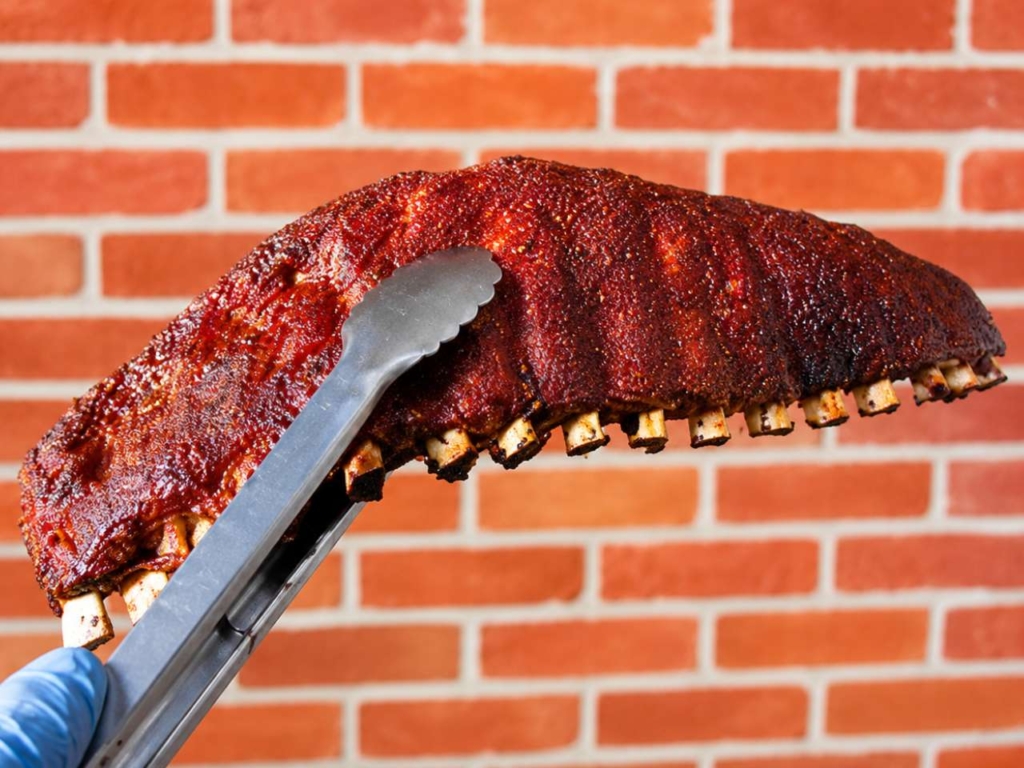
One of the keys to smoked rib nirvana is learning how to know when ribs are done (and no, this does not mean “fall off the bone”!).
There is an old joke among some competition cooks about how to know when ribs are done. Take one slab of spareribs and one slab of baby back ribs and put them both in the smoker. When the baby backs are dry, the spareribs are done.
OK. Maybe that’s a bit extreme. But it underlines how hard it is to really know when ribs are done cooking. That’s because ribs come in so many different weights and thicknesses. Not to mention the fact that keeping an outdoor oven at a precise temp can be tricky. Here are some guidelines and techniques for learning how to know when ribs are done (click here for a Food Temperature Guide for other meats).
Hungry for more ribs recipes, tips, and techniques? Click here to download our ebook “Amazing Ribs Made Easy” $3.99 on Amazon (free Kindle app runs on all computers and devices). Or, get this book and others FREE as a member of the AmazingRibs.com Pitmaster Club. Click here to join.
How to know when ribs are done vs when they are ready
I differentiate between “done” and “ready,” a fine semantic line, but an important one when it comes to barbecue.
Meat is “done” when the temperature at its thickest point reaches the point at which it is safe to eat. That doesn’t mean it’s “ready”, though.
According to USDA, ribs are “done” when they are 145°F internal temp, but they may still be tough. If you take them up to 190 to 203°F, the collagens and fats melt at this temp and make the meat more tender and juicy. That’s when they’re ready to eat! See the diff?
Notice the sign here from the side of a smoker at Dinosaur Bar B Que in Rochester, NY. There are temperatures and tactile tests the pitmasters use.
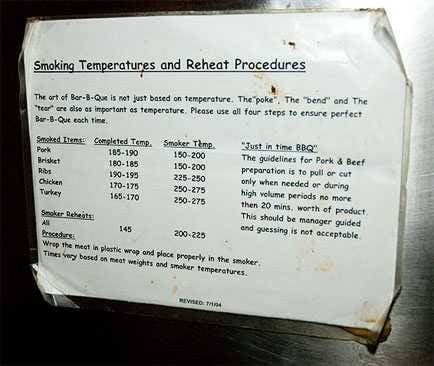
How do I know when my ribs are done AND ready to eat? I work hard to control my cooking temperature. I use a quality digital thermometer and shoot for at least 190°F or, better yet, up to 203°F. That said, for ribs, there is not much use in trying to read the temp of the meat. It is too thin and varies in thickness from end to end and side to side. Plus, the meat next to the bone can be warmer than in the middle of the bones. I keep the oven probe near the meat, but not on the meat. I watch the clock. When they I think they are ready, I use the bend test (described in more detail below).
For more on meat science, click here.
Ribs should not fall off the bone!
Properly cooked ribs will not not not fall off the bone! The only ribs that fall off the bone are ribs that have been boiled and steamed and that process usually robs them of flavor because water is a solvent. Steamed and boiled ribs usually have a mushy texture. Properly cooked ribs will pull cleanly off the bone with your teeth, but they will still have some resilience and chew, like a properly cooked steak, but not be tough. Remember, boiling meat is the way to make flavorful soup, not flavorful meat.
How to tell when ribs are ready
Every grill and smoker is different and every slab of meat is different, so exact cooking time depends on a number of variables. I use a thermometer, but also use some other techniques.
The time test
The ideal cooking temp is about 225°F, hot enough to brown the surface, to develop a crusty bark, and to melt fat and collagens. On most cookers, when the oven temp is 225°F at sea level, it takes about 4 to 5 hours to cook a slab of baby backs and about 6 to 7 hours to cook a slab of St. Louis cut ribs or spares. This can vary depending on the thickness of the slab.
They are slightly undercooked at that stage. I then put the sauce on and sizzle it in on a hot grill for about 5 minutes per side (click here for saucing strategies). This finishes the cooking and makes sweet sauces taste their best. But you have to stand there and watch them so the sauce won’t burn. If you skip the sizzling step, add another 30 minutes of cooking time at 225°F.
At higher cooking temperatures, decrease the cooking time. For example, at 325°F, baby backs can cook completely in only 90 minutes, but there will be shrinkage and they will be tougher. At higher altitudes, increase the cooking time 20% or more. The key here is to keep the cooking temp under control, and that is the barbecue chef’s craft.
That said, it should be noted that each slab is different, and some can take a good bit longer. In the words of one Merrill Powers, known as Captain Que to his friends, “they’re done when they’re done!”
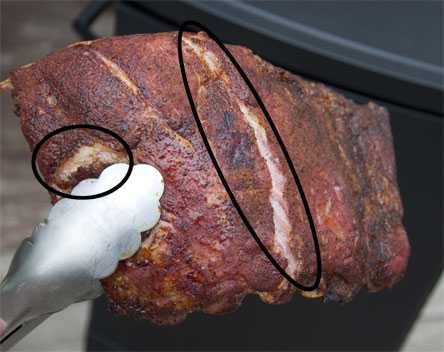
The bend test for ribs
This is the method I like best. I pick up the slab with a pair of tongs near the center and bounce them slightly. If they are ready, the slab will bow until the meat starts to crack on the surface. A small crack means you need a little more time. It should be close to breaking when you lift the slab. You’ll get the feel for this with practice.
The twist test
Another technique is to grab ahold of the tip of a bone somewhere near the middle. If you twist, it should start to break free of the meat. This means the collagens in the tough connective tissues have melted and turned to gelatin.
The popup test
A lot of books and websites say to wait until the meat begins to pull back from the tips of the bones, exposing about 1/4″ of bare bone as in the picture at right. Some folks call this the natural popup thermometer. Problem is that this is not necessarily a sign that they are ready. Heat can cause this shrinkage. Put ribs on a hot grill and they will shrink within an hour, but they won’t be done. On the other hand, if you keep the temp under 250°F, by the time the meat pulls back, it is overcooked.
The peek-a-boo test
If you are unsure if the meat is ready, you can cut into it and sneak a peek. The meat in the center should be white and there should be no pink juices. Remember, if you have cooked with smoke, there will probably be pink meat near the surface, but the meat in the center should be white or tan. Click here to see a perfect rib.
The taste test
Some cooks pull one bone off the end, look at the meat, and then taste it. This works fine, especially because you get to eat the rib you removed! Problem is when the meat is not ready. Then you have to pull off another bone. Then another. And then there’s nothing for the guests.
The toothpick test
Jack Waiboer, a champion cook from South Carolina likes the toothpick method for his recipe. “You poke a toothpick into the meat between the bones. When it slides in with little or no resistance you have a done rack of ribs. It’s best to test various parts of the rack to be sure you have them done to your liking. With a little practice you can better judge the doneness of your ribs than the bend test. I hesitate to use the word accurate in a barbecue conversation. After a few beverages accuracy seems to depend on the quality of the bourbon.”
Before you can post a comment or question you must sign into our commenting partner, Disqus. This helps make sure everyone hanging around the grill is civil. We do not tolerate nastiness, racism, porn, inappropriate language, or attacks on others. All comments are the property of AmazingRibs.com and we reserve the right to quote them, edit them, delete them, and block people from making future comments.
Please leave comments and questions on the same page that is devoted to that subject so others can see questions and our answers when they are reading about the subject. You must enable JavaScript to use the comments section, and you must accept cookies to post comments. Note: the software that runs Disqus is different from the Pitmaster Club, so members need to sign into the Pitmaster Club separately.