


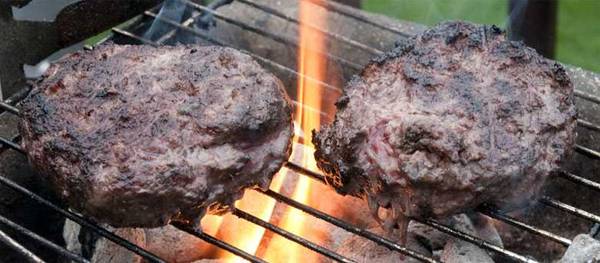
Every spring the uninformed popular media feel obligated to play Chicken Little and run the same old tired stories that grilling causes cancer. Does it? And why do we never see articles that say frying causes cancer?
These alarmist articles are usually written by reporters with little understanding of science, the articles are usually poorly researched, poorly worded, ill-informed, or motivated by a vegetarian agenda. Here is what I have learned by reading the research and not the same old articles by the popular media.
Bottom line: High heat cooking may increase health risks, indoors or out. In fact frying is probably worse than grilling, and there is probably zero risk to grilling if you do it properly as we teach it on this site.
HCAs and PAHs
At issue is the possible presence of two compounds, heterocyclic amines (HCAs) and polycyclic aromatic hydrocarbons (PAHs). They are thought to change DNA in rodents, but it has never been shown to alter human DNA or that these alterations can cause cancer.
The National Cancer Institute says “HCAs are formed when amino acids (the building blocks of proteins), sugars, and creatine (a substance found in muscle) react at high temperatures.” The longer they are exposed to high temperatures the more HCAs form.
USDA says “Some studies suggest there may be a cancer risk related to eating food cooked by high-heat cooking techniques as grilling, frying, and broiling. Based on present research findings, eating moderate amounts of grilled meats like fish, meat, and poultry cooked — without charring — to a safe temperature does not pose a problem.” Notice that they say “may be a cancer risk”. The do not say it is a cancer risk nor do they say what is the level of risk. They also say “moderate amounts” are not a problem.
The article continues to explain that charring meat is a fine way to create HCAs. Charring your meat is not only unhealthy it is unappetizing and ruinous to your reputation. When it comes to grilling, the best tasting foods are cooked over low temps most of the way although, sadly, many backyard cooks have not learned this yet. The best grillmasters have learned that the best tasting foods are made when the majority of the cooking is not over open flame, with a 2-zone setup. When cooked this way the dripping fats and juices do not hit high heat or flame and cannot cause aerosolized HCAs or PAHs.
According to one of the country’s primary researchers in the field, Dr. Rashmi Sinha of the National Cancer Institute “There’s a clear relationship between very high temperatures and the risk of cancer-causing agents.”
Dr. Sinha has some healthy cooking advice that all good chefs can agree with from a tasty cooking standpoint. She says we need to avoid blackening meat on the outside. This charring creates potentially hazardous compounds. And, I might add, carbon just plain tastes bad.
She says we should avoid flare-ups caused when fat hits the flame. Flare-ups just burn the food and deposit soot on the surface. You can avoid flare-ups by using a gas grill with metal flavor bars between the food and the flame, of by using a 2-zone cooking system on a charcoal grill and by having a squirt gun handy.
Dr. Sinha says that if there are burned parts of the meat, especially burned fat, just cut them off. “It’s important to help consumers understand how to cook without undercooking or overcooking,” to which the National Cancer Institute (NCI) adds “That’s one more reason to use a food thermometer. ” Amen.
The one thing that is crucial to assessing the risk is called dose. How much charred fat increases your risk? If you grill a steak once a week and there is a little char on the edges, is this enough to raise the risk? Let me know when you can answer that question.
It is also important to note that to be hazardous HCAs and PAHs must be metabolized by specialized enzymes and each of us has different levels of them. It is impossible to get epidemiological (observational) data because you would have to study hundreds of bad grillers who burn their meat against people who don’t grill at all over many years to see how many get cancer.
In their report on HCAs in Cooked Meats, NCI says “Four factors influence HCA formation: Type of food, cooking method, temperature, and time. HCAs are found in cooked muscle meats; other sources of protein (milk, eggs, tofu, and organ meats such as liver) have very little or no HCA content naturally or when cooked. Temperature is the most important factor in the formation of HCAs. Frying, broiling, and barbecuing produce the largest amounts of HCAs because the meats are cooked at very high temperatures.”
So where are the “fried tofu causes cancer articles”?
They also added “Researchers found that those who ate their beef medium-well or well-done had more than three times the risk of stomach cancer than those who ate their beef rare or medium-rare.” I might add that well done meat is tougher and drier. Click here for more on proper meat temperature in which I make the case that lower cooking temperatures and indirect heat just plain make better tasting food, regardless of health impact. And if flareups are a source of nasty stuff, use a product called GrillGrates ™ and get rid of them. and click here for more on food, cooking, and barbecue safety.
Now let’s look at PAHs. According to the EPA “PAHs are created when products like coal, oil, gas, and garbage are burned but the burning process is not complete.” That includes the incomplete combustion of charcoal, wood, and meat drippings. Smoke includes as many as 100 compounds in the form of microscopic solids including char, creosote, ash, as well as combustion gases that include carbon monoxide, carbon dioxide, nitrogen oxides, polymers, and liquids such as water vapor, and phenols. Complete combustion produces much less smoke, and PAHs, than smoldering, which is incomplete combustion. Smoked meat is usually made by incomplete combustion, at low temperatures so it is low in HCAs and high in PAHs.
Propane grilling is the most popular outdoor cooking method in the US and burning propane produces almost no smoke. While a charcoal fire is starting it can produce smoke, when it is fully lit it produces little smoke. Drippings from the food can produce smoke, but the contents of that smoke are a lot different than the smoke from a hardwood fire. Even so, grilling most meals goes so quickly that there isn’t enough time for smoke to accumulate in significant quantities on the meat. The amount of PAHs are small. Also, the best tasting smoke, called blue smoke, comes from complete combustion, not smoldering.
Furthermore, PAHs are lipophilic meaning that they cannot penetrate fat, like natural casings on sausages and hot dogs or the fat cap on a brisket.
Of course all this begs the question: What is high heat? Nobody seems to know. All this research is fairly new and I haven’t seen data on what is the threshold, but more than likely it is not a single number, it is a gradual increase in risk as you get into ranges of 350°F or higher.
Smoked meats vs. grilled meats
Many research papers linking grilling to cancer were all about smoked meat which is different from grilled meat. There are, broadly speaking, two ways to smoke meat, cold smoking and hot smoking. In cold smoking, the food is not heated much. Cold smoking usually involves smoldering wood, higher in PAHs. Many smoked meats are also treated with a “curing” agent containing high concentrations of salt and preservatives. Almost all our cold smoked meats come from USDA licensed processors using hardwoods. Two of the key research papers were eating surveys in China and Hungary where they were smoking over softwood, long known to be hazardous. Very few Americans have the equipment and expertise to cold smoke in their back yard. Cold smoking at home is in and of itself risky from a microbial standpoint and not recommended unless it is done precisely.
Hot smoking heats and cooks the meat. It is becoming popular in the US, as in Southern barbecued ribs or pulled pork, and Texas beef brisket. As pitmasters know, the smoke of a hot hardwood fire, called blue smoke, looks and tastes very different from a low smoldering fire. A good pitmaster seeks blue smoke, clean hardwood combustion which will contain fewer PAHs.
It is important that consumers understand that much of the relationship between HCAs, PAHs, and cancer is still not thoroughly understood, that there is a lot of research yet to be done, and that eating burned steak once or twice a year isn’t likely to make you sick. We also need to remember that many of the studies are epidemiological eating surveys, which are not very accurate and are best used to tell us that further research is needed. Click here for more on the pitfalls of this type of research.
Reducing risk
The compound implicated as a cancer causer is Heterocyclic Amines (HCAs) created by burning or overcooking food. Current research shows there is probably no risk in properly grilled foods.
Should your chicken look like the one above (yes, that’s my handiwork – don’t ask, but let’s just say that I did it in the name of research), it is said you can decrease the impact of HCAs by popping antioxidants, such as vitamins E and C and beta-carotene.
J. Scott Smith, a Kansas State University food chemistry professor who researched the issue of the cancer risk of grilling for the Food Safety Consortium has shown that commercial rosemary extracts can inhibit the formation of HCAs in cooked beef patties by 61-79%. Other spices had inhibiting effects, but rosemary leads the pack.
Tomatoes, which are rich in lycopene, are also believed to be a cancer fighter.
So here’s my solution:
Take your vitamins, use a rub with rosemary (like Meathead’s Memphis Dust), don’t burn your meat, slather it with tomato based barbecue sauce, and chase the whole thing with a Bloody Mary.
Bottom line
The real message here is that good food is also good for you and that if you’re going to grill, do it good. The average life expectancy is now about 79 years. If you eat three meals a day you will eat 86,505 meals in your lifetime. You can have grilled food whenever you want. It is just a tiny teensy bit of your intake. If you really want to reduce your health risks, keep grilling and quit driving.

Before you can post a comment or question you must sign into our commenting partner, Disqus. This helps make sure everyone hanging around the grill is civil. We do not tolerate nastiness, racism, porn, inappropriate language, or attacks on others. All comments are the property of AmazingRibs.com and we reserve the right to quote them, edit them, delete them, and block people from making future comments.
Please leave comments and questions on the same page that is devoted to that subject so others can see questions and our answers when they are reading about the subject. You must enable JavaScript to use the comments section, and you must accept cookies to post comments. Note: the software that runs Disqus is different from the Pitmaster Club, so members need to sign into the Pitmaster Club separately.