



Here is a myth so pervasive that challenging it will certainly bring howls from every corner of the culinary world, but the fact is, it is indisputably false. And if you believe it you could end up badly overcooking your poultry or spend the night on the toilet. Or worse.
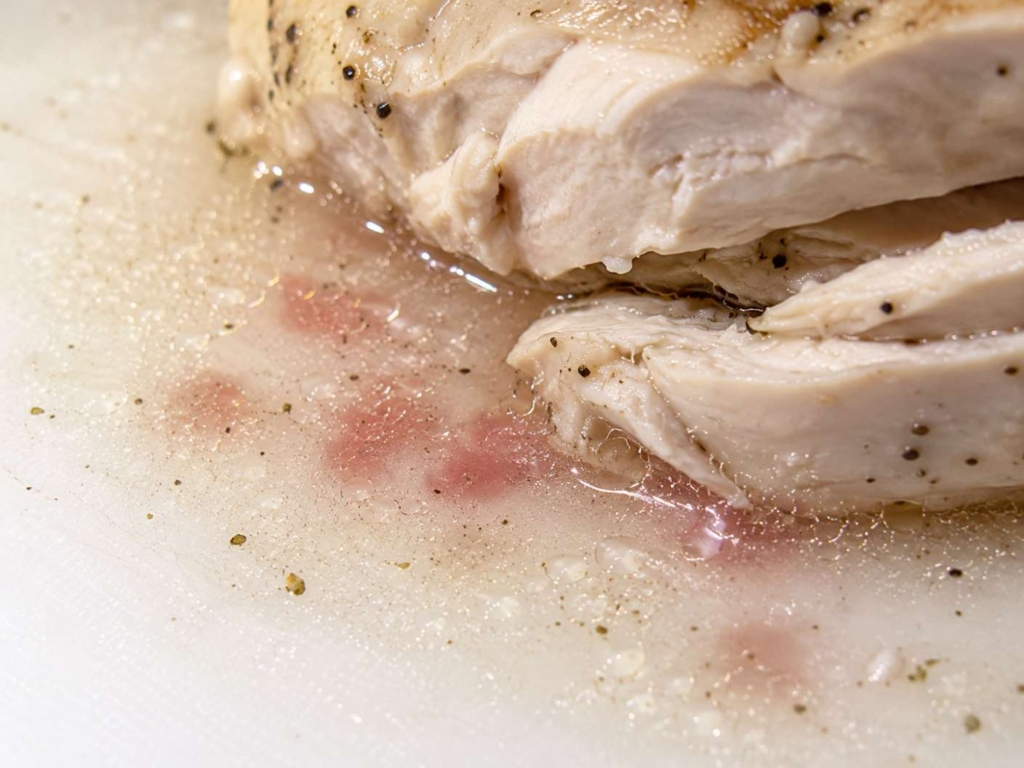
How many times have you read “cook chicken until the juices run clear”? It means that, if you stab or slice into a chicken or turkey, and you see pink juices, it is not done. This myth lives in hundreds of cookbooks and thousands of websites. Type “juices run clear” into Google’s book search and the first hit is the Good Housekeeping Cookbook.
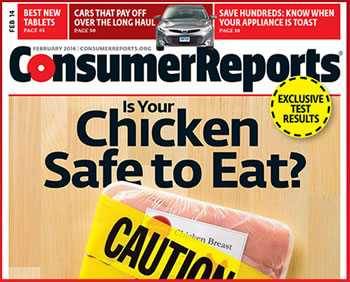
In February 2014 the cover story of Consumer Reports said that they had tested chicken breasts from supermarkets across the nation and 97% contained bacteria that can make you sick, and almost half contained antibiotic resistant strains.
I began to wonder about the clear juices rule of thumb when I’d accidentally overcooked a chicken to 175°F (as measured on a quality digital thermometer) and there were still pink juices. Nothing is more embarrassing than having to take meat off my guests plates and run them back out to the grill while they discard the “contaminated” side dishes and get clean plates. Been there done that?
Nothing is more embarrassing than having a guest bite into a wing and push away her plate because the joints are purple. Been there done that?
Lately I have noticed that both these mishaps happen even though the meat is cooked properly.
What is going on here?
Two separate phenomena.
Pink juices
Food is done when it is safe to eat. Period. That is a hard fast rule. So cooks and cookbook authors naturally assume that somebody once determined that chicken and turkey are safe when the juices run clear. Once upon a time this may have been true. Sadly, nowadays, following this morsel of common wisdom can result in illness or badly overcooked meat.
Pink meat and thin pink juice in chicken, turkey, and even pork is due to a protein called myoglobin that is stored within the muscles and usually found mixed with water, making a pink fluid. It is not blood, which is dark red, and thick. When myoglobin is cooked, its protein structure changes, a process called denaturing. When the molecules are altered, they absorb light differently, the color is changed, and meat and juices lose their pink tint. So the question is, at what temp does myoglobin change color?
Turns out there is no fixed temp at which this happens because other factors come into play.
I spoke to a research scientist at a major chicken processor who prefers that I not use his name. He explained that the acidity (pH) of the meat is a major factor. “When the muscle is high in pH [low in acid] it takes a much higher temperature to denature the myoglobin. The meat may need to be 170 to 180°F before the myoglobin in breasts is denatured sufficiently to see clear juices. The drumstick and thigh have higher levels of myoglobin and they require an even higher internal temperature to denature it. Typically we cook drums or thighs to 175 to 180°F in our plant to make sure no pink remains. It is hard to convince consumers when they see pink juices or meat.”
Conversely, “If the muscle pH is low then the myoglobin is denatured at a lower cooked temperature. This means that one might potentially see clear juices at 150°F and this is not safe.”
What causes the pH to be high or low? “Muscle pH fluctuations are typically a function of genes and pre-slaughter stress conditions. Stress may occur during catching, transportation, holding at the plant and unloading the birds. Climatic conditions can also have an impact. These are all things we try to control since meat [from these animals] will not retain moisture during further processing. This leads to a less juicy product for the consumer, and yield loss, which is money to us.”
What the USDA doesn’t tell you
Interestingly, the USDA recommended mark of 165°F is not hard and fast. It is a number they give the consumer in order to make food safety simple, but killing microbes is a factor of both temperature and time. At 165°F internal temp in the geometric center of the meat, all microbes are killed in about seven seconds, so it is called the “instant kill zone”. But you can also kill them all at lower temps if you hold the meat there for a longer time. For example, chicken can be safe at 150°F if you can hold it there for five minutes. Also, if you cook a large bird, like a turkey, you can take it off at 160°F since it retains enough heat to kill pathogens, and it will likely rise 5°F due to carryover cooking.
Click here to learn more about safe cooking temps.
Red bones
The chicken thigh with the purple bone on this page was cooked to 180°F as measured with a precise thermometer. It is well past safe. It is also scary. Dr. O. Peter Snyder of the Hospitality Institute of Technology and Management reports that red or purple bones are more common because “Chicken is so young—6 1/2 weeks at slaughter—and the bones are too porous, even though the animal is large enough to be sold for food.”
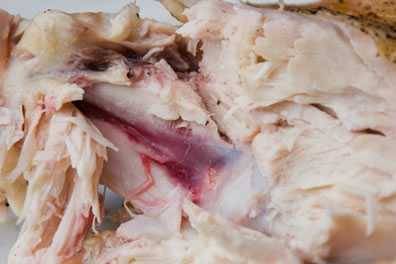
Red or purple is the color of bone marrow because that’s where blood is made. As birds age, more calcium is deposited on the exterior of bones so the blood in the marrow becomes less visible. But modern breeds, feeds, and additives grow birds from egg to three pounds in 6 1/2 weeks! If you grew as fast as a chicken, you’d weigh 350 pounds by age two! Often the bones don’t have time to thoroughly calcify, and even though the bird is cooked properly, even though it is perfectly safe, the purple remains. According to Dr. John Marcy, Professor and Poultry Processing Specialist at the University of Arkansas “The dark color next to the bone is even more pronounced in chicken that has been frozen because that process forces more marrow pigments out of the bone.” USDA says “This is an aesthetic issue and not a safety one.”
Snyder has written “The retail food industry is being forced to sell grossly overcooked chicken in order to get rid of the red blood color around the bones. The result is chicken that is dried out, unappealing, and does not taste good. A counter measure is to needle the chicken, pumping in solutions of phosphates, flavoring compounds, and water, which puts pathogens in the middle of the chicken. If consumers were taught to eat safely prepared, bloody chicken, as they want to do with beef, they would be able to enjoy juicier chicken. This is an interesting problem for the USDA to solve.”
Well I’m not waiting for USDA. Let’s start the education process here.
Pink meat
Sometimes the purple in bones can discolor the meat touching them and they remain pink even though the meat is safely cooked. Sometimes the pink color can come from nitric oxide (NO) or carbon monoxide (CO) produced by the cooker. NO and CO can be byproducts of combustion in gas ovens and grills, as well as charcoal and wood grills.
This pink meat can be soft and spread evenly throughout the meat, or it can take the form of a distinctive band called a smoke ring which is right below the surface. USDA says “All the meat—including any that remains pink—is safe to eat as soon as all parts reach at least 165°F as measured with a food thermometer. Often meat of younger birds [can be] pink because their thinner skins permit oven gases to reach the flesh. Older animals have a fat layer under their skin, giving the flesh added protection from the gases. Older poultry may be pink in spots where fat is absent from the skin. Also, nitrates and nitrites, which are often used as preservatives or may occur naturally in the feed or water supply used, can cause a pink color.”
And of course, meat can become pink as a result of chemical reactions that happen during smoking. The pink band called a smoke ring is right under the skin, and can sometimes extend as much as 1/2″ into the meat. Click here to read more about smoke rings and what causes them.
Cook chicken livers to 165°F too
In 2013 the Center for Disease Control (CDC) reported outbreaks of food borne illness caused by the bacteria Campylobacter jejuni found in undercooked chicken livers. They too need to be cooked to 165°F.
The report said, in part, “These outbreaks should not come as a surprise, given that previous studies have shown that 77% of retail chicken livers are contaminated with Campylobacter and that, when contamination is present, it is usually in internal tissues, as well as on the surface.”
It continues “In this investigation, the livers were found to be intentionally cooked lightly to maintain a desired texture and taste. This practice might be common, particularly when preparing chicken livers for use in a mousse or patŽ. A popular recipe for this dish instructs readers to cook “until the livers are just stiffened, but still rosy inside”. The quote is from “Mastering the Art of French Cooking, Volume 1” by Julia Child, Simone Beck, and Louisette Bertholle.
Bottom line
The clear juices and pink meat rules may have been true once upon a time, but (ahem) clearly they are not true any longer! You cannot tell if poultry is safe by merely looking at the meat, at the bones, or at the juices as is said in most cookbooks. You must get a good digital thermocouple thermometer.
This myth is thoroughly busted.

Before you can post a comment or question you must sign into our commenting partner, Disqus. This helps make sure everyone hanging around the grill is civil. We do not tolerate nastiness, racism, porn, inappropriate language, or attacks on others. All comments are the property of AmazingRibs.com and we reserve the right to quote them, edit them, delete them, and block people from making future comments.
Please leave comments and questions on the same page that is devoted to that subject so others can see questions and our answers when they are reading about the subject. You must enable JavaScript to use the comments section, and you must accept cookies to post comments. Note: the software that runs Disqus is different from the Pitmaster Club, so members need to sign into the Pitmaster Club separately.