


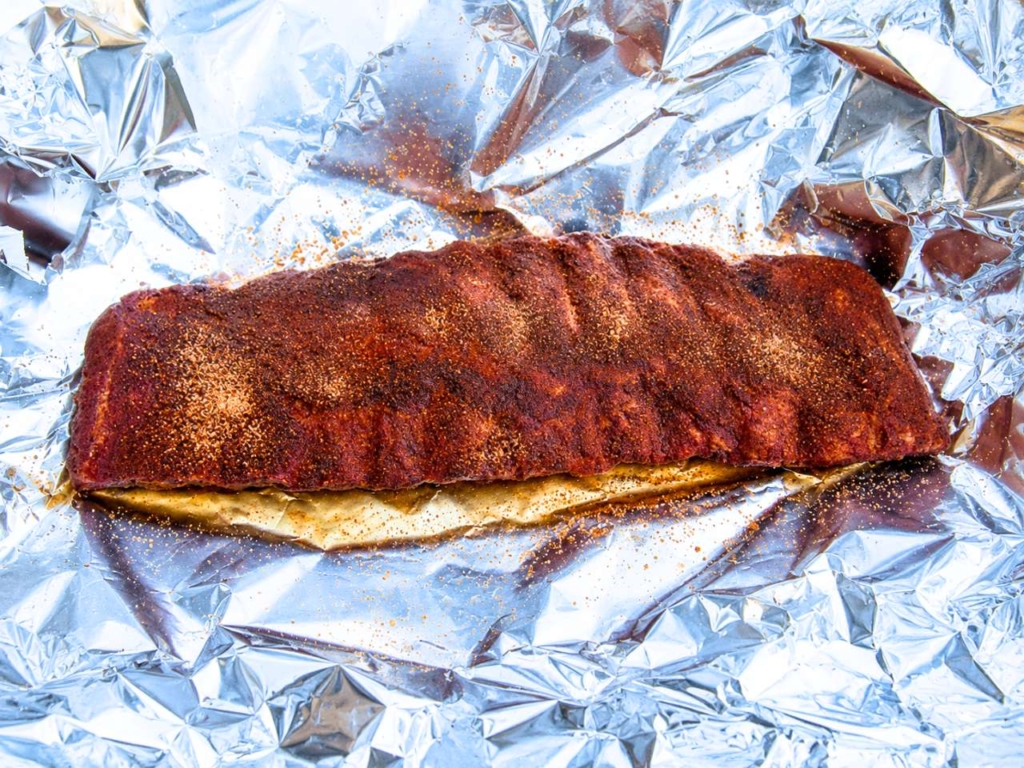
Called the Texas crutch because some folks think it was developed in Texas, practically all the top competitive barbecue teams use this wrapping technique for ribs, pork shoulder (pork butt), and beef brisket.
Table of contents
First they smoke the meat for a few hours, then they wrap it tightly in foil or pink butcher paper for a while where it steams and braises in its own juices. Sometimes they unwrap it and roast it again to firm up the surface, sometimes they don’t.
The Texas crutch concept is a descendant of the tropical technique of wrapping meat in banana leaves. It helps make meat more tender and juicy. Plus, it has the added benefit of speeding the cooking process. It is a routine step in competition where every little incremental improvement is needed and if you are chasing that big prize money, you have to go for it. It is like a swimmer shaving his body.
Which is better for the Texas crutch, foil or butcher paper? That has been the subject of much debate and taste testing. I use foil.
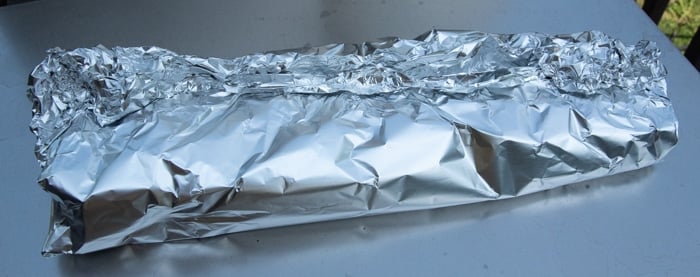
On the downside, wrapping can soften the bark, the crispy exterior made of dehydrated meat, smoke, and rub, that is in many ways the best part of low and slow cookery. It can also make brisket taste a bit like pot roast if not done properly. And you have to get the timing right. Too long in foil and you end up with mush. Paper is more forgiving on bark.
If the meat is not in the crutch, more moisture evaporates and the meat flavors concentrate.
Here’s the science of the Texas crutch
The idea is to cook the meat most of the way, then seal the meat tightly in foil with just a little water, juice, wine, or beer. Apple juice is popular. Some people add margarine and sugars like honey or agave. The liquid mixes with the juices that drip from the meat and gently braises the meat. Braising is the same process used by a slow cooker where the meat sits partially submerged in a water based liquid. The liquid transmits heat to the meat better than air, speeding cooking.
Most importantly, the Texas crutch prevents surface evaporation from the meat and helps keep it moister. Before and after wrapping, evaporation cools the meat, and that is what is responsible for the infamous “stall” a period of several hours where the meat’s internal temp plateaus and beginners start to panic. With the crutch, the meat finishes cooking faster. Crutch for too long, and you will extract flavor from the meat, remove all the rub, and cause the proteins to get their undies in a bunch, forming tight knots that will make the meat tough and wring out moisture, and then eventually make the meat too soft and mushy.
Most crutchers wait until the meat hits the stall, the point at which the internal temp ceases to rise because evaporative cooling equals heating. Others wait until it achieves a dark enough color due to the maillard reaction in the meat and caramelization from the sugars in the rub, close to the color they want it to finish at, usually an even brown.
That said, there are some, among them two of our very knowledgeable moderators, Huskee and Jerod, who don’t let the stall faze them. They let it happen and then wrap at about 180°F (82°C). Says Huskee “It still speeds up the cook but the bark is hardier at the start of the wrap therefore less affected by it.”
For ribs
Here’s a video of Mark Lambert of Sweet Swine O’ Mine in Memphis preparing the Texas crutch for a slab of pork ribs. Lambert has won all the major competitions at one time or another.
Here’s how he does it.
1) Large sheet or two of heavy duty foil or butcher paper. Use two sheets of double strength foil to be safe.
2) Margarine on the foil. Squeeze bottle margarine is easier to use than butter. Brown sugar or turbinado on top of the margarine.
3) Meat side down.
4) More margarine in the bone side.
5) Brown sugar or turbinado on the bone side.
6) Vinegarry sweet sauce.
7) Fold it tight but be careful not to puncture the foil.
8) Add 1/4 cup (60 mL) of citrus soft drink or apple juice.
9) Seal it tight. It is important that the packet not leak liquid from the bottom, and that steam not be able to escape from the top.
10) Back on the smoker for no more than 1 hour.
I used to pooh pooh crutching ribs, but I find myself doing it more often for 30-60 minutes or so. The tenderness is worth it. In competition, you need all the help possible so you must crutch. If you are going to crutch ribs, be very careful that the bones don’t puncture the foil. A double layer is recommended. People ask if they can put more than one slab in a package. Yes, but the effect will not be the same. You are essentially making a single thicker piece of meat and that will take longer to reach temp. Remember, thickness determines cooking time more than anything else. I don’t recommend stacking.
Click here to learn how to tell when ribs are ready. When the meat is ready you can take it out of the Texas crutch, paint on sauce, place it on a hot grill to caramelize the sugars, and serve. Click here to learn more about saucing strategies. If you wish, make Vermont Pig Candy with the liquid in the foil.
For brisket
Here’s a video of the pitmaster of Panther City BBQ in Ft. Worth, TX showing how they wrap briskets. I have tasted the results and their brisket is awesome. Notice that he uses pink butcher paper.
1) Crutch brisket, bare meat on the paper when the stall starts or when it hits about 150°F or 160°F (65 or 71°C) and has a dark ruddy color, and leave it wrapped until it hits 200-205°F (93-96°C). No peeking. The moment you open the wrap it will start cooling rapidly.
2) Spritz the paper with water or oil to help it stay folded.
3) Rub and margarine on top only.
4) Fold it snug.
5) Back in the smoker for a few hours until it hits target temp (between 200 and 205°F (93 and 96°C) and the texture feels right).
Seal it tight
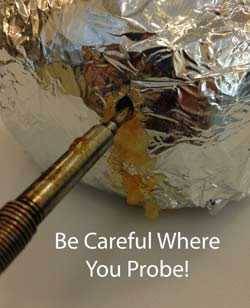
In a fascinating series of experiments, the AmazingRibs.com science advisor Prof. Greg Blonder proved that if the crutch does not hug the meat, and especially if it leaks even a little, the meat will cool from evaporation and it will drastically slow cooking. He also points out that you should crimp the foil around your thermometer probe if it is inserted through the foil, and be careful to stick the meat from the top so juice doesn’t leak out.
After the Texas crutch
Some cooks put the meat back into the smoker to dry the surface and firm the bark. Some cooks put the meat in an insulated box, a faux cambro, to rest and further soften connective tissues. I call this “holding” rather than “resting” which is a term many chefs use for steaks and chops and poultry cooked to much lower temperatures. I think holding is important for brisket. Less so for other meats. When you open the package be extremely careful to avoid the hot steamy air that will escape. Then remove the meat and cook at 225°F (107°C) for about 30 minutes or so to dry the surface and firm up the bark.
Forget the 3-2-1 method for ribs
Many websites tout the “3-2-1 method.” It says you should cook a slab of St. Louis cut pork ribs for 3 hours, then wrap it in foil for 2 hours, then take it out of the foil for 1 hour. Don’t do it.
Sterling Ball of BigPoppaSmokers.com and winner of the prestigious American Royal in KC says “I’d like to kill the man who came up with the 3-2-1 concept. He’s ruined more meat…”
I agree. Two hours in foil is waaaay too long for pork ribs, especially if there is liquid in the foil. Beef brisket needs two hours or more in foil, but not ribs. I think anything more than 1 hour softens the meat too much and makes it mushy.
Experiment until you and your cooker get it the way you like it best. Your mileage might vary. These are guidelines not rules.
Butcher paper
In Texas, where many of the best BBQ joints began life as butcher shops, pitmasters often wrap the meat in pink butcher paper rather than foil. The people who make Reynold’s foil have recently come out with rolls of the stuff just for BBQ lovers. Other brands make it too. It works similarly to foil, capturing moisture and preventing evaporative cooling. But there is a difference. The paper can saturate with fat and water on the bottom and it cooks a bit more slowly.
Not any butcher paper will do. Some are impregnated with melted wax or silicone. If you are tempted to try it, make sure it is plain unadulterated food grade butcher paper. And if you want to be authentic, you can order the very same pink stuff they use at Franklin, Kreuz and other bastions of que in Texas from ABCO.
Before you can post a comment or question you must sign into our commenting partner, Disqus. This helps make sure everyone hanging around the grill is civil. We do not tolerate nastiness, racism, porn, inappropriate language, or attacks on others. All comments are the property of AmazingRibs.com and we reserve the right to quote them, edit them, delete them, and block people from making future comments.
Please leave comments and questions on the same page that is devoted to that subject so others can see questions and our answers when they are reading about the subject. You must enable JavaScript to use the comments section, and you must accept cookies to post comments. Note: the software that runs Disqus is different from the Pitmaster Club, so members need to sign into the Pitmaster Club separately.